Hitler dreamed of a 1,000-year Reich. Putin is said to have grand, almost theatrical ambitions of territorial conquest, aiming to restore a questionable historical empire he calls “Greater Russia.” Sure, there are people around Donald Trump who imagine using his rise to power to build some kind of big, civilization-shaping project: white nationalists who dream of a country cleansed of those they see as racially impure; Christian nationalists who envision a future theocracy where women wear long braids and skirts and don’t vote; techno-reactionaries who picture a future of interplanetary colonies, tech-assisted eugenics, and polygamous harems.
But Trump himself is strikingly small in his dreams. His ambitions are relatively modest, rarely reaching beyond his ego and his senses.
He wants praise. He wants to see his name and his portrait everywhere. He wants to feel like a big man, and to see those who have wronged him feel sorry and upset. Maybe most of all, he wants to indulge in his own bad taste, repeatedly revisiting the lowbrow favorites of the 1980s, when he was young and at the height of his tabloid fame.
He loves Andrew Lloyd Webber musicals. He loves Bon Jovi and the Village People. And he loves the flashy, clownish symbols of masculinity that appeal to very young children: big trucks, big muscles, and displays of physical strength.
So it felt fitting that on Trump’s 80th birthday, at an event meant to celebrate the 250th anniversary of the nation’s founding but really serving as a party for a very special boy, the White House hosted a cage fight for the Ultimate Fighting Championship. The UFC is a competitive league for mixed martial arts—a vaguely sport-like activity that combines kickboxing, wrestling, and traditional boxing, and seems designed to satisfy a TV audience’s hunger for maximum violence.
The event, planned for months, required diverting Secret Service resources, using military musicians, and building a large octagonal cage and audience area on the White House’s south lawn—all at untold taxpayer expense and likely breaking numerous ethics rules. On Saturday, the night before the event, the fighters posed shirtless, nose to nose, at the ceremonial weigh-in—a press event that seems mainly meant to stir up interest in online gambling—in front of the Lincoln Memorial.
View image in fullscreen: Donald Trump (second from left) with UFC CEO Dana White (left), Melania Trump (center), and other guests inside the cage on the South Lawn of the White House in Washington DC. Photograph: Evan Vucci/CNP/Shutterstock
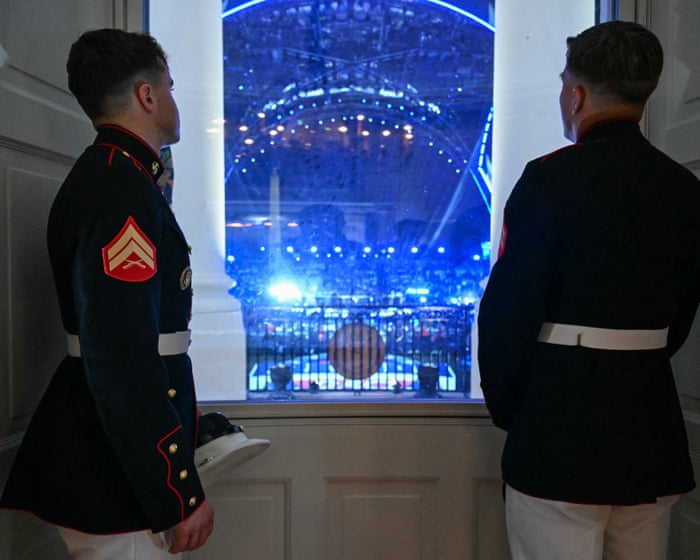
On the big night, a bad weather forecast seemed like it might spare the country the embarrassment of the fights going ahead. But God chose to punish us instead, and the clouds passed. Trump, visibly stooped, hobbled in and sat uncomfortably in the front row to listen to a band of US Marines play a weak version of “The Boys are Back in Town.”
Mixed martial arts is a frantic and ugly spectacle, with none of the redeeming grace of boxing and little in the way of required strategy. The main assets needed seem to be physical size and a willingness to hurt someone.
Before each fight, artificially tanned women in sequined, American-flag-themed tiny outfits would smile blankly and hold up a sign with the round number. These were the “Octagon Girls,” a staple of UFC fights who serve a purely decorative role, and their exit from the stage starts the competition.
Fights are three or five rounds long but usually last only a few minutes—a format perhaps well suited to an era of short attention spans. Shirtless men in spandex shorts with their names on them face each other and trade high kicks before locking bodies and falling to the floor, which on the White House lawn was covered with an image of a Monster Energy can. Once they’re on the ground together, one hits the other repeatedly in the face.The goal seems to be to cause repeated head injuries, which might help explain why so many fighters heaped praise on Trump. After his match, one winner—a redhead with a prominent cauliflower ear named Bo Nickal—thanked the president first and God second.
In Trump’s imagination, hosting a UFC fight on the White House lawn likely fed his most basic, childish fantasies of self-gratification. Using government property and national landmarks for his own birthday celebration—one that also made money for many of his friends in the private sector—helped him blur the line between the federal government and himself, insisting that he is America and the state.
The fact that the event was UFC—crudely primal, a celebration of violence and raw strength—also reinforces his values. The message seems to be that the US is now him.
Trump wages war at will without Congress. That’s already imperial enough. Now he oversees violent spectacles for his own entertainment, like a dysfunctional Roman emperor eating grapes at the Colosseum. Soon, he’ll be appointing his favorite horse to the cabinet.
At the start of the broadcast, as rain clouds still hung over Washington DC, the TV networks stalled for time. Meat-headed men in suits that were too small kept repeating how crazy it was that they were at the White House, and chatted aimlessly about various fighters, noting with satisfaction that their locker room was in the executive office building.
At one point, a montage showed fighters’ faces projected onto DC landmarks—the Capitol building, the reflecting pool, the Washington Monument—while a voiceover praised the virtues of violence. “A dominance so undeniable that it becomes permanent,” the voice cooed.
This, of course, is the fantasy of Trumpism: permanent domination. The movement hopes that Republicans, through sheer force, have won the game—defeated the forces of pluralism, dignity, and self-government, shut down any chance of meaningful political competition, and handed their opponents a painful, humiliating defeat, a TKO. But this hope is futile: no domination is permanent.
Moira Donegan is a Guardian US columnist.
Frequently Asked Questions
Here is a list of FAQs based on Moira Donegans comparison of Trump to a dysfunctional Roman emperor overseeing violent spectacles The questions are written in a natural conversational tone and the answers are direct and simple
BeginnerLevel Questions
1 What does it mean to say Trump acts like a dysfunctional Roman emperor
It means he focuses on public drama personal loyalty and violent displays of powerlike ancient emperors who used gladiator fights to distract peopleinstead of actually governing effectively
2 What violent spectacles is Donegan talking about
Shes referring to events like the January 6 Capitol riot his calls for police to be rough with protesters and his social media posts that encourage harassment or threats against his political enemies
3 Why compare him to a dysfunctional emperor
Because a functional emperor would keep order and run the empire Trumps style creates chaos weakens institutions and often backfires making the government less stable not stronger
4 Is this just an insult or is there a real point
Its a sharp analogy but the point is serious it highlights how a leader can use fear and spectacle to hold power while ignoring the actual needs of the country
Advanced Questions
5 How does this spectacle actually benefit Trump politically
It keeps his base engaged and angry distracts from scandals or policy failures and paints him as a strongman fighting a corrupt system The chaos becomes his brand
6 What specific historical Roman emperor is Donegan likely referencing
She probably means emperors like Caligula or Nero who were known for erratic behavior lavish public violence and alienating the Senate Trumps attacks on the deep state echo their distrust of traditional power structures
7 What are the realworld consequences of this emperor style
It normalizes political violence erodes trust in elections and courts and makes it harder for the government to function For example his pressure on officials to overturn the 2020 election led to threats against election workers
8 How is this different from other presidents using tough rhetoric or military parades
Other presidents used spectacle for unity or patriotism eg Reagans Morning in America