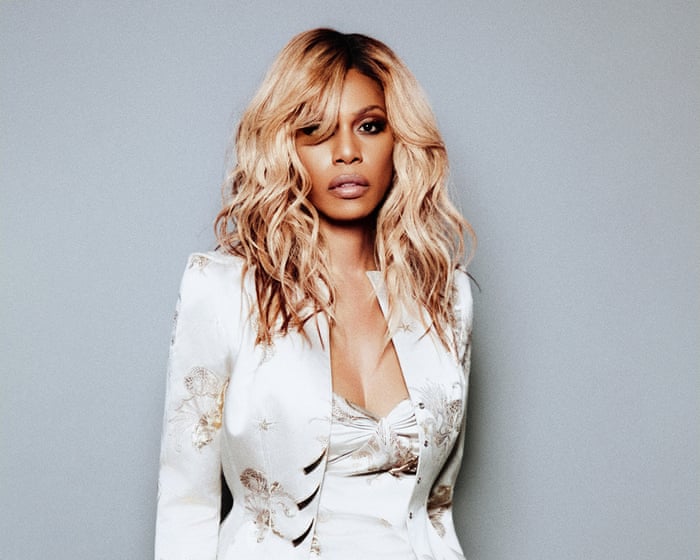
Two days before she spoke to me, Laverne Cox had been at the premiere of a new animated version of Animal Farm, where she voices Snowball. The film is highly controversial because of its childish tone and happy ending, which feel completely un-Orwellian. But Cox had bigger concerns than film criticism.
“If we don’t wake up and understand what’s happening, trans people will be exterminated,” she said that day in April. “People’s rights are being taken away. People are losing their jobs and their healthcare. People are being detransitioned in prison. Gender-affirming care is under attack, not just for children but for adults too. It was never about protecting women. It’s always been about creating a way to scapegoat trans people, to dehumanize us, to take away our rights, and to push us out of public life.”
This isn’t the kind of language you’d expect on a red carpet from an actor, talk show host, and reality TV star whose big break was in the gritty but upbeat Orange Is the New Black.
But Cox doesn’t have time for pleasantries. Growing up in Mobile, Alabama, in the 1970s (she’s 54), she has faced violent and quiet prejudice since childhood. She was bullied for being effeminate as a kid, verbally abused by her mother, terrified of puberty, sexually abused as a teen, and confronted with the silent exclusions of poverty when she attended the Alabama School of Fine Arts on a scholarship. In the 1990s, she transitioned and lived as a Black trans woman, dealing with constant street harassment. She’s survived the worst of less accepting times, and she’s not about to stay quiet now.
“There are certain things you should never tell people,” my mother would say. And I lived by that. But that doesn’t work.
Transcendent is her first book, a memoir. She was raised, along with her twin brother M Lamar—a composer, countertenor, and artist—by a single mother. Gloria Cox was a member of the conservative African Methodist Episcopal Zion church and had her own demons to fight, including a violent father. But you can’t ignore her cruelty, both verbal and physical: a lot of casual, angry homophobia and harshness at home. At one point in the book, when Lamar accidentally throws a stone through a patio door, Gloria launches into a dramatic spiral of abandonment that ends with the twins in a children’s home. But the smaller details are just as hard to read. Every time Cox shows vulnerability, enthusiasm, or joy, it gets shut down.
“I suspect I’m not the only one who grew up with a parent who maybe didn’t fully understand them—whether it was about being trans or being an artist,” she tells me carefully during a video call from her home in New York.
“But I love my mother,” Cox says. “Even my brother loves and respects her. She’s a remarkable woman. She raised two kids—who were remarkable in many ways—by herself. She put herself through graduate school, bought her own home, never with a man’s help. She’s an incredible woman, but there’s a lot of trauma there.”
“Part of talking about my grandfather and his cruelty,” she explains, “is to think about how that cruelty came from the remnants of chattel slavery. He grew up on a plantation. I’m trying to put my mother’s behavior in context.” Cox also believes in Dr. Joy DeGruy’s theory of “post-traumatic slave syndrome,” a set of behaviors passed down through generations. “The best example I can think of is when Black parents say, ‘Oh, my child is so lazy—they don’t work hard enough.’” That comes from the plantations, Cox says, where you would downplay your child’s achievements. “It was all about not having your child stand out.”Your child was taken from you.
In 1983, Cox was 11 years old, “going to sleep every night praying I would wake up different.” She tried to kill herself before she turned 12. “It was literal, physical pain in my body, writing this, trying to dig it up,” she says now. “It was excruciating. It was like throwing up the pain of that time.” After surviving that, she decided to embrace being bold and flashy on a tight budget. Slowly, she started dressing the way she wanted—experimentally, in a feminine way—all from thrift stores. She calls this her “Salvation Armani” period.
This isn’t a misery memoir; it doesn’t feel like it has a hidden agenda of revenge or exposure. “It’s about freeing myself from the shame that grows in secrecy. You think, ‘If people know this about me, I won’t be lovable.’ My mother always said, ‘There are certain things you should never tell people.’ And I lived by that. But that doesn’t work.”
I made a promise to myself that I would never do drugs. If I had, I’d probably be dead.
I don’t really believe talent is something you’re born with. I see it more as a series of happy accidents. But it’s striking how gifted Cox and her twin were, in different but overlapping ways. As teenagers, they both got scholarships to the Alabama School of Fine Arts—”the Fame school, as I thought of it”—she for creative writing and dance, he for visual arts. This period was harder for Lamar, but that’s his story to tell. Cox went on to earn a dance degree from Marymount Manhattan College in New York. “When you study classical ballet, you understand how hard it is to be good at something—how much you have to train and study, how much discipline, dedication, and sacrifice it takes.” She says she never had the right body for it, and “there were so many people who were much better than me.”
Besides, this was 1993. “Madonna was going to Sound Factory and found the people for her ‘Vogue’ video there. Everyone partied together. There was a time in New York when you wanted club kids, drag queens, and transsexuals at your party, or it wouldn’t be a happy party.”
Cox thrived in this world, partly because it was all highs and no lows. “I made a promise to myself as a child that I would never do drugs. And I never did. That’s good, because I’d probably be dead. I don’t think working-class Black people can do drugs and be successful.”
“A few guys I dated thought they could pressure me, and I was like, ‘Sweetie!’ I don’t know if I’m proud of it; I guess I am, sort of. But I don’t think drugs are bad—some people can do them and it’s fine. I don’t judge any of that.”
The club scene changed a couple of years later with the rise of “bottle service”—basically, some incredibly rich guy buying booze by the bottle at a huge markup because he can. Sex and the City had a very bottle-service vibe: “One of my favorite shows of all time, but I think it changed the nature of New York. It was capitalism bringing in very conservative people. Everything became commercialized—there wasn’t room for broke artists who bring that fabulous energy. They can’t afford to live anymore, and they can’t get into the same clubs.”
Cox started transitioning in 1998. She was doing a lot of off-Broadway theater, making independent films, and reality TV, wondering how she could make money from being cool while using whatever platform she had to try to “change the conversation about trans people.” Then Orange Is the New Black came along.When Orange Is the New Black came along, it had “a surprisingly good budget and these great scripts. The world was so alive.”
Based on the true story of Piper Kerman—about as WASP-y as you can imagine—who ended up in prison for money laundering, the show was bold, funny, and sharp. It tackled racial dynamics, gay sex, brutality, and the total irrationality of the US women’s prison system. Laverne Cox played Sophia, a trans hairstylist for the inmates. “What’s wild to me, especially in Britain, is that all the talk is about how trans women shouldn’t be in prisons with other women. Orange Is the New Black was based on a memoir from the 90s. The author was incarcerated with a trans woman.” Cox’s character actually had the longest run of any side character in the series. In one memorable subplot, her pre-transition self was played by Lamar.
The show started airing in 2013, when Cox was 41. It made streaming feel like a real thing and put Netflix on the map. “I didn’t think anyone would go for it. My hope was that casting directors might see it and I could get more work. I thought, how can I turn this into other opportunities? Then it ended up being successful. After a few months, walking down the street got crazy, so my life changed a lot. Before, when people ran up to me, it was to attack me or call me names.”
During this time, Cox earned four Emmy nominations and two Screen Actors Guild awards. But there just aren’t that many roles for a trans actor, and she always had other work—speaking at colleges and for businesses, working as a brand ambassador. That didn’t take off until 2018, when she started hosting red carpets for awards shows and similar events. Over the past two years, though, she’s lost 90% of her income. Hosting contracts have ended and weren’t renewed. Corporate speaking gigs have dried up.
She’s clear about who she blames. “This administration has threatened to cut funding for any colleges and universities that promote gender ideology or DEI [Diversity, Equity, and Inclusion].” She doesn’t even get teaching work, because “even if I’m teaching a graduate acting class, it could be seen as promoting trans ideology. These are the realities. I’m not complaining—I’m very blessed. But the important thing to note is that if Laverne Cox’s income has dropped significantly, what about all the other trans people who aren’t as privileged and blessed as I am? There are real material consequences to this kind of discrimination and scapegoating.”
Cox says this isn’t just some weird side effect of Trump’s chaos. It was all spelled out in Project 2025, the far-right plan from the Heritage Foundation that came before MAGA’s victory: “All these words had to be removed from every piece of legislation, policy, and government document: gender, gender ideology, gender identity, LGBTQ, DEI, abortion, contraception.”
Cox’s acting career took off after she studied under Susan Batson, who has been working since the 1960s. Batson told her: “Work is at its highest level when the character’s unfulfilled need is present in every moment. If you can do that as an actor, it changes people.” That was Cox’s hope for acting—that it would challenge assumptions and deepen empathy. And with Orange Is the New Black, that turned out to be true.
She still gets approached by trans people whose parents watched that show and reconciled with them. But her identity itself has become a challenge to the politics around her. Maybe you can have a fundamentalist Christian ethno-nationalist project without oppressing LGBTQI+ people. But Cox points out that when the Nazis started burning books in 1933, Magnus Hirschfeld’s research on trans and gay people was among the first to go.She was among the first to go up in flames. For her, “we’re in a very similar moment to Germany at that time.”
Transcendent: A Memoir is published by Merky Books (£20) on 25 June.
In the UK and Ireland, Samaritans can be reached for free at 116 123. In the US, you can call or text the 988 Suicide & Crisis Lifeline at 988, or chat online at 988lifeline.org. In Australia, the crisis support service Lifeline is available at 13 11 14. For other international helplines, visit befrienders.org.
Frequently Asked Questions
Here is a list of FAQs based on the topic Laverne Cox Freeing myself from shame covering her childhood and being a trans woman in Trumps America
BeginnerLevel Questions
1 Who is Laverne Cox
Laverne Cox is an awardwinning actress and LGBTQ advocate best known for her role as Sophia Burset on the Netflix series Orange Is the New Black She is also a prominent transgender rights activist
2 What does freeing myself from shame mean in this context
It means Laverne Cox is talking about the process of letting go of the deep embarrassment selfhatred and judgment she felt growing up as a transgender person Its about learning to accept and love herself despite society telling her she was wrong or different
3 Why was her childhood so difficult
She faced intense bullying rejection and misunderstanding She was often teased and physically threatened for being effeminate She also struggled with her identity before she had the words to explain that she was a transgender girl
4 What does she mean by Trumps America
She is referring to the political and social environment in the United States under President Donald Trumps administration which many people felt was hostile toward transgender rights This included policies like the transgender military ban and rollbacks of protections for trans people in healthcare and schools
5 Is this article just about politics
No While politics is a big part of it the article is mostly about her personal journey of healing It connects her painful childhood experiences to the challenges she faces as an adult and how she finds strength and freedom by letting go of shame
IntermediateLevel Questions
6 What specific events from her childhood does she talk about
She often recalls being called homophobic slurs being physically attacked by other kids and feeling deeply isolated She also talks about the painful moment when she was told by adults that she was acting out or wrong for expressing her true gender identity
7 How does the political climate under Trump specifically affect her
She describes it as a time of heightened fear and anxiety She felt that the government was actively trying to dehumanize and erase trans people especially trans women of color This made her feel more vulnerable and reminded her of the rejection she felt as a child