Israeli exporters to Europe are regularly hiding where produce from occupied Palestine really comes from, so they can get illegal tax breaks that support the settler economy, according to a rights group investigation.
The legal non-profit Global Echo looked at over 30,000 export documents for thousands of Israeli shipments to the UK and EU over eight years. One in six shipments they checked contained agricultural products from illegal settlements in occupied Palestine and the Syrian Golan Heights, which had been wrongly labeled as Israeli-grown.
“This isn’t a one-off or an accident,” said Emily Schaeffer Omer-Man, Global Echo’s executive director. “This is a system that the UK and the EU have kept going and agreed to.”
The group is calling on the UK government to review controls on Israeli imports and has promised to take legal action if HMRC doesn’t address verification issues.
Europe is Israel’s biggest market, and the EU is its top trading partner, accounting for nearly 30% of exports. A free trade agreement signed in 1995 lowered tariffs for Israeli imports, but products from settlements don’t qualify because Israel’s military occupation of Palestine and Syrian territory is illegal under international law.
However, Global Echo’s research showed that mislabeled settlement goods made up “a significant and ongoing part” of agricultural trade from Israel to Europe in recent years, the group said in a 400-page report. Besides reviewing export documents, the investigation looked at publicly available data and interviewed Palestinians and senior Israeli industry representatives, including whistleblowers.
Hiding where settlement produce comes from lets importers claim lower import tariffs. This makes fruit and vegetables from occupied land cheaper in European shops, while cutting tax revenues for European governments. The overall effect is that European consumers and governments unknowingly help fund settlement agriculture.
“European trade continues to materially support an unlawful territorial regime, directly conflicting with EU law,” Global Echo said. Settlement exports were “not the result of isolated mistakes, but of a systemic failure in regulation, enforcement, and accountability,” it added.
The report found that Israeli exports used legal loopholes or fraud to enter Europe under a “grown in Israel” label, using three main methods. Some producers give an accurate settlement address and postcode but list their produce as Israeli—an approach Global Echo called “hiding in plain sight.” This misleading labeling is allowed under a 2005 technical agreement between Israel and the EU and is encouraged in guidance from the Israeli tax authority, even though that guidance also says settlement products aren’t eligible for lower tariffs. This puts the burden of detecting and correctly taxing goods from occupied territory on EU and UK border officials.
The other two methods involved fraud, though they were publicly detailed by Israeli businessmen in a 2015 Knesset session. Settlement firms either give a “fake address” that falsely suggests production inside Israel’s recognized borders, or “mix” settlement goods with Israeli products for export, often in cooling or packing facilities, and label the mix as “grown in Israel.”
“Together, these practices undermine the effective application of EU trade and policy rules by systematically hiding territorial origin,” Global Echo said.
European customs authorities also routinely accepted invalid Israeli-issued organic and plant health certificates for settlement products, Global Echo added. Only Palestinian or Syrian authorities can certify produce grown in occupied territory. The shipments examined by Global Echo represent a tiny fraction of Israel’s exports.Total agricultural trade with Europe included €13 million (£11.2 million) worth of mislabelled settlement goods grown on land taken from Palestinians.
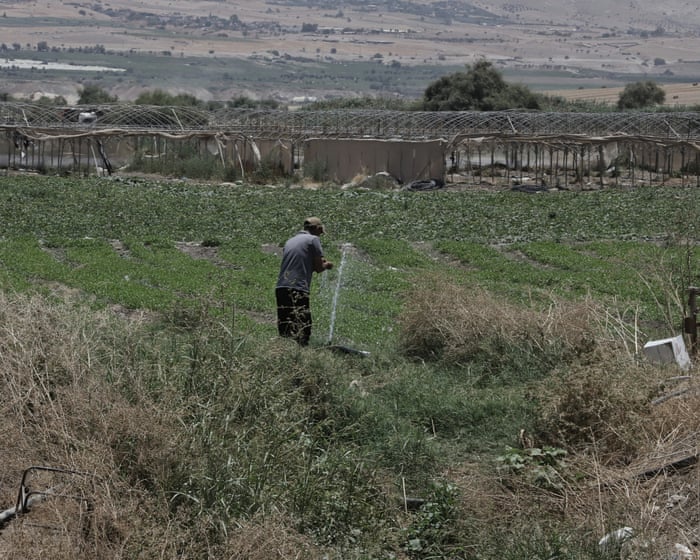
Amer Abu Khader, 35, has never set foot on three family plots near his home in Ein al-Beida, a village in the northern Jordan Valley. Shortly after the 1967 Six-Day War, Israeli settlers fenced these plots into a new settlement called Mehola.
“We have all the documents proving it belongs to us,” Khader said. He added that other families had also been robbed by settlers in Mehola, who falsely claimed the land belonged to absentee landlords to seize it. “Many of the owners are still alive and living in the area, yet their land was taken.”
According to Global Echo, one of the Khader family plots is now part of the agricultural holdings of a major Israeli importer that supplies the UK market. This information comes from documents from the company and Israel’s agriculture ministry.
For decades, Europe has considered Israel’s settlements illegal. This position was strengthened by the International Court of Justice’s 2024 ruling that Israel should end its occupation of Palestine “as rapidly as possible.”
However, the EU has never used its vast economic power to “attach meaningful consequences to that illegality,” according to legal scholar Michael Lynk, who wrote an introduction to the investigation. Lynk, a professor emeritus of law at Canada’s Western University and former UN special rapporteur for human rights in the occupied Palestinian territories, said the findings reveal a “gap between European principle and conduct.”
Even when Europe applied its own trade rules, Israeli government subsidies reduced their impact on the settlement economy, Global Echo said. When exporters of goods grown in occupied territories are barred from claiming preferential tariffs in Europe, they can get compensation from a secretive fund.
The EU is debating whether to impose tariffs on goods from occupied Palestine to curb Israeli violence and settlement expansion, but there is little clarity on how much trade could be affected.
Neither European countries nor Israel publish data on exports from illegal settlements. The scale of the settlement economy is hidden by Israel’s effort to prevent any economic or political distinction between citizens and companies in occupied territory and those within its recognised borders.
The only public figure comes from an unverified estimate Israel gave to the World Bank 15 years ago, which said 2.23% of exports to Europe came from settlements. Since then, the settler population in the occupied West Bank has grown by over 50%, and Israeli leaders have been clear about the role of settlement farms in expanding control over occupied Palestine.
“We are erasing the Green Line through agriculture in Judea and Samaria [the occupied West Bank],” Israeli finance minister Bezalel Smotrich posted on X in 2024. The Green Line is the 1949 armistice boundary, once seen as a possible border for Israel with a future Palestinian state.
Israel’s subsidies for everything from water to transport help make many settlements economically viable. Their population has long since grown beyond a core of ideological supporters. One US immigrant to Israel recently told the Haaretz newspaper that she moved to the West Bank “to manage her costs.”
Support for Israeli agriculture in occupied territories is paired with attacks and restrictions that undermine Palestinian farmers. These range from cutting off water access and limiting their movements to violent attacks.The situation has escalated since the Hamas-led attacks on October 7, 2023.
“We sell our produce in Nablus, Qabatiya, and Jenin, but getting to those markets is hard because the checkpoints on the roads are often closed,” said Mohamed Faiz Daraaq, a 53-year-old neighbor of Khader.
“The spring near our land, which was essential for our farming, has been taken from us,” he added. “The settlers turned the area into a recreational spot for themselves, with swings, seating areas, and other facilities. It has become a place for their tourism and leisure.”
Additional reporting by Sufian Taha and Quique Kierszenbaum.
Frequently Asked Questions
Here is a list of FAQs based on the investigation into settler products being sold as Israeli goods in Europe
BeginnerLevel Questions
1 What exactly is the problem here
Products made by Israeli settlers in the occupied West Bank are being labeled and sold in Europe as Made in Israel The investigation found this is happening even though these settlements are considered illegal under international law
2 Why does this matter to me as a consumer
If you want to make informed choicesfor example to avoid buying products from disputed territoriesthe current labels are misleading You might think youre supporting Israel but youre actually buying something from a settlement
3 Arent settlements part of Israel
No Most countries including the European Union and the United Nations do not recognize Israeli settlements in the West Bank as part of Israel They are considered illegal under international law
4 What kind of products are we talking about
The investigation focused mainly on agricultural goods and cosmetics made in settlement factories or farms
IntermediateLevel Questions
5 How do these products end up in European stores
The products are often exported through Israeli companies The packaging is printed with an Israeli address or a Made in Israel sticker and they are shipped through Israeli ports bypassing the requirement to label them as Settlement or West Bank goods
6 What are the EUs rules on this
Since 2019 the European Court of Justice has ruled that products from settlements must be clearly labeled as coming from Israeli settlements or the West Bank not just Israel The investigation found that many companies are ignoring this ruling
7 Is this just a labeling issue or is it illegal
Its both Mislabeling the origin of a product is a form of fraud under EU consumer law It also violates the EUs specific regulations on labeling goods from occupied territories
8 Why would a company do this