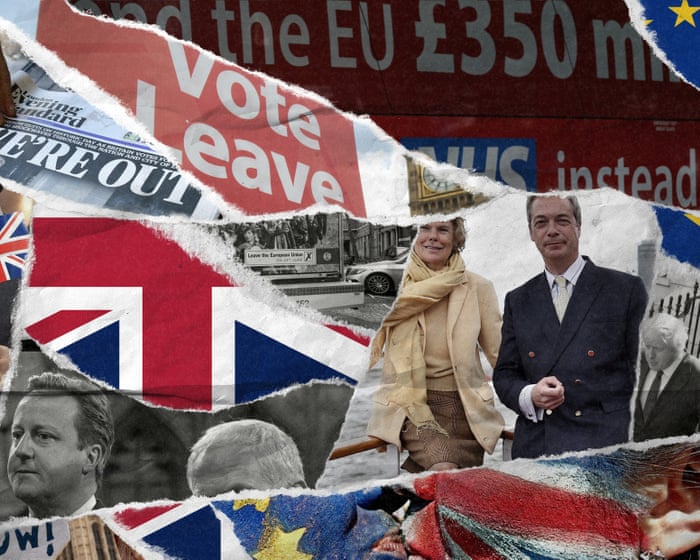
On 20-21 February 2016, David Cameron, who had promised in 2013 that a future Conservative government would hold a referendum on Britain’s EU membership, announced the vote would take place on 23 June 2016. The next day, Boris Johnson, then the mayor of London, said he would campaign for leaving the EU.
Bernard Jenkin, a senior Conservative backbencher who campaigned for leave, said: “The starting gun was really fired in the [2013] speech. I went to see David Cameron after that and begged him not to hold an in/out referendum, simply because it would tear the Conservative party apart. He told me, ‘I know 50 Conservative MPs may vote leave, but we can live with that.’ And I immediately realised he didn’t really understand the Conservative party at all.”
David Lidington, minister for Europe from 2010 to 2016 and a close ally of Cameron, campaigned for remain. He said: “[Holding the referendum] was very much a prime ministerial decision. I didn’t think it was the right one, but I understood David’s reasoning. He was the prime minister, and his view was that this was a chance to deal with the growing discontent within the Conservative party over Europe. I always felt it was like throwing chunks of raw meat to wolves chasing a sled. They’d gobble up the meat, and then they’d definitely come back for more.”
Craig Oliver, director of communications for No 10 and the official remain campaign, Britain Stronger in Europe, said: “At the start of the campaign, I felt we were in real trouble – not because we thought we’d lose the referendum, but because it was such a battle inside the Conservative party. The heart of the party was very much behind leave, and anyone who fought for remain wouldn’t be acceptable as prime minister. So I went into the campaign with a pretty bleak view of our chances. I thought we’d probably just scrape through, but soon after, the Conservative party would come after David Cameron.”
Will Walden, director of communications for Boris Johnson, said: “I was with [Johnson] almost the whole of that weekend. For most of the country, people weren’t sure which way to go. I don’t think Boris was any different. Was there any political calculation in his final decision? Probably, but I think the truth is he was genuinely torn. He was pro-European. He just had issues with the EU. He spent the weekend at his Oxfordshire farmhouse, being pulled in all directions – by Cameron, [George] Osborne, and his family. By the time he got back to London, with the press waiting outside his house, he genuinely hadn’t made up his mind. He was all over the place, like a shopping trolley. He was very stressed. At one point, he looked at me and said, ‘What should I do?’ And I told him, in pretty strong language, ‘I’m not making the most important decision you’ll ever make. You need to decide.’ He said, ‘You’re right, let’s get on with it. Let’s make the decision.’ It took him another hour of hesitating to finally decide. He went outside, and I think that announcement changed the course of history.”
David Lidington added: “David Cameron and his political team were pretty shocked and annoyed by Boris Johnson’s decision. Though I think David was more upset by [justice secretary and close friend] Michael Gove’s decision to back leave. That broke a much closer personal friendship. I don’t think David Cameron ever really believed Boris Johnson was doing this out of some high principle. It was clear that ambition and a desire to position himself were driving him.”As the favored son of the Conservative Party’s hard right—with an eye on eventually taking over—this was very much on his mind.
Jess Phillips, a Labour MP who campaigned for Remain, said: “I can’t say I remember thinking Boris Johnson was a particular threat, and that was foolish of me. To me, Boris Johnson was just a fool, and I genuinely couldn’t understand why anyone would think anything he said was anything but a lie. So I just thought, does it really matter which campaign he backs?”
1–13 April 2016
Campaigning kicks off in earnest when a government leaflet about the dangers of Brexit is sent to every household. Leave campaigners dismiss it as part of “Project Fear.”
Jess Phillips: “I got involved with the Remain campaign pretty quickly, but it wasn’t like any campaign I’d ever been part of. It was very disorganized. Trying to knock on doors in my constituency, for example, became impossible because we had no base to work from. We were making things up as we went. We thought, okay, we’ll target Labour supporters, who might be more likely to vote Remain. That turned out to be completely wrong.”
[Image: Jess Phillips, left, and Yvette Cooper, right, pose for a photo with staff at a Sure Start centre in Walsall, during the Labour In campaign. Photograph: Christopher Furlong/Getty]
“I remember feeling the campaign was quite elitist. I thought people would care about losing free mobile roaming when we went to Málaga—I was trying to make it more relatable, because for the people I live among, the terrible things that were predicted to happen after Brexit didn’t really mean anything.”
Ivan Rogers, Britain’s permanent representative to the EU from 2013 to 2017: “I was probably always seen—rightly—as the most pessimistic person near Cameron, and I thought Leave was quite likely to win. I said repeatedly that it was an extremely close vote. And in that situation, I thought the prime minister would have to resign. The Leave campaign was much better organized than Remain. So it seemed clear to me quite early on.”
Tom Watson, Labour MP and deputy party leader, campaigned for Remain: “I was very worried that the Brexit campaigners would win quite early on, mainly because I called all our Labour MPs to ask what they thought the outcome would be, and they said they were sure Remain would win. But then I asked how things were going in their constituencies, and they said, oh no, everyone’s voting for Brexit in my constituency. It just seemed to me that the whole campaign was based on hope and empty promises.”
[Image: Tom Watson, third from left, attends a launch in front of the ‘Labour In For Britain’ campaign bus, with colleagues including Jeremy Corbyn. Photograph: Ray Tang/Anadolu/Getty Images]
Caroline Lucas, Green MP and board member of Britain Stronger in Europe, campaigned for Remain: “It was very strange to be on the same side as the prime minister. I have to say, I think it was a mistake to put David Cameron at the head of the campaign—especially since there’s such a temptation between elections for voters to punish whoever is prime minister. I think the Remain side ran an absolutely terrible campaign. I tried as hard as I could to make sure we had a much wider range of voices—it was frustrating that it was almost entirely white, establishment men. The focus was almost exclusively on economics, while the Leave campaign spoke very directly about what it means to take back control.”
22 April 2016
During a visit to London, US President Barack Obama says Britain will be “at the back of the queue” for trade deals if it leaves the EU.
Craig Oliver: “Barack Obama came to Downing Street, and it was clear he thought it was a crazy idea for the UK to leave the EU, so there was discussion about what he might say.”At his press conference with David Cameron, Barack Obama used the word “queue,” which led Leave campaigners to claim he had been fed the line by the Remain side.
George Osborne said: “If we want a trade deal with the US, we’d have to go to the back of the queue.” Obama then asked, “Would it help if I said that?” and the general feeling was that it would. So he used those words in the press conference, and people said, “That sounds like someone told you to say that, because you said ‘queue’ instead of ‘line.'” In my view, Obama saying that really made people stop and think.
Paul Stephenson, director of communications for Vote Leave: That week when Obama said “back of the queue” was the peak of No 10’s campaign. We felt really on the defensive.
A lot of people told me we needed to get MPs out there defending us against Obama, but he’s the US president, and it’s fair for the BBC to report what he said. I remember Dom Cummings [director of Vote Leave] and Dominic Raab [Eurosceptic Tory MP] saying it would backfire if people felt they were being told what to do by a US president. Was it a strong move? Yes, it was. It was one of the biggest stories of the campaign.
11 May 2016
Senior members of the Vote Leave campaign start a tour on a red battlebus with the slogan: “We send the EU £350m a week. Let’s fund the NHS instead.” This figure has been widely debunked.
Will Walden: [Boris Johnson] has always been a great campaigner, and Vote Leave played it perfectly by putting him on the bus over and over, sending him to places where they thought he could really make a difference. It was like his mobile talk show.
On the first day, I remember him looking at [the £350m slogan] and raising an eyebrow, like, “Hold on, how are we going to justify that?” Journalists spent the whole time on the bus arguing about the £350m. I think Vote Leave’s view was, let them ask the question, because even if they say it’s £170m after the rebate, people at home are still thinking, “That’s a huge amount of money.”
Caroline Lucas: I was shocked by how blatant the lies were, and that there was no way to correct any of it. It was totally clear that the Leave campaign didn’t care that they were lying—they just wanted us talking about it. From their perspective, it was a brilliant move, but it really damaged politics.
Every time there was any media coverage of the Leave campaign, that damn bus was in the background. You couldn’t escape it. And it felt like we didn’t have a strong enough argument on our side.
20 May 2016
In coordinated statements and on a poster, Vote Leave claims that “Turkey (population 76 million) is joining the EU.” Critics say this is “complete fantasy” and plays on prejudice.
Jonathan Faull, a senior British official in the European Commission: Penny Mordaunt [Eurosceptic Tory MP] saying on TV that Turkey was going to join the EU and we couldn’t stop it—that’s simply a lie. Any member state can block an expansion. I nearly threw something at the TV. Probably every day I nearly threw something at the TV, because someone said something outrageous.
Will Walden: The [Turkey] poster was almost a turning point for Boris in this campaign. He said himself that he nearly considered quitting at that point.
He had Turkish ancestry and was a pro-immigration mayor of London.When he saw that poster—and he hadn’t been consulted about it beforehand—he went absolutely ballistic. I was at my in-laws’ house in Wiltshire. I took the call outside, put the phone on the farm gate, and stepped back three or four feet. It wasn’t on speakerphone, but I could still hear him shouting and swearing. He was furious. I think what he really wanted to do was go back to London and probably punch Dominic Cummings, but I talked him out of it.
15 June 2016
Nigel Farage and Kate Hoey join a group of anti-EU fishermen on boats sailing up the Thames to Parliament. They are met by a flotilla of Remain campaigners led by Bob Geldof.
Kate Hoey, Labour MP who campaigned for Leave:
All these little boats had been organised to come down and sail up the Thames. It was a wonderful sight. The main boat was absolutely packed with media—more journalists than Leave campaigners. When we got to Parliament, I felt quite moved. Here we were with all these genuine, hardworking people who felt they were being affected.
Then we found out Bob Geldof had come along with a group of his supporters, including Boris Johnson’s sister Rachel, shouting—what I can only describe as—abusive stuff at us.
But then we realised this would actually help the Leave campaign. Because here were establishment people attacking ordinary fishermen who just came to protest and show their support for Leave. I think we all went home feeling it had been a really worthwhile effort.
Rachel Johnson, journalist and Boris Johnson’s sister, campaigned for Remain:
It had good intentions, but the optics were terrible. As someone said, it looked like a bunch of posh Tories or sharp-suited city types on a fun day out, flicking V-signs at working-class people. It was a really bad look.
Farage spun it brilliantly. He said it was outrageous that I was hanging out with these disgraceful characters like Bob Geldof, insulting honest, hardworking fishermen.
I wasn’t fully aware at the time, but Brendan Cox—the husband of MP Jo Cox, who was murdered the next day—and his kids were in a small boat nearby. Looking back, that just makes me feel so sad.
I think the flotilla really helped deliver Brexit, in a way I thought would be stopped by Jo Cox’s murder. Within 24 hours, you had the flotilla and her murder. I thought no one would remember the flotilla, and everyone would think of Jo Cox. I assumed people would think: “We don’t want to be a country where an MP campaigning for Remain can be shot in broad daylight outside her constituency office by a man shouting ‘Britain first.’” But actually, I think the Thames flotilla was the deciding factor.
I said to Boris later: “You should have given me a damehood for services to Brexit.” Because everyone thought: “Well, if it’s Bob Geldof, Rachel Johnson, Matthew Freud, and all those wankers on that boat, I’m with the fishermen.”
Gawain Towler, head of press and communications at Farage’s UKIP:
We set off from near Tower Bridge and invited British media and broadcasters. There were queues of foreign media desperately trying to get on from the docks. It was a crazy event.
Nigel and Kate Hoey were at the front of our boat like a late-middle-aged version of Titanic. The press were drunk, and that idiot from The Last Leg was trying to interview Nigel from another boat. Some people boarded Bob Geldof’s boat like pirates, and Rachel Johnson looked really annoyed. At one point, the harbour master asked Geldof to turn off the siren.He backed down and refused. Geldof was shouting, “You’re no fisherman’s friend,” at Farage and started flipping him off. I pointed at him and said, “This is a sanctimonious millionaire pop star who has contempt for fishermen” – and that image made front pages around the world. It’s one of the most amazing days of campaigning I can remember because we had no control over it at all. So thank you, Bob.
16 June 2016
Nigel Farage (not part of the official leave campaign) releases a poster showing a crowd of Syrian refugees near the Croatia-Slovenia border, with the slogan “Breaking point: the EU has failed us all.” It immediately sparks backlash. Later that day, Jo Cox, a Labour MP who had been a prominent campaigner for remain, is murdered in her constituency after holding a surgery, by a white supremacist in an act of terrorism.
Craig Oliver: The hardest day of my professional life was a week before the vote. It started with the leave campaign claiming on BBC News that Mark Carney, the governor of the Bank of England, was falsifying information to try and persuade people to stay in the EU. I remember calling the BBC and saying, “This is completely ridiculous, there’s no evidence for this at all,” and they said, “Well, the leave campaign is saying it, so we have to report it.” I found that really depressing, but not as depressing as a few hours later when Nigel Farage released his Breaking Point poster. It was deeply shocking to see how it was covered. It exploded everywhere and was treated with a seriousness I didn’t think it deserved. A few hours after that, I got a call telling me Jo Cox had been murdered, and it was soon confirmed that she was shot, kicked, stabbed to death, and spat on by a man shouting “Britain first.” Those three events made me realize something had gone deeply wrong in our country. There was something we hadn’t really been aware of that was coming to a head just one week before the referendum. This was the first time we realized we were canaries in the coal mine of populism. Just because the establishment thought something and campaigned for it, and people were told it wouldn’t be good for them, they weren’t necessarily going to believe it. And the rest is history. It was an extraordinary moment of realization.
Gawain Towler: The awful murder of Jo Cox changed everything in that last week. We had a series of seven posters, but we only used two. We scaled back our campaign because it was the right thing to do. The poster had been in the papers, and okay, it wasn’t great. I could understand why people didn’t like it; it wasn’t my favorite. The news about Jo being killed came about two hours later. That poster became linked to her murder and turned into a huge deal afterwards. Before that happened, the strategic thinking was: if we talk about immigration in the last week, we’ll win, and if we talk about the economy, we’ll lose. The fact that the whole press talked about Breaking Point for the next four days did the trick. I would have chosen a different poster myself, but the strategy of getting them to talk about migration in the last week worked.
Jess Phillips: I was at Jo Cox’s house 48 hours before she was killed. She’d held a party to celebrate those of us from the 2015 intake. I distinctly remember as I was leaving, because I was going off with some girlfriends to Spain for the weekend, she said to me, “What do you think is going to happen?” And I said, “I don’t know.” She told me she was scared, and I told her it would be okay.I told her it would be okay and gave her a hug. I’m grateful I said I loved her. The last thing I said to her was, “Look, it’ll be okay, and I’ll see you on the other side of this.” And of course, I never saw her again.
I found out she had died from a news alert on my phone while I was in Spain. Then I saw what now seems like hundreds of missed calls. I didn’t believe it. I thought the news was a mistake.
In a stupid, crazy moment, I called her, as if she would answer. She didn’t. So I sent her some messages saying, “You’re going to be okay, just call me when you feel better. Let me know how you’re doing, and I love you.” I just couldn’t believe it was that serious.
Everyone stopped campaigning. There was a real feeling, especially among her friends in Westminster, that we all wanted to be together. I came home from Spain and remember going to be with Labour MPs Wes Streeting, Anna Turley, and others because they were the ones who would understand. As kind as my friends were, people didn’t really get how it made us feel. It made us feel hunted, like our jobs put us at risk.
People were kinder for a while, but that faded quickly. On the day the referendum was won by his side, Nigel Farage said, “We did all this without a single shot being fired.” I felt a deep resentment for that.
Things actually got worse after that, the way members of parliament were treated. What I resent most is the idea that Jo Cox’s murder became just one of those things, like people get murdered. That’s not how it felt to me, and not how it felt to my colleagues.
Tom Watson: I remember crying in the arms of the speaker’s chaplain, Rose Hudson-Wilkin. She was very caring to the Labour MPs, who were obviously devastated.
I remember talking to David Cameron and others who were worried that we wouldn’t be campaigning that last weekend. But nobody in the Labour party was ready to do anything after Jo’s death. They needed time to grieve. I don’t think it would have changed the outcome, but we weren’t ready for that.
20 June 2016
Representatives from the Leave and Remain campaigns faced each other in a BBC head-to-head at Wembley Arena in front of 6,500 people. The “great debate,” chaired by David Dimbleby, was billed as the largest debate in British history.
Boris Johnson, Gisela Stuart (a German-born Labour MP), and Tory MP Andrea Leadsom debated for Leave, while Ruth Davidson (the Conservative leader in Scotland), Sadiq Khan (the new mayor of London after Johnson left a month earlier), and TUC general secretary Frances O’Grady argued for Remain.
Mishal Husain, the BBC journalist who chaired a secondary panel of Leave and Remain public figures at the event: We prepared really thoroughly. I also voiced the graphics that came before each section we debated—sovereignty, the economy, and immigration. They had to be absolutely accurate, and the wording had to be just right. We had some pretty intense discussions about the phrasing.
It was different from the political panels I was used to because we were crossing party lines, and it also included business people and other voices. Then there was the challenge of the time and the number of panellists. I think it was probably one of the harder things I’ve done as a journalist. The stakes felt very high.
That whole night…What stood out to me most clearly was when Boris Johnson said from the main stage that the vote could be the UK’s independence day. The crowd of people planning to vote Leave just erupted. It wasn’t just that people were cheering for one side or the other—it was the intensity. There was a passion on that side that seemed completely missing from the other. Maybe that’s the difference between keeping things the same and pushing for change.
Paul Stephenson: The TV debates took up a huge amount of time and energy. There was an incredible amount of focus from politicians who wanted to be on stage at Wembley, because Robbie Gibb [then the BBC’s editor of live political events, later Theresa May’s director of communications at No 10 and a BBC board member] had built it up to be such a big deal. Boris talked about “independence day,” which I think became the rallying cry and grabbed a lot of headlines. Having Gisela Stuart on stage helped too—she showed that you didn’t have to be born in Britain to support leaving. Here was a reasonable, German-born Labour female politician saying, “Look, staying in has risks, and it’s better to leave for democratic reasons.” That broadened the argument beyond just Boris and Michael [Gove] arguing with David Cameron.
23-24 June 2016
Polling day, results come in.
[Image description: Supporters of the Stronger in Europe campaign watch the results come in overnight on 23 June. Photograph: Rob Stothard/AFP/Getty]
Paul Stephenson: A lot of us had been telling each other we thought Leave would win. Later, it turned out not everyone really believed that. But the data looked good for us, the postal ballots seemed positive, and on the day itself, we had a WhatsApp group of people on the ground saying Leave areas were turning out in big numbers. By the afternoon, we felt something was happening. The way I’d describe the last few weeks is like a cup final—you’re ahead, but it’s very tight, and anything could turn it into a draw or a loss. It was one minute to go, and we thought we could get it over the line, but we hardly dared to believe it.
Will Walden: The 24 hours leading up to the referendum result being declared were extraordinary. For most of voting day, we were stuck in Scotland with Boris and his family at his daughter’s graduation, and then we had a problem with the plane on the way back to City airport, which left us scrambling to reach the polling station. I remember running down the road in Islington to get him there to vote, because I knew the one thing that would look really bad was if the leader of the Vote Leave campaign didn’t manage to actually cast a vote.
[Image description: Boris Johnson with his then wife, Marina Wheeler, after casting his vote late in the day, having rushed to get to the polling station before it closed. Photograph: Xinhua/Rex/Shutterstock]
I was so focused on that, I hadn’t noticed that on the DLR train back from City airport into London, he’d told a member of the public that Vote Leave was going to lose. It turned out that guy was a pro-Remain Labour activist. So the first thing we saw on TV was Boris Johnson predicting after 10 o’clock that Vote Leave had lost. And I think, for all his efforts, he probably thought they had.
Boris had a study at the back of his house where he worked, with a big screen TV, and everyone gathered there. The moment he jumped off the sofa and said, “God, I think we’re going to win,” was when the result from Sunderland came in. For the next two hours, he became comically focused on the betting markets, and he grew more and more confident.
Then, of course, when the result was declared, I think the reality hit him really, really suddenly. He was both euphoric and sort of deflated. It was like: “My God, what happens next?” I remember trying to send him to bed because he needed to—He was resting, and then suddenly appeared in the living room 35 minutes later, dressed oddly in surfing shorts and a Brazilian football shirt. He said he couldn’t get to sleep and needed to focus on the speech he was giving the next morning.
View image in fullscreen
Leave supporters at a party on the night of the referendum. Journalist Robert Peston said there was ‘euphoria’ among leave supporters. Photograph: Toby Melville/Reuters
Tom Watson: I spent the evening of the referendum in Westminster doing interviews. My 11-year-old son, Malachy, was with me, and we had pizza at the Yes campaign offices. After midnight, we went to my office, built a den, and watched the results on TV. I fell asleep, but I remember waking up early to see Malachy looking completely confused, unable to understand what the country had done. That’s when I realized we had taken away his generation’s future.
Robert Peston, ITV political editor: Night after night on ITV’s News at 10, I said that if we voted to leave the EU, we would be poorer. The economics were strongly against Brexit, and on the night itself, the speculation and rumors suggested the British people had voted to remain. I thought, okay, the British people have done what they usually do—voted in an economically rational way. The pound rose. Even Nigel Farage made statements that implied he thought he had lost.
I ended up reporting from the remain party, and we watched the results come in. The one that sticks in my memory is Sunderland, where the Nissan factory is. There was an assumption that Nissan workers would vote to stay in the EU because Nissan itself had benefited so much from Britain’s membership in the single market. Sunderland voted to leave. In fact, the local MP told me that the workers at Nissan actually cheered when they heard the result. At the party in the Festival Hall, it felt like a massive freezer door had opened. The temperature in the room dropped completely.
Then I went to the leave party, and there was a growing sense of euphoria. It was a night where I had to rethink my view of how people vote, because in the end, economics weren’t decisive.
Caroline Lucas: When I went to bed, I thought we had probably done it because I’d spent most of the day in London, where more people were in favor of remaining. But I remember very early in the morning, turning on the radio, and the first thing I heard was David Dimbleby saying, “And now the result is in – and we’re out.” It felt like a dagger in my heart.
View image in fullscreen
Caroline Lucas speaks at a rally in Parliament Square in central London on the second anniversary of the Brexit referendum. Photograph: Wiktor Szymanowicz/Future Publishing/Getty Images
It was a lovely sunny day, and I remember walking over the River Thames with some staff from my office, feeling like we were all in mourning. There was a tribute to Jo Cox—a boat with lots of flowers on it in the Thames—and there was such a stark contrast between the utter grief, the sense that we had failed, and obviously the massive price Jo had paid, and the beautiful day. It was a morning full of contradictions.
24 June 2016
David Cameron resigns.
View image in fullscreen
David Cameron announcing his resignation outside No 10. His director of communications said there were discussions among his closest allies about whether he should step down. Photograph: Ben Stansall/AFP/Getty
Craig Oliver: David Cameron’s closest team gathered on the afternoon of the vote, and there was a debate about whether he should resign if he lost the referendum. Some people in the room thought he owed it to the country to stay on for stability. My view—very, very strongly—was that if you lose this referendum, you should go. There were two reasons for that. One, he had just spent the last few months trying to persuade everyone that the right thing to do was…They wanted to stay in the EU, but the vote went against that. The second thing was that I wanted him to do it for his own personal dignity. You’ve made your case, and people are rejecting it, so leave with dignity. Don’t put yourself in a position where you look like you’re holding on, only to be pushed out anyway.
At four in the morning, after the results came in, I walked to the prime minister’s office. He said to me, “Craig, do you think I really have to resign?” And I said, “Sadly, I think you do.” I remember patting him on the back as he walked upstairs to his flat.
David Cameron resigned the day after the Remain campaign lost the referendum. Photograph: Leon Neal/AFP/Getty
David Cameron tries to handle the toughest moments with humor. The next morning, he walked into the office where we’d been drafting a resignation statement for him and said, “Well, that didn’t go well, did it?”
He walked outside, and Sam [Cameron’s wife] stood beside him. I think people knew at that moment he was going to resign. It was very emotional inside his private office.
He walked back in and said to us, “Look, you’ve all been a great team. I don’t blame you at all. I think you’re amazing, and I’m just sorry we couldn’t get it over the line.” A lot of people were crying. He went into his office with Sam, and they had a private moment together.
After that, we went to meet some of the Remain campaign team and had a drink with them. People were feeling pretty beaten up. Then I saw Boris Johnson and Michael Gove—I remember that very clearly. They both looked totally shocked, as if they’d never really intended this to happen and didn’t know what to do next.
Will Walden: I don’t think Boris realized that Cameron would resign. When he did, I think Boris felt genuine concern for Dave and Sam. I remember him saying, “God, poor Sam, look at her, she looks terrible.”
The referendum result came as a surprise to Boris Johnson, who a day earlier had said he thought the Leave campaign would lose. Photograph: Sean Smith/The Guardian
The full weight of it really hit him when we left the house to go to Vote Leave [campaign HQ]. He lived in a very pro-Remain area in Islington, north London, and we needed about 20 police officers just to get us into the cars.
People were furious. They felt Boris had given away their stake in the future. I remember sitting in the car as we sped off down the road. The light turned red, and the driver slammed on the brakes. We were suddenly surrounded by hundreds of cyclists, trapped, banging on the car door and the window, telling [Johnson] exactly what they thought of him.
I don’t think he was afraid for his safety, because the police were there quickly. But I think at that moment, Boris realized the magnitude of the decision that had been made and how it would change the course of politics and the course of this country.
Frequently Asked Questions
Here is a list of FAQs based on the story of the Brexit campaign centered around the Bob GeldofNigel Farage incident
BeginnerLevel Questions
Q What is the Geldof flicking Vs at Farage story about
A It refers to a moment during a 2016 Brexit campaign boat protest on the River Thames Musician Bob Geldof was leading a ProEU flotilla and when Nigel Farages proBrexit boat came near Geldof made Vsigns at Farage It became a famous confrontational symbol of the campaign
Q Who is Bob Geldof
A Hes an Irish musician and activist best known for leading the Live Aid charity concerts During the Brexit campaign he was a vocal supporter of the UK staying in the European Union
Q Who is Nigel Farage
A Hes a British politician and former leader of the UK Independence Party He was the most prominent public figure campaigning for the UK to leave the European Union
Q Why were they on boats
A Both sides organized flotillas on the Thames to create a visual spectacle and gain media attention It was a way to show public support for their cause
Q Was this just a funny moment or did it mean something
A It meant a lot It captured the raw angry and deeply personal nature of the campaign It showed that the debate had moved beyond policy into open hostility between the two sides
Intermediate Advanced Questions
Q What exactly happened on the river that day
A Geldofs proEU flotilla was heading to Parliament Farages smaller proBrexit boat approached As the boats passed Geldof shouted Farage youre a disgrace and made two distinct Vsigns Farage smiled and waved back
Q Did this event have any real impact on the referendum result