Here’s the rewritten version in fluent, natural English:
“`css
:root {}
@media (min-width: 980px) {
:root {}
}
@media (prefers-color-scheme: dark) {
:root:not([data-color-scheme=light]) {}
}
@media (min-width: 980px) {
.content–interactive-grid {
grid-template-columns: 620px 300px;
grid-template-areas:
“title right-column”
“headline right-column”
“standfirst right-column”
“media right-column”
“lines right-column”
“meta right-column”
“body right-column”
“. right-column”;
}
}
@media (min-width: 1140px) {
.content–interactive-grid {
grid-template-rows: auto auto auto min-content 1fr auto;
grid-template-columns: 140px 1px 620px 300px;
grid-template-areas:
“title border headline right-column”
“. border standfirst right-column”
“. border media right-column”
“lines border body right-column”
“meta border body right-column”
“. border . right-column”;
}
}
@media (min-width: 1300px) {
.content–interactive-grid {
grid-template-columns: 219px 1px 620px 80px 300px;
grid-template-areas:
“title border headline . right-column”
“. border standfirst . right-column”
“. border media . right-column”
“lines border body . right-column”
“meta border body . right-column”
“. border . . right-column”;
}
}
@media (min-width: 740px) and (max-width: 980px) {
.content__main-column–interactive > .element–immersive,
.content__main-column–interactive > .element-immersive {
margin-right: -20px;
}
}
.content__main-column–interactive > .element–fullWidth,
.content__main-column–interactive > .element-fullWidth {
margin-top: -20px;
}
@media (min-width: 1140px) {
.content__main-column–interactive > .element–fullWidth,
.content__main-column–interactive > .element-fullWidth {
–grid-width: 1140px;
–grid-left-col-width: 161px;
margin-left: calc((100vw – var(–grid-width) – var(–scrollbar-width, 0px)) / -2 – var(–grid-left-col-width) – 21px);
}
}
@media (min-width: 1300px) {
.content__main-column–interactive > .element–fullWidth,
.content__main-column–interactive > .element-fullWidth {
–grid-width: 1300px;
–grid-left-col-width: 240px;
}
}
body {
–primary-text-color: #121212;
–secondary-text-color: #707070;
–tertiary-text-color: #707070;
–primary-bg-color: #ffffff;
–secondary-bg-color: #f3f3f3;
–tertiary-bg-color: #f6f6f6;
–primary-line-color: #333333;
–secondary-line-color: #dcdcdc;
–border-divider-color: #dcdcdc;
–axis-color: #bababa;
–primary-button-color: #121212;
–primary-button-text-color: #ffffff;
–primary-button-highlight-color: #333333;
–highlight-color: #ffe500;
–highlighted-text-color: #121212;
–info-color: #00b2ff;
–news-grey-01: #121212;
–news-grey-02: #707070;
–news-grey-03: #a1a1a1;
–news-grey-04: #bababa;
–news-grey-05: #dcdcdc;
–news-grey-06: #f3f3f3;
–news-core-01: #005689;
–news-core-02: #0094da;
–news-core-03: #c70000;
–news-core-04: #23b4a9;
–news-core-05: #494949;
–news-core-06: #cca36e;
}
div#maincontent:focus {
box-shadow: none !important;
}
.gv-header-wrapper#gv-header-wrapper {
z-index: 20;
background-color: #fff;
color: #000 !important;
opacity: 0.8;
margin-top: 60px;
padding-left: 12px;
padding-top: 12px;
margin-right: 20px;
}
@media (min-width: 1140px) {
.gv-header-wrapper#gv-header-wrapper {
margin-left: 160px;
}
}
@media (min-width: 1300px) {
.gv-header-wrapper#gv-header-wrapper {
margin-left: 240px;
}
}
[data-gvname=gv-header-wrapper-item] .gv-header-wrapper#gv-header-wrapper,
[data-gvname=gv-header-wrapper-item] h1 {
color: #000 !important;
}
[data-gvname=gv-header-wrapper-item] p {
color: #000 !important;
margin-right: 6px;
}
[data-gvname=gv-header-wrapper-item] div {
color: #000 !important;
max-width: 610px;
border-top: 0px !important;
}
[data-gvname=gv-header-wrapper-item] > div {
color: #000 !important;
max-width: 610px;
border-top: 0px !important;
}
[data-gvname=gv-header-wrapper-item] span {
color: #c70000;
max-width: 610px !important;
}
#gv-header-wrapper-item {
color: #000 !important;
max-width: 610px;
}
[data-gvname=gv-header-wrapper-item][data-gu-name=lines] {
display: none;
}
.content__main-column–interactive p:first-of-type:not(.scrolly-text):not(li *):first-letter {
font-family: GH Guardian Headline, Guardian Egyptian Web, Georgia, serif;
font-size: …
}
“`Ukraine’s fortress belt is made up of five towns and cities that form a key defensive line against Russian advances in the Donbas. The area’s higher ground, forests, and the Kryvyi Torets and Kazenyi Torets rivers all help with defense, but the biggest obstacle is the urban settlements themselves. Ukraine fears that if this fortress belt were to fall or be given up, it could open a route—now or in the future—across the sparsely built lowlands to major cities like Dnipro, Kharkiv, and Kyiv. The Guardian visited the fortress belt, where anti-drone nets cover roads and buildings, and both soldiers and civilians live under the constant threat of Russian attack.
In the small Ukrainian city of Lyman, a thick web of used fiber-optic cable hangs over the buildings. This cable is used to control the deadly drones deployed by both Russia and Ukraine. After years of fighting, it has built up so densely that new drones struggle to fly through it.Tangled in the mess. Birds pull it out to build their nests.
Beneath the shiny strands, apartment blocks are shattered by shellfire as Moscow’s forces still push every day to take a city they briefly held until Ukraine’s 2022 counteroffensive drove them out.
The roughly 1,000 civilians who remain live in basements with no electricity, gas, or running water.
Lyman is the northern outpost of the “fortress belt,” a string of towns and cities crucial to Ukraine’s defense in the Donbas region. It has come to symbolize Kyiv’s long-term, though sometimes controversial, strategy of pinning down and wearing out Russian forces in eastern Ukraine within an urban landscape surrounded by trees and rivers.
View image in fullscreen: Anti-drone netting can be seen along a road between the ‘fortress belt’ towns of Druzhkivka and Kostyantynivka. Photograph: Anatolii Stepanov/Reuters
Oleksandr Pavlovych, a vegetable seller, fled Lyman the day before the Guardian met him at an evacuation center in nearby Sloviansk. His 78-year-old mother had been hit in the stomach by shrapnel. Over a long day, she died slowly and without help.
He buried her in the garden, then took a bicycle to ride 19 miles (30km) to relative safety. He survived an encounter with a Russian first-person-view drone (FPV) that exploded on an anti-drone net covering the road, with the battery hitting his ankle.
“The city is so badly damaged,” he said as he packed his few belongings to move to a nearby apartment. “You have to go to the central park to have a chance of getting a mobile phone signal. And outside, the drones are everywhere. We were afraid to leave. But when my mother died, I was scared to stay alone.”
View image in fullscreen: Oleksandr Pavlovych with the few belongings he managed to escape with from Lyman. Photograph: Peter Beaumont/The Guardian
Some Donbas towns and cities, including Pokrovsk and Bakhmut, have already fallen after bloody sieges that wiped them off the map. Others have teetered dangerously on the edge.
But in May, for the first time since another Ukrainian counteroffensive in 2023, Kyiv took back more territory than Russia captured. There are signs that the war’s tide may finally be turning—for now—in Ukraine’s favor.
Ukrainian drone attacks have increasingly destroyed Moscow’s long supply lines in the Donbas and to Crimea, and a stubborn defense of the fortress belt has consumed huge amounts of Russian lives and effort. It is part of the 10% of the Donbas not under Russian control, which Russia has demanded as part of any peace deal—a scenario Ukraine fears would leave cities to its west, including Dnipro and Kyiv, vulnerable to a future invasion.
View image in fullscreen: A resident of Druzhkivka is evacuated by police. Photograph: Anadolu/Getty Images
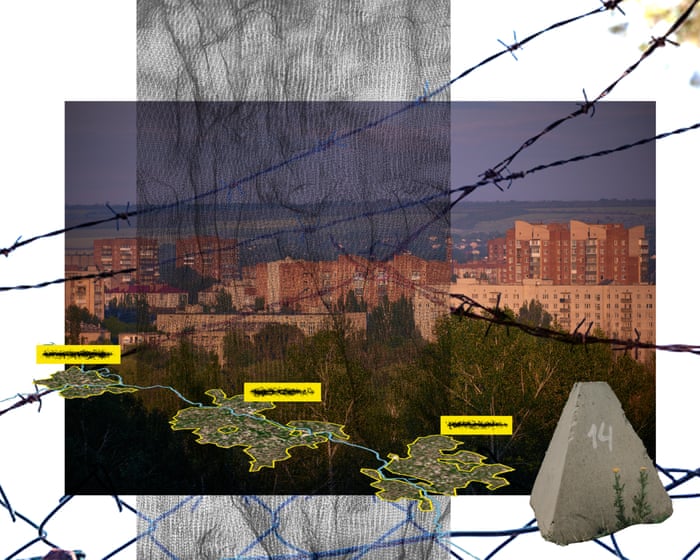
The fortress belt was identified for its potential strengths in the event of a full-scale Russian invasion under Volodymyr Zelenskyy’s predecessor, Petro Poroshenko, in 2015—the year after Russia seized Crimea and fighting began in eastern Ukraine, events Ukrainians see as the start of the war. The strategy envisioned a defensive line based around four large cities in Donetsk oblast and their satellite settlements, running 30 miles north to south along the H-20 Kostyantynivka-Sloviansk main road.
Map of Ukraine’s fortress belt: The area consists of a concentration of dense urban centers, often with sprawling industrial facilities close together, and a complex geography of rivers, woods, and rising terrain that favors its defenders.
In an April paper on the importance of the belt, the US thinktank the Institute for the Study of War described it as “optimized for defense across nearly every possible topographical and geographical characteristic” and said it gave Ukraine a significant advantage. “The high costs that Russia paid in the Battle of Bakhmut or the campaign for Pokrovsk will pale in comparison to those necessary to seize the fortress belt, assuminIt added: “That Russian forces can even succeed.”
The pace of Russian attacks has picked up sharply in recent weeks, but—at least for now—Russian troops have made few real gains, while more and more lives are being thrown into the Kremlin’s “meat grinder.”
[Image description: A 2023 photo shows rescuers working at a block of flats in Sloviansk partly destroyed by Russian shelling. Credit: Ihor Tkachov/AFP/Getty Images]
[Image description: The aftermath of a Russian multiple rocket attack on Sloviansk in June 2026. Credit: Anadolu/Getty Images]
The way war is fought has completely changed over the course of this conflict, which began with Russia’s full-scale invasion in February 2022 and has already lasted longer than World War I.
The brigades that came to fight in this region for the 2023 counteroffensive traveled in convoys of hastily camouflaged civilian cars. Now, they move through cities and along the front in vehicles that look like something out of the dystopian Mad Max films—bristling with spikes made from heavy metal cable to set off Russian drones early, or covered in wire grilles for protection.
In the woods and fields, defenses that were once basic have turned into deep layers of obstacles: tank ditches, barriers, and tangled barbed wire.
[Image description: Ukrainian military vehicles, fitted with anti-drone cages and wire, now resemble cars from Mad Max films. Credit: Roman Pilipey/AFP/Getty Images]
Alongside these physical barriers are antennas to spot drones and electronic countermeasures to disable them, while streets and large sections of highway are covered by anti-drone net tunnels.
“The war has changed since [the full-scale invasion in] 2022,” said Lt Col Shamil Krutkov, a commander in Ukraine’s 93rd brigade and a veteran of battles across the Donbas, whom the Guardian met in Kramatorsk.
He admitted that many soldiers had been skeptical over the years about defending the fortress belt and outlying towns, but said the strategy had bought Ukraine time to adapt to a new kind of war dominated by drones, battlefield robots, and remote sensing.
[Image description: Ukrainian servicemen install anti-drone nets along a road near Sloviansk. Credit: Tommaso Fumagalli/EPA]
The Ukrainian soldiers you meet have changed too. Where infantry once talked about close combat in woods and cities, now they are just as likely to be drone operators fighting remotely on a frontline that has become a heavily watched “kill zone,” where any attempt to move forward is visible and deadly dangerous.
“Technology has turned everything upside down. We’ve had very tough fights in the Donbas, but those hard times forced us to think and be creative,” Krutkov said, adding that there is now little room for maneuver warfare with large forces. “We both have the same technologies,” he said. “I’m not sure either side has a chance for a big offensive.” That’s a problem for Russia’s generals as they promise new victories soon along this front, but less of an issue for the defenders.
[Image description: A soldier from the 63rd brigade carries a drone. Credit: 63rd Mechanised brigade of Ukrainian Army]
“The situation over the years,” Krutkov added, “has gone from facing a Russian regiment to two Russians trying to sneak in. I joke that since the war began, we’ve gone from fighting hard for villages, cities, and districts, then for forests, to fighting for foxholes where Russian soldiers want to hide.”
His best guess for the coming months is that the deadly “grey zone” between the forces will expand, leaving Russian forces stuck in their quagmire.
Vadym, an officer in the 63rd brigade, which is fighting in and around Lyman, credited the fortress belt’s success to military reforms started in 2024 that improved the Ukrainian armed forces.Forces are now better able to coordinate on a larger scale.
“Before, a single brigade would hold its ground and try to defend its position, only to be outflanked by the Russians on both sides. There was no coordination, and the enemy always looked for gaps between brigades. Now you can feel the difference. It’s better,” he said.
“We started creating proper kill zones. We cleared forests, dug tank ditches, and laid wire and obstacles using trees. When the enemy moves, it’s all out in the open… Over the last six months in our sector, we haven’t given the Russians a single meter.”
View image in fullscreen
Downtown Kramatorsk has been devastated by constant Russian attacks. Photograph: Francisco Richart/ZUMA Press Wire/Shutterstock
None of this means Russian troops haven’t advanced in some places. In Kostyantynivka, the southernmost point of the belt, Russian forces now hold the east side of the city. The west side, across the Kryvyi Torets river, has become a kill zone as Russian groups try to infiltrate the city center. This advance has come at a huge cost in lives for Russian forces.
For the Ukrainian military and civilians, the cost has also been heavy. In Sloviansk and Kramatorsk, factories and apartment buildings show the damage from daily drone and rocket strikes. Petrol stations are covered with nets, fuel pumps are sandbagged, and concrete shelters are in place for staff and customers.
When FPV drones appear—multiple times each day—a continuous siren sounds, distinct from the usual air raid warnings.
Firefighters tackle a blaze after a drone attack in Kramatorsk
In Kramatorsk, after leaving the basement meeting with Krutkov, the Guardian saw the aftermath of a recent strike on an apartment building a block away. A delta-winged Shahed drone hit it, injuring four people.
Yulia Melnyk, 46, who lives in the building, is fatalistic as she cleans her flat. The stairwell outside is charred and smells of smoke from the explosion. “Sometimes the noise scares me. But if I hear the explosion, I’m alive and life goes on. It exploded somewhere else,” she said. “Sometimes I think I need to do something and move. But two hours later, I change my mind. And look, my building is still standing.”
Other buildings in Sloviansk and Kramatorsk haven’t been as lucky, but recently installed drone nets and shelters let residents shop, including at open markets. However, the nets only work against smaller drones and offer no protection from the much larger Shaheds and glide bombs.
View image in fullscreen
Yulia Melnyk in her drone-damaged apartment in Kramatorsk. Photograph: Peter Beaumont/The Guardian
But overall, Ukraine feels the fortress belt is largely holding up against Russian attacks. It believes it can resist Moscow’s demands to give up territory in exchange for an uncertain ceasefire, which Kyiv thinks would let Russia use the Donbas as a base for future attacks. The defense has given Kyiv time to implement other strategies, most notably drone attacks on supply lines to occupied Crimea and the Donbas, which are weakening Moscow’s ability to sustain its operations.
Vadym, whose brigade is fighting in and around Lyman, said: “The enemy isn’t giving up on trying to storm Lyman and establish a foothold there. Their task last year was to take Lyman by October. Then it was by the end of the new year. Then March. Now, by the end of summer.”
Defending one town also helps defend the others, though Vadym noted that the fortress belt’s interconnected urban centers and industrial facilities could be both a strength and a weakness if supply routes are cut. “Obviously, if we lose Lyman, it’s a problem for Sloviansk. But that’s if…”
He noted a change in how the strategy is viewed more widely in Ukraine, where previously thereThere were tough questions about the cost of the defense.
“I remember two years ago, people kept asking why we were holding certain positions, even though it was pretty obvious,” he said. “But now it’s completely different. Back then they said, ‘Why hold onto this?’ What do they say now? The opposite. We need to build up our strength so we can get some kind of tactical advantage.”
Civilians carry their belongings during an evacuation of Druzhkivka. Photograph: Anadolu/Getty Images
The human cost—often overlooked as the war drags on, with success and failure measured in meters—remains.
At the evacuation center in Sloviansk, Lyudmilla, 68, and her friend Tatiana have just escaped from a village two miles from the Russian front lines.
Lyudmilla is exhausted and traumatized. The day before, a Russian glide bomb hit her house, killing her husband and two other men, and amputating a neighbor’s hand. “I had just stepped into the yard. It’s a miracle I wasn’t hurt. For the last two years, we’ve been living in the cellar.”
“Soldiers came to help and look for my husband. But he had disappeared. I don’t feel safe in Sloviansk,” she added. “We could hear explosions last night and couldn’t sleep. I’ll go to the west of the country, where my son, his wife, and my grandchildren are. But I need to know what happened to my husband. I can’t rest until I know.”
Satellite imagery courtesy of Planet Labs PBC
Frequently Asked Questions
Here is a list of FAQs about kill zones and drone nets within Ukraines fortification belt written in a natural conversational tone
BeginnerLevel Questions
1 What exactly is a kill zone in this context
A kill zone is a specific area that defenders have preaimed their weapons at If an attacker enters that area they get hit by fire from multiple directions at once Its designed to be a deadly trap
2 Why are they using drone nets Arent those for catching birds
Yes they look similar but these are heavyduty nets strung up on poles Their job is to stop small FirstPerson View drones from flying directly into trenches or bunkers to drop bombs
3 What is the main purpose of this belt of fortifications
To slow down a Russian assault It forces attackers to move through specific dangerous paths while protecting Ukrainian soldiers from drones so they can fight longer
4 Is this like the trenches in World War I
Sort of but modern The basic idea of digging in is the same but now you also have to worry about drones flying over your head so the defenses are much deeper and include antidrone measures
5 How do soldiers stay safe if they are standing under a drone net
The net creates a physical barrier A drone trying to divebomb them will get tangled in the mesh and crash or have to fly so high that it cant aim accurately
Advanced Technical Questions
6 How do you design a kill zone so the enemy cant just go around it
Kill zones are layered They are placed in natural choke points and are covered by overlapping machine gun and artillery fire If you try to go around you just walk into another kill zone
7 What are drone nets actually made of Do they stop all drones
They are usually made of thick polyethylene or nylon mesh like heavyduty fishing net They stop small FPV and reconnaissance drones Larger militarygrade drones are too big and heavy but those are usually shot down by antiair guns anyway
8 Dont drone nets just get blown up by artillery
Yes they are fragile Thats why they are