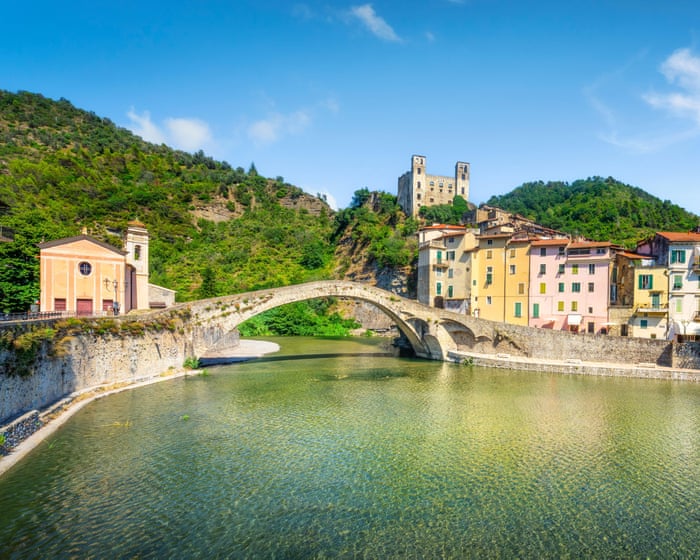
On the Riviera di Ponente, tucked between the flashy resort towns of the Ligurian coast, lies the Albenga plain. Filled with campsites and holiday bungalows, this area grew during Italy’s postwar boom as an affordable escape for workers looking to get away from the smog of nearby industrial cities like Turin and Milan. While much of the coast nearby has since turned into upscale beach clubs, this part of the riviera remains a place where families gather under eucalyptus trees to play cards, share picnics, and doze through the afternoon heat to the sound of cicadas. These are the loyal followers of villeggiatura: Italy’s legendary month-long summer holiday.
The tradition of villeggiatura dates back to the Renaissance, when nobles would leave their city palaces for grand countryside villas in the hills, staying for weeks at a time. But during the 20th century, middle- and working-class Italians made it their own, turning an aristocratic privilege into a widespread ritual. By the 1960s, millions of Italians saw a long summer break as a basic right, spending their holidays in ancestral villages, seaside campsites, or even company-funded holiday resorts. This was the era captured in Gino Paoli’s 1963 hit song Sapore di Sale (The Taste of Salt), which celebrates “lazy days passing by” at the beach, dreaming “of a different world” beyond the factory and office.
There’s something undeniably nostalgic about this picture-perfect image, but the politics that made it possible are worth thinking about, especially compared to our own overworked times. Italy’s enviable leisure culture didn’t just appear out of nowhere. It was the once-powerful trade unions that fought for this right, securing Italian workers some of the longest protected holidays in Europe. Businesses had to adapt. Companies like Fiat and Olivetti didn’t just close down for most of August; they actively encouraged their employees to take the summer off, funding mountain retreats and seaside camps for workers and their children. Even the government helped support the long break, offering cheap train tickets and backing budget holiday programs so that families from all backgrounds could take part.
There are similar examples elsewhere in Europe, from England’s Wakes Weeks to France’s villages vacances. What made Italy’s postwar period unique was the teamwork between organized labor, business, and the state, and it gave Italy a cherished tradition that remains part of the national culture today.
Of course, some have criticized Italy’s August shutdown as the ultimate example of southern European laziness, wondering how an entire country can simply stop for weeks at a time. Yet villeggiatura has always had its own economic sense. During the 1960s, at the height of the trend, Italian productivity grew by an average of 4-6% each year, higher than in the US. Industrial output was strong, job stability was high, and despite some early protests against increased automation, urban unemployment hit historic lows. Decades later, international data from the OECD continues to show that working longer hours brings diminishing returns, reinforcing a truth many Italians once saw as obvious: that the right to rest supports an economy, rather than draining it.
But the real philosophy behind villeggiatura is less about economic numbers and more about human well-being. In today’s Italy, where unstable jobs have created constant insecurity, workers spend the year dealing with long, unpredictable hours only to rush off on short, expensive breaks. This cycle of burnout and frantic consumption is, surely, unsustainable. Villeggiatura offers a different way. Instead of Airbnbs, it relies on long-term rentals and family homes. Instead of sightseeing, it focuses on sunbathing and sleeping. Instead of fancy meals and overpriced drinks, it values simple pleasures, like sharing focaccia and watermelon on the beach with family and friends.A beach at Torre dell’Orso, Italy, in August. Photograph: Diego Fiore/Alamy
On paper, this sounds like an ideal way to spend a summer. Unfortunately, though, fewer and fewer Italians can actually do it. Workers used to be able to take weeks off at a time, but by the 1990s, the average holiday had dropped to 13 days as deregulation changed the job market. Now, it’s barely six days. Last year, 35.7% of Italians said they couldn’t even afford a short break. To make things worse, the idea of villeggiatura is being taken over by luxury brands. The Belmond hotel group recently put out a $120 coffee table book called Villeggiatura, using the language of the long holiday to market places like Portofino’s Splendido, where a room can cost several thousand euros a night.
Despite these pressures, Italians haven’t given up this tradition. Places like Albenga are still popular for long August breaks, as are the traditional beach spots of the Riviera Romagnola on the Adriatic coast. Even with more exclusive beach clubs popping up, there are still affordable options. Heritage groups are working to bring back the old corporate vacation sites, from the Eni village in Borca di Cadore to Olivetti’s seaside retreat in Marina di Massa. Some state support also remains, like government-funded grants that let children of lower-income public-sector workers go to summer camps.
For the most part, though, villeggiatura today takes more compromise and financial strain than it used to. Many Italian workers choose inland spots away from the coast, where prices are lower. Others deal with fewer work benefits, piecing together the limited time off their employers give them. Digital workers are perhaps the most creative followers of this tradition, with many choosing to skip pay to take time off, or giving up some rest hours to answer emails from under a beach umbrella.
The fact that so many are fighting to keep this ritual alive against all odds shows what’s at stake. Villeggiatura was never just about taking a holiday, but about taking back life from the all-consuming logic of the market. In an era when workers across Europe are tired, isolated, and struggling with the high cost of living, that simple idea remains quietly inspiring. Far from being a relic of 60s nostalgia or a gimmick for luxury brands, its true legacy is a strong belief in the need for rest. Villeggiatura reminds us that a slower, healthier way of life shouldn’t just be a privilege for the elite, but a basic right – one that, with some political will, could once again be within reach for everyone.
Jamie Mackay is a writer and translator based in Florence
Frequently Asked Questions
Here is a list of FAQs about Italys August shutdown and the idea of adopting a similar concept elsewhere
Beginner Questions
1 What exactly is the August shutdown in Italy
Its a traditional nationwide break that peaks around August 15th For 1 to 3 weeks most shops offices and factories close down so families can go to the beach or mountains Its a legal and cultural right not just a nice to have
2 Is it true that literally everything closes
Almost Youll still find hospitals emergency services and some barsrestaurants in tourist areas open But in cities youll find bakeries dry cleaners and offices shuttered with signs saying Chiuso per Ferie
3 How did this tradition start
It has two roots Ancient Rome and the Catholic Church But the modern shutdown was a hardfought victory by labor unions in the 20th century securing paid leave for workers
4 Why do Italians actually shut down for weeks not just a day
Because the heat in August is brutal and the law guarantees a minimum amount of annual leave Since the weather is perfect for the sea everyone takes their leave at the same time making it pointless for businesses to stay open with no customers or staff
5 What would be the main benefit of doing this in my country
It would force a collective pause Instead of staggered isolated vacations youd get a synchronized reset where everyonefrom the CEO to the cashieractually unplugs without fear of missing emails
Advanced Questions
6 Isnt a mass shutdown bad for the economy
It seems counterintuitive but Italys GDP doesnt crash in August The money is just redistributedinstead of buying lunch near the office people spend on hotels ferry tickets and gelato It also creates a massive spike in domestic tourism which supports coastal towns
7 How did Italian workers actually win this right
Through decades of strong union pressure and collective bargaining agreements in the postwar era They didnt