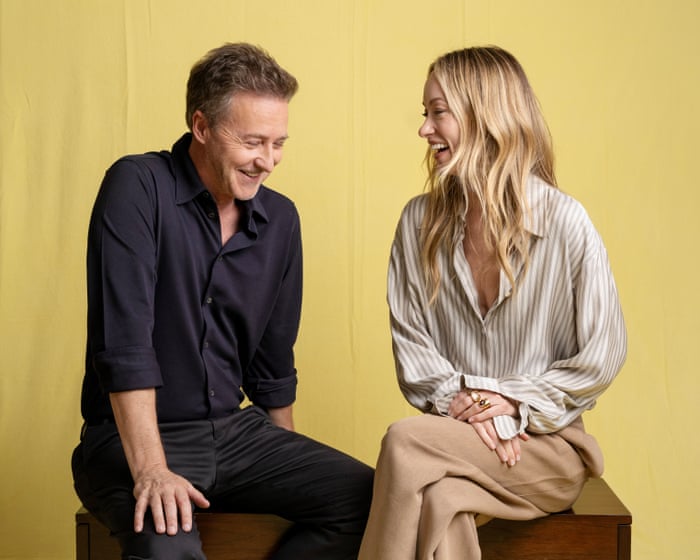
Earlier this week, Edward Norton took a red-eye flight from New York to London and felt so awful the next day that he decided to get a massage. “I hadn’t had one in such a long time,” he says, “and I almost started crying. You’re like: ‘Oh! Ah!'”
He’s heard similar sounds from audiences watching his new movie, The Invite, which is about how marriage can wreck your sex life. “People are almost in tears. They’re like: ‘I haven’t had a good, adult laugh that made me feel understood in a long time.'”
He grins, looking tanned and relaxed. “Most people feel alone in the messiness of their relationship—worried that only the two of you are having these problems. Knowing it’s universal is a relief. It lets you forgive yourself a lot.”
Next to him, Olivia Wilde, his co-star and director, nods. “My favorite laugh from an audience,” she says, “is the one that seems to say: ‘I thought I was the only one!’ It’s like ha-ha-ha-aaah; a little bit of a groan. When you hear yourself laugh at something that feels revealing, and then someone else does it too, the quiet shame you felt is instantly lifted.”
View image in fullscreen
Bed death … Olivia Wilde and Seth Rogen as a married couple in The Invite. Photograph: Adam Newport-Berra/PA
Seeing and feeling understood by The Invite is cathartic. It’s also far from flattering. Wilde plays Angela, a frustrated artist married to failed musician Joe (Seth Rogen). They share a 12-year-old daughter but not much else. When their daughter is at a sleepover, Angela invites the upstairs neighbors—smooth former firefighter Hawk (Norton) and his girlfriend, Piña, a therapist played by Penélope Cruz—down for dinner. It’s not a spoiler to say the evening doesn’t go well, or as expected. Think Who’s Afraid of Virginia Woolf? with a bit of kink.
Of the four characters, only Piña is someone you might actually want to be, probably because she represents the film’s consultant: Belgium-born, Manhattan-based psychotherapist Esther Perel. Piña voices many of Perel’s key ideas—most notably that all relationships end, but sometimes you can restart one with the same person. One of Perel’s ideas, which isn’t said out loud but seems to hang in the air, is that “bed death” is an unavoidable side effect of the American dream.
Yes, says Wilde eagerly. “It’s that American sense of duty: I started this marriage, I’ll finish it, I’ll push through. The puritanical roots of our culture mean it’s not just shameful to value pleasure, but also to admit defeat.”
For women in such a society, she says, there’s still “a sense of achievement in marriage. You’ve signed a contract that will keep you safe and feels like success. Pleasure and your ongoing exploration of it come second to keeping the family together.”
Wilde and Norton each have two children; she with her ex-partner, Jason Sudeikis, he with his wife of 14 years, producer Shauna Robertson. “When you see a family with a young child in France,” Wilde continues, paraphrasing Perel, “the assumption is that those people are having sex, which is what led to the child. In America, it’s like: those people are not having sex because they have a young child. That inherently signals the end of sexual exploration and a shift to a very different sense of femininity, much more rooted in duty and care.”
View image in fullscreen
‘I have that feeling that if I never made anything else, I’d be OK.’ Photograph: Linda Nylind/The Guardian
The Invite feels very specific to the US, even though it’s based on a Spanish play that has already been made into movies in Italy, Switzerland, France, and South Korea. That’s because, besides being set in San Francisco and channeling California’s favorite sexologist, the cast spent two weeks workshopping the script with screenwriters Rashida Jones and Will McCormack.
Adding their own hang-ups toThe mix was easy and low-pressure, says Norton. “There was a lot of pre-existing comfort and trust.” They already knew each other—he and Rogen had worked together before on the animated food orgy film Sausage Party, which shares some of the same crude DNA as The Invite. There was plenty of improvisation: very funny jokes, slapstick, and even a devastating speech where Hawk explains the origin of his name. Norton is still amazed that Wilde let him wing that part. “Directors just don’t say, ‘Don’t tell me what this key moment is going to be.'” Especially when you’re shooting on 35mm film. “Actually, I’m kind of amazed that Seth was okay with it. Seth is a very methodical and precise craftsman.”
More than a year later, Norton, 56, still seems energized by the shoot. He keeps laughing and sharing his favorite lines. He talks about getting “into a flow state” and the “exuberant feelings” when they realized it was all coming together. He brings up a jazz quartet metaphor. He says he’s made over 50 movies, but this was the first one filmed in chronological order (on a single set, over about three weeks).
“It would never, ever have had that arc if it had been shot out of sequence. We would have been much more cautious. It had a really profound effect on how the story built toward its finale.”
Wilde beams at him, her striking, angular Bambi face glowing. “I feel both thrilled and ruined by this experience,” she says, “because I don’t know when I can possibly expect to have another one like this. To have a group of people so in sync. I do have that feeling that if I never made anything else, I’d be okay.”
View image in fullscreen
Odd couples … Wilde, Rogen, Cruz, and Norton in The Invite. Photograph: Black Bear/PA
The Invite is unlikely to be her final film. After its premiere at Sundance in January, it was sold to A24 for $12 million (£9 million) following a bidding war. It’s now a critical hit, a commercial success, and an awards contender. It even surpasses the enthusiastic reception of Wilde’s 2019 directorial debut, Booksmart, and nearly erases the memory of her follow-up, Don’t Worry Darling (2022), which didn’t please critics, audiences, or Harry Styles fans (Wilde and her co-star dated for a couple of years; she has been harsh about the intense media scrutiny).
“I believe in using storytelling to experience emotions that no amount of therapy can fully uncover,” says Wilde. “I was surprised by my own performance, because things were sort of erupting from me that I didn’t plan for.”
‘God, life is so strange’: Diane Keaton interviewed in 2023 on dogs, doors, wine, and why she’s ‘really fancy’
Read more
Among these moments was when Angela calls herself a “stupid fucking cunt” before reassuring Hawk that she’s fine—it’s just her inner monologue. That, says Wilde, was a roundabout tribute to the late Diane Keaton, to whom the movie is dedicated.
“She was probably the most self-effacing person I’ve ever met. Certainly in so many of her great roles, she had this immediate self-awareness that was both brutal and vulnerable.” They played mother and daughter in 2015’s Christmas with the Coopers, and Angela inherits a lot from Keaton, just as the film draws from Woody Allen’s best bickering comedies and the sharpest Mike Nichols films.
The “cunt” line, then, is the swear-filled heir to Keaton’s “what a jerk” ramble in Annie Hall’s post-tennis scene—a scene, says Norton, that not only includes the first “la-di-da” and the first sight of Keaton’s classic hat-tie-waistcoat-slacks outfit (elements of which Wilde has adopted today), but also “a generational moment in that it was the first person doing the inner monologue, saying the quiet part out loud.”
View image in fullscreen
Penélope Cruz as Piña and Olivia Wilde as Angela. Photograph: Adam Newport-BerThe Invite encourages its audience to say what’s usually left unsaid and—thanks to Keaton’s incredible talent—to stay spontaneous. Norton says resisting both is partly because of “what these things”—he points at his phone—“are doing to us psychosexually.” There’s only one scene in the movie that involves technology, and it’s terrible. That lack of tech adds to the film’s nostalgic feel, along with its main setup: a last-minute party thrown by people who barely know each other. “Now, our social worlds are heavily curated,” says Wilde. “You hang out with people who think like you. You check out your date before you meet them. You already know everything about them. The idea of running into the unknown today is completely foreign.”
She adds that it’s also scary. Technology tells us we don’t need other people. “And we’re still recovering from Covid, which taught us to fear others and embrace being alone. Intimacy involves risk and friction—all the things we’re now completely removing from our lives.”
Wilde, getting more into it, says social media stops us from growing in the ways needed to keep relationships exciting. “People have become brands. Everyone has defined their brand. I wonder if putting out a record of who you are and what you like means people feel less free to change.”
When she was younger, every new stage—high school, college, a new city—was a chance to reinvent herself. “I hate the idea that people feel less open to that because they’ve documented a public record that will be held against them as proof of who they used to be.”
Wilde’s first wedding was at 19, to an Italian aristocrat, on a school bus with two witnesses. Today, she’s less convinced by that kind of commitment. “There’s this sense of: ‘How dare you change! You said at 24 you wanted this kind of life, and now you’re 44. How dare you want different things!’ The most successful relationships I’ve seen are between people who seem genuinely interested in the other person as they are right now.”
In the film, Piña says settling is shameful: people live on scraps, forgetting they deserve more. This idea is taken almost directly from Perel, a philosophy the psychotherapist traces back to being raised by Holocaust survivors—a group she splits into “those who didn’t die, and those who came back to life.”
“This sense of having one life and needing to live it authentically is definitely what seems to drive her,” says Wilde. It’s interesting, I note, that Perel’s spiritual predecessor, the beloved US sex therapist Dr. Ruth Westheimer, was also the daughter of European Jews sent to concentration camps—though both of her parents were killed.
Norton nods into his coffee. Did I know, he asks, that Perel’s husband, Jack Saul, is also a therapist who specializes in post-traumatic stress disorder? “I talked about this with Esther,” he says. “We’re living in global trauma right now. We literally have genocide being live-streamed. Mechanized armies attacking civilians in Ukraine and Sudan. Masked, fascist thugs shooting American citizens on the streets. This is the big picture of what’s being pumped into us. And trauma, violence, and brutality suppress eroticism.”
So the Invite isn’t just light entertainment, he says—it’s a remedy. “A kind of medicine. People feel incredibly disconnected from their erotic selves in times like these. You feel bad complaining about your own lack of emotional or psychosexual energy because the whole world is telling you: you just have to survive this horror.”
He and Wilde look at each other and sigh. Maybe it’s time for another massage. The InviThe film is now in theaters. Do you have any thoughts on the issues discussed in this article? If you’d like to submit a response of up to 300 words by email for possible publication in our letters section, please click here.
Frequently Asked Questions
Here is a list of FAQs based on the quote I feel both thrilled and ruined by this from Olivia Wilde and Edward Norton about making their sex comedy
BeginnerLevel Questions
Q What is the movie I feel both thrilled and ruined by this
A Its not the title of a movie Its a quote from Olivia Wilde and Edward Norton describing how they felt while making their upcoming sex comedy
Q Who are Olivia Wilde and Edward Norton
A They are actors Olivia Wilde is also a director Edward Norton is an actor and filmmaker
Q What kind of movie is a sex comedy
A Its a funny movie that deals with relationships dating and sexual situations in a humorous way
Q Why would making a comedy make them feel ruined
A Making any movie is exhausting A sex comedy can be especially intense because it involves very personal awkward or vulnerable scenes that are physically and emotionally draining
IntermediateLevel Questions
Q What does thrilled and ruined actually mean in this context
A It means they loved the creative challenge and the exciting result but the process was extremely difficult exhausting and maybe even a little embarrassing or uncomfortable
Q Is this a common feeling for actors making sex comedies
A Yes Many actors say they feel a mix of pride and exhaustion The intimacy and physical comedy require a lot of trust rehearsal and emotional energy which can leave you drained
Q What are the main challenges of making a sex comedy for the actors
A The biggest challenges are 1 Performing awkward or intimate scenes without feeling embarrassed 2 Keeping the humor natural and not silly 3 Maintaining chemistry with costars for long repetitive takes
Q Did Olivia Wilde direct this movie
A No she is starring in it alongside Edward Norton A different director is making the film
AdvancedLevel Questions
Q How does a quote like thrilled and ruined change the marketing or audience expectations