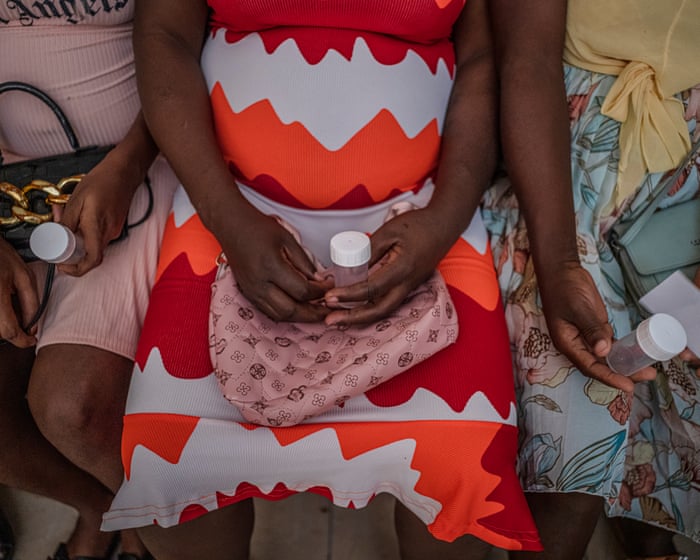
Eight months pregnant, Françoise, 45, arrives early in the morning at an empty school in Bel Air. This hillside neighborhood in Port-au-Prince has been under gang control since a violent takeover in 2019. Schools are closed, electricity is cut off, and food is scarce. Gunfights can break out at any time.
Françoise waits for a Doppler ultrasound in a clinic set up for just a few hours inside the abandoned school in Bel Air.
What was once a school in safer times in Haiti’s capital has become a temporary pop-up health clinic. The only light comes through cracks in the boarded-up windows and over the sandbags stacked to block stray bullets. A room lined with wooden benches is packed with newborns, their mothers, and pregnant women seeking maternity services from the aid organization Médecins Sans Frontières (MSF).
According to Human Rights Watch, the Trump administration’s suspension of USAID funding in 2025 left about 750,000 women and girls in Haiti without access to healthcare. When care is still available, women line up and wait for hours.
The clinic in the abandoned school in Bel Air is run by Médecins Sans Frontières.
Ten days before Françoise’s visit to the clinic, the area saw a violent clash between rival gangs. Dozens of people were killed, including 10 children, a local human rights group told the Associated Press.
In the final three months of her pregnancy, Françoise feels she has no choice but to travel to the clinic, despite the danger. She has been diagnosed with a condition that greatly raises her risk of eclampsia, which can cause seizures during pregnancy and after childbirth. If left untreated, it can lead to coma, brain injury, and sometimes death. If the clinic weren’t there, Françoise says, “only God knows” where she would go.
The government-controlled Port-au-Prince district of Pétion-Ville.
A one-month-old baby girl, Luguiona, in the arms of Ruth, a friend of the baby’s mother, Adeline, at the Bel Air clinic.
Residents in Pétion-Ville. About 1.4 million Haitians have been internally displaced, and more than 6 million people need urgent humanitarian help.
After the assassination of President Jovenel Moïse in 2021, Haiti sank deeper into chaos. About 1.4 million Haitians have been forced from their homes. More than half the population now faces severe food shortages, and over 6 million people need urgent humanitarian aid.
The impact on maternal health has been devastating. According to MSF, between February 2022 and April 2025, the rate of maternal deaths in hospitals rose from 250 to 350 per 100,000 live births.
Only a few health facilities in Port-au-Prince are still open and reachable for women living in the poorest neighborhoods, like Bel Air and Tabarre. A clinic in Cité Soleil was forced to close in May due to gang violence. An estimated 60% of births in the city happen without medical care—at home, in camps, or on the streets. Complications like bleeding, infections, and high blood pressure go untreated, making them the leading causes of maternal death.
Prenatal exams at the Bel Air clinic take place behind a screen, lit by battery-powered lamps because there is no electricity in the gang-controlled area.
Clockwise from top left: A female patient is treated for a gunshot wound in her upper leg in Tabarre; women seeking healthcare in Cité Soleil; a baby girl, Gamalla, in the arms of her mother, Fabienne, seven days after being born at home; expectant mothers hold urine sample cups at the Bel Air clinic.
The midwife treating Françoise says her baby will likely need to be delivered by cesarean section. WithIf she doesn’t get it, either she or the baby could die. She already has three daughters, two of whom were born by C-section. If this baby is also a girl, Françoise plans to name her Lovinska.
After spending several hours at the clinic, gunshots are heard outside. The medical staff quickly pack up their equipment, and the women at the clinic scatter. Françoise begins the long walk home through the unpredictable streets of Bel Air, to the camp for displaced people where she lives with her husband and children.
[View image in fullscreen]
Rollens, 5, and his mother, Eliphète, at a hospital run by MSF in Tabarre. Rollens suffered burns on his arms and legs after his foot got caught in a motorcycle’s exhaust pipe.
The situation in Port-au-Prince is getting worse by the day. Weeks after Françoise visited the clinic in Bel Air, heavy fighting broke out. Seven volunteers working with MSF were trapped inside a building for hours before they could escape. A former volunteer was wounded and died right outside the building’s gate. Once again, maternal health services were suspended.
Frequently Asked Questions
Here is a list of FAQs about a photo essay on giving birth under the shadow of Haitis gang violence
General Background Questions
Q What is a photo essay
A Its a story told mainly through a series of powerful photographs with a few words to explain the context It lets you see the experience rather than just read about it
Q Why is giving birth in Haiti so dangerous right now
A Gangs control many parts of the capital PortauPrince They block roads attack hospitals and make it impossible for pregnant women to safely reach medical care
Q What is the main point of this photo essay
A To show the real human cost of the gang violencespecifically how it turns what should be a joyful event into a lifeordeath struggle
Questions About the Women Their Experiences
Q What happens when a pregnant woman goes into labor and cant get to a hospital
A Many women give birth at home in the street or in makeshift shelters with no medical help Some die from bleeding or infections that could have been treated
Q Do women try to travel to safer hospitals
A Yes but its extremely risky They might have to walk for hours through gangcontrolled areas bribe checkpoints or travel at night to avoid gunfire
Q How do the photos show the fear
A You see womens faces their tense bodies and the crowded unsafe places where they give birth The images capture the constant worry and exhaustion
Questions About the Gangs Violence
Q How do the gangs specifically affect pregnant women and babies
A They block ambulances loot hospitals for medicine and shoot at people trying to flee Some women are even caught in crossfire while in labor
Q Is it safe to go to a hospital at all
A Some hospitals are still open but they are overwhelmed and often run out of supplies Doctors work without electricity or running water and many have fled the country
Practical Human Impact Questions
Q What happens to the babies born in these conditions
A Many are born prematurely underweight or with infections because their mothers couldnt get prenatal care Some dont survive the first few days