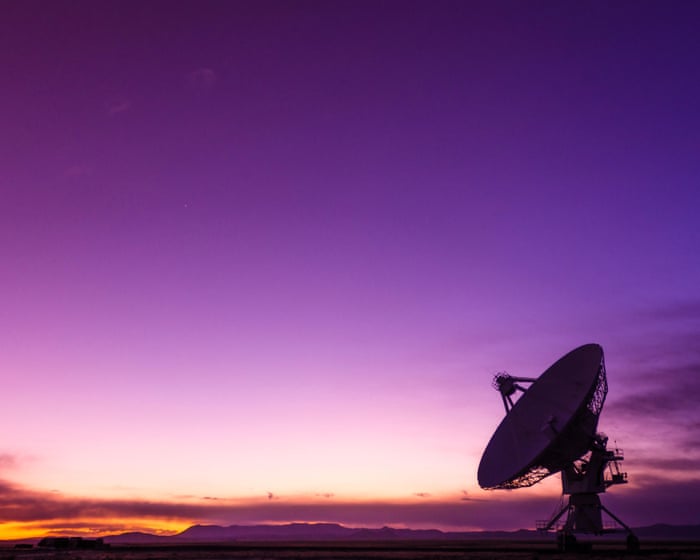
In 1950, during a visit to the Los Alamos National Laboratory, Enrico Fermi—one of the key figures behind the Manhattan Project—was having lunch with other physicists. The conversation turned to flying saucers, and at some point, Fermi suddenly asked, “Where is everybody?” Or, as another person at the table remembered it, “Don’t you ever wonder where everybody is?” In other words, if aliens exist, why haven’t we ever come across them?
This moment became famous, marking a shift in how people thought about extraterrestrial life. Before, it was mostly a topic for philosophical debate, but now it became a serious scientific question. For centuries, people had wondered if there was life on the Moon or Mars, but they assumed we’d never know for sure, since traveling to another planet was impossible. By the 1950s, that no longer seemed so out of reach. Besides space travel, scientists were also developing ways to detect radio signals coming from stars many light-years away. These technologies were still in their early stages, but it was already clear that humanity wasn’t stuck on Earth forever.
This new sense of possibility raised an uncomfortable question. Since the 16th century, when Copernicus showed that Earth isn’t the center of the universe, modern science had gotten used to the idea that our planet is nothing special. And if Earth is just an average planet, there’s no reason it should be the only one with intelligent life. Given that the universe is about 13.8 billion years old, it should be full of civilizations with technology far more advanced than what we’ve developed in just a few thousand years of human history. Yet we can’t find any sign of them.
That was true in 1950, and it’s still true today, despite some well-publicized claims to the contrary. Since 2017, when the New York Times reported that the US military had video recordings of pilots encountering UFOs, aliens have become a mainstream topic. The House of Representatives even held hearings about what are now called “unidentified anomalous phenomena” (UAP), treating them as a possible national security threat. But the blurry, inconclusive “Pentagon UFO videos” haven’t led to any clear images of alien spacecraft, just like earlier waves of UFO sightings never produced solid proof.
For most scientists, the real mystery about aliens isn’t their presence but their complete absence.
The first serious attempt to pick up radio signals from alien civilizations in deep space happened in 1960, when American astronomer Frank Drake ran an experiment called Project Ozma. Using a telescope at the National Radio Astronomy Observatory in West Virginia, Drake searched for signals at a specific spot on the electromagnetic spectrum: 1420 MHz, known as the “hydrogen line,” because hydrogen atoms give off photons at that frequency.
Since hydrogen is so common in the universe, this line is easy for radio telescopes to detect. In a 1959 paper, astronomers Giuseppe Cocconi and Philip Morrison argued that any advanced civilization would discover this fact early in its development of radio astronomy, just as humans did. So they reasoned that any species wanting to broadcast signals to attract attention from cosmic neighbors would likely pick 1420 MHz. But even though Project Ozma spent 150 hours observing two relatively close stars similar to our sun, it found no unusual activity at the hydrogen line.
In 1971, NASA brought together a group of experts to study the best ways to search for extraterrestrial life. Their report, called Project Cyclops, came out the next year and has been a key reference for the search for extraterrestrial intelligence (often shortened to Seti) ever since. The report proposed building the Cyclops system, described as “an ‘orchard’ of antennas 10km to 10 miles in diameter, containing 1,000 to perhaps 2,500 antennas.”Such an array could scan the sky 200,000 times faster than Ozma. Building Cyclops was estimated to cost between $10 billion and $25 billion—equivalent to $77 billion to $192 billion today—making it roughly as expensive as the Apollo program. It was never built, and in 1993, Congress cut NASA’s modest funding for SETI projects. Since then, all U.S. efforts have been privately funded, mainly by billionaires like Paul Allen, co-founder of Microsoft, and Yuri Milner, a Soviet-born entrepreneur. Advances in computer technology mean today’s SETI efforts are far more sophisticated than those of half a century ago, capable of scanning millions of radio channels from tens of thousands of galaxies. But the outcome remains the same: no artificial signal from an alien civilization has ever been detected.
That doesn’t discourage true believers. Seth Shostak, an astronomer at the California-based SETI Institute, writes that SETI’s “failure is tempered by the fact that the number of star systems sampled is still quite small.” In 2010, astronomer Jill Tarter, a leading figure in the field for decades, calculated that so little of the universe had been searched that it was like dipping a single glass into the ocean to determine whether it contains fish.
If extraterrestrial signals are out there and it’s just a matter of looking in the right place, it’s entirely possible that SETI could find one tomorrow. But it hasn’t happened in more than 65 years of searching, and until it does, alien signals remain as hypothetical as alien spaceships. Not only is there no evidence that extraterrestrials are trying to contact or visit us; there is no evidence that they exist at all. This non-appearance poses a more serious challenge to modern scientific assumptions than any UFO sighting. It turns out there really is something unique about Earth: as far as we currently know, it is the only place where life exists. But why?
In October 1961, a year after Frank Drake failed to detect any alien radio signals with Project Ozma, he invited a dozen scientists to a conference to discuss the future of SETI. To clarify the problem, he tried to calculate how many extraterrestrial civilizations could be broadcasting radio signals in our galaxy. The answer, Drake reasoned, depended on seven variables, including “How many planets in an average system are capable of supporting life?” and “On planets where life exists, how often does an intelligent species like humanity evolve?”
Multiply all the variables and you get the number of potential targets for SETI in the Milky Way. Drake wrote out the formula, which has been known ever since as the Drake equation. At the time, none of the variables could be estimated with any confidence. Drake’s rough calculations yielded an estimate of 50,000 transmitting civilizations, but this was essentially just a guess. The real purpose of the Drake equation was to establish a research program—a set of questions for astronomers to try to answer. In the 21st century, they have made significant progress, thanks to new space-based telescopes that allow us to see the cosmos in more detail than ever before.
For the first variable—how fast are new stars formed in the Milky Way—it’s now estimated that 10 to 20 new stars are born every year (a far slower rate than when the galaxy was young and richer in star-forming gas). The total number of stars in our galaxy is on the order of 100 billion. In the visible universe as a whole, there are an estimated 2 trillion galaxies, yielding a total of about 100 sextillion stars. So much is still unknown about the universe that this figure is certain to be revised, but it’s sufficiently mind-boggling to get the Drake equation off to a promising start.
It is much easier to detect stars than the planets that orbit them, and in 1961 the answers to Drake’s seThe second and third questions—how many stars have planets, and how many of those planets could support life—were completely unknown at the time. As telescopes became more powerful, scientists were able to detect exoplanets, which are planets outside our solar system, by measuring the tiny changes in a star’s light when a planet passes in front of it. The first exoplanet was found in 1992, and the second in 1995. Discoveries sped up dramatically in the 2010s, thanks to observations from the Kepler space telescope and the Transiting Exoplanet Survey Satellite.
By 2025, about 6,000 exoplanets have been identified in the Milky Way, including at least three orbiting Proxima Centauri, the closest star to the Sun. This is only a small fraction of what’s out there. While we can’t yet give a definitive answer to Drake’s second question, a study published in Nature in 2012 suggested there are at least 100 billion planets in our galaxy alone.
To tackle Drake’s third question—how many of those planets could sustain life—a new field of science has emerged: astrobiology, the study of life beyond Earth. This is a tricky area because we have no examples to study. Instead, astrobiologists focus on the basic conditions needed for life and how we might figure out if distant planets meet those conditions.
Exoplanets are far too distant to see what’s happening on their surfaces. But we can measure a planet’s size and its distance from the star it orbits, and use that to make educated guesses about its atmosphere, temperature, and even its magnetic field. Since Earth is the only planet we know supports life, it makes sense to assume that exoplanets similar to Earth in these ways are the most likely to be habitable.
View image in fullscreen
A NASA illustration showing what the planet Kepler-452b might look like. Photograph: NASA/Reuters
Astrobiological research also involves studying life on our own planet to understand the range of environments where it can thrive. The discovery of “extremophiles”—simple organisms that survive in extreme conditions—has shown that life can exist under two miles of ice and in hot springs reaching 208°F (98°C). This suggests that some form of life could develop even on planets that seem inhospitable. For example, while there’s no liquid water on Mars today, frozen remnants of ancient oceans are thought to lie beneath its surface, and it’s possible that future probes could detect some kind of extremophilic life there.
In 2025, NASA announced that a rock sample analyzed by the Perseverance rover contained two minerals, vivianite and greigite, which on Earth are byproducts of bacterial metabolism. These minerals might be a sign that primitive microorganisms existed on Mars billions of years ago. If confirmed, this would be a groundbreaking discovery. As astrobiologist David Catling wrote, “Even the simplest microbes native to Mars … would change the balance of probabilities that life exists elsewhere in the galaxy, for they would demonstrate that life can originate twice within one solar system.” However, proof of life on Mars wouldn’t necessarily mean it started independently on both planets. It’s also possible that life began on Earth and traveled to Mars, or the other way around, carried through space in meteorites or dust. That would support the “panspermia” theory, which suggests life originated in just one or a few places in the universe and then spread naturally over vast periods of time.
On Earth, any life form more advanced than bacteria needs liquid water to survive. So the most important factor for a habitable exoplanet is that it can’t be too close to its star, where intense heat would evaporate water, or too far, where cold would turn it into ice. If an Earthlike planet sits in the “Goldilocks zone”—where the temperature is “just right” for liquid water to exist—it becomes a prime candidate for habitability.First, it could be considered a candidate for life. The first such planet discovered was Kepler-452b, spotted by the Kepler space telescope in 2015. It’s slightly larger than Earth and takes 385 days to orbit its star, which is very close to our 365-day year. By 2025, the Habitable Worlds Catalog—a database run by the University of Puerto Rico—listed 29 Earth-like exoplanets, and we’re only just getting started. A 2020 study in the Astronomical Journal estimated that the Milky Way contains at least 300 million Goldilocks-zone planets, possibly up to 6 billion.
Astronomy has made huge strides in figuring out the first three factors in the Drake equation. But as astronomer Sara Seager has noted, “the first three factors are measurable; the other four are not, and arguably never will be.”
The closest we can get to answering Drake’s fourth question—how many planets actually develop life—is to search for biosignatures: chemical compounds in an exoplanet’s atmosphere that, on Earth, are linked to life. In 2025, researchers announced they had found dimethyl sulfide in the atmosphere of K2-18b, an exoplanet in the habitable zone of a star 124 light-years away. Since that compound is produced by ocean plankton on Earth, it could hint at organic life. But other scientists quickly pushed back, arguing the data didn’t confirm the presence of dimethyl sulfide.
K2-18b highlights the limits of astrobiology. Finding an exoplanet is tough; finding one in the Goldilocks zone is harder; detecting possible biosignatures is even harder. And even if biosignatures were confirmed for sure, it would only suggest life might exist. There’s no way to know if it actually does, let alone what form it takes.
The search for exoplanets is dramatically expanding our view of the cosmos. “We have learned that the universe is teeming with a fascinating variety of planets, more types than we could have imagined,” writes astrobiologist Lisa Kaltenegger. But so far, it has found exactly as many extraterrestrials as radio astronomy has: zero. The more we learn about the universe, the sharper the Fermi paradox becomes.
To explain this “great silence,” researchers focus on the last three variables in the Drake equation: on planets where life exists, how often does an intelligent species like humanity evolve? Of those intelligent species, how many develop the technology to send radio signals into space? And finally, how long does a transmitting civilization last before it vanishes?
These questions go beyond astronomy; even in theory, building more sensitive telescopes won’t answer them. The only way to shed light on them would be to compile a catalog of species across the cosmos and study their histories. But the very reason we ask Drake’s questions is that we don’t have such a catalog.
So, in practice, thinking about extraterrestrial intelligence means thinking about the only intelligent species we know—ourselves. What conditions had to exist for Homo sapiens to evolve and develop spacefaring technology, and how long can we expect technological civilization in its current form to survive?
Of the seven variables in the equation, Drake and his colleagues found the last one—which they called “L” (for “length of time”)—the hardest to estimate, offering guesses ranging from 1,000 to 100 million years. This uncertainty reflects the fact that L is essentially a prediction about humanity’s future. As long as ours is the only technological civilization we know of, we can’t estimate how long such civilizations last except by thinking about how long ours might. And there’s good reason to think it might not be very long. The birth of radio astronomy and space flight coincided withThe invention of nuclear weapons coincided with the development of rocket technology—the same rockets that carried astronauts to the Moon were also used to build intercontinental ballistic missiles. So far, humans have managed to avoid destroying ourselves in a nuclear war for the past 80 years, but it would take a bold prophet to guarantee we won’t do so in the next 80, let alone the next 800. It’s possible that technological progress is self-limiting: any species powerful enough to leave its planet is also powerful enough to destroy it.
Enrico Fermi, one of the architects of the Manhattan Project, posed the question in 1950: “Where is everybody?” Drake thought that multiplying all the variables in his equation would give about 50,000 transmitting civilizations in our galaxy. If the real number turns out to be just one, then at least one of those variables must be much smaller than expected. In other words, there must be one or more steps in the evolution of advanced civilizations that are very hard to get past.
As economist Robin Hanson wrote in an influential 1998 paper: “There is a ‘great filter’ along the path between simple dead stuff and explosive life.” For some reason, “the vast majority of stuff that starts along this path never makes it. In fact, so far nothing among the billion trillion stars in our whole past universe has made it all the way along this path.”
Like the Drake equation, the great filter gives us a way to think about what makes technological civilization possible. Answering that question involves astronomy, physics, and biology. It also raises questions about human nature and destiny that have traditionally been left to philosophy and religion.
We’ve long known that certain physical conditions are necessary for life to develop: being the right distance from the sun, having water, and having a breathable atmosphere. But there are many other cosmic coincidences that might be just as necessary for life to emerge and survive. For example, a planet that gets hit by asteroids regularly would struggle to sustain life for long. When a single asteroid about six miles wide struck the Yucatán Peninsula 66 million years ago, it’s thought to have wiped out three-quarters of all species, including the non-avian dinosaurs.
Such impacts would be much more common if it weren’t for Jupiter. This giant planet sits just the right distance from Earth to intercept comets and asteroids. A neighbor like Jupiter might be a prerequisite for advanced life, because on a planet without one, mass extinctions would keep resetting the clock of evolution.
Then there’s plate tectonics. Earth’s surface is broken into large plates that drift slowly over time. At their fault lines, old rock made of carbon is pulled into the planet’s hot interior, and new rock rises up as magma. This “conveyor belt” helps stabilize the level of carbon in the atmosphere, preventing runaway heating or cooling that could wipe out life.
Geologists aren’t sure why Earth has tectonic plates—the best current theory is that radioactive decay in the planet’s interior produces heat that melts subsurface rock. But we know ours is the only planet in the solar system with them. Mars and Venus, which are rocky and about the same size as Earth, have rigid surfaces that don’t break into separate pieces. So it’s possible that plate tectonics also belongs on the list of prerequisites for life.
The more conditions life needs, the easier it is to narrow down the galaxy’s 100 billion planets as potential homes for it. The “rare-Earth” hypothesis suggests that Earth-like planets with all these features might be extremely uncommon.The “Rare Earth hypothesis,” writes Serbian astrophysicist Milan Ćirković, suggests that “each of these requirements [for life] is unlikely and they are (or at least seem to be) causally independent, so that their combination is bound to be incredibly rare and probably unique in the Milky Way.”
Life on Earth appears to have started fairly soon after the planet formed; the oldest bacteria are only a few hundred million years younger than the solar system. This seems like a good sign that, given the right conditions, life can get going easily. But after those early beginnings, major evolutionary steps came very slowly. It took about 2 billion years for the first cell nucleus to develop, allowing the shift from simple prokaryotic bacteria to more complex eukaryotes. Another billion years passed before the first multicellular organisms appeared.
Interestingly, genetic evidence shows that each of these key developments happened only once in Earth’s history. This suggests they may not be inevitable stages that life would go through anywhere, but extremely rare accidents. Life might exist on other planets as archaea—single-celled organisms that can survive in extreme environments—without ever evolving as far as sponges, let alone plants and animals.
As for mammals like us, our time on Earth is also highly dependent on chance. Dinosaurs ruled the planet for over 150 million years. In comparison, Homo sapiens has been around for only about 300,000 years, which is 0.006% of Earth’s history. Looking back at human history from this perspective, we seem to be perched on a wobbly Jenga tower of incredible coincidences. So many factors had to align perfectly for us to exist; change just one, and we wouldn’t be here. This is dizzying, reminding us that everything we take for granted about our world is actually radically contingent. Not only do life and human life not have to exist; it would be far more reasonable for them not to.
In earlier centuries, some thinkers reached a similar conclusion and saw it as proof of divine providence, which shaped the finely tuned cosmos to support human evolution. Today, instead of turning to old supernatural beliefs to explain human uniqueness, a new generation of cosmologists argues that we need to greatly expand our ideas about what forms life and intelligence might take, and how we should search for them.
Seti operates on the assumption that we will find aliens because they want to be found. It looks for radio signals sent deliberately into space with the aim of attracting attention from civilizations advanced enough to detect them. The Project Cyclops report argues that “the sending race will attempt to make the job of deciphering and understanding the messages as simple and foolproof as possible.”
This assumption reflects the optimism of the space age, when humanity landed on the moon and looked into deep space for the first time. Having achieved so much so quickly, it was natural to believe that other intelligent species would be just as adventurous. Wouldn’t they want to end their cosmic loneliness as much as we do?
View image in fullscreen
A radio telescope at the National Radio Astronomy Observatory, Green Bank, West Virginia. Photograph: Jim West/Alamy
Such ideas about how aliens would behave are fundamentally human-centered, imagining that any intelligent species would be driven by the same motives we are: a love of knowledge and a love of power. But there is no reason why intelligent life elsewhere in the universe should have evolved to resemble us, either physically or mentally.
In a 2016 paper titled The “Hard Problem” of Life, physicists Sara Imari Walker and Paul Davies note that “both astrobiology and our assumptions about non-human consciousness tend to be biased by our understanding of terrestrial life.” We take for granted that the specific forms that evolved on EarthFrom the level of cells to multicellular organisms, and from eusocial groups to linguistic societies, these forms are the inevitable result of natural laws. So, something like them must emerge wherever life exists. But Walker and Davies argue that, in reality, life as we know it comes from “a combination of chance and necessity,” including many unlikely events that pushed evolution down new paths.
Instead of expecting all living things to look like us—with arms, legs, rockets, and radio telescopes—Walker and Davies suggest we rethink life itself. They propose defining it in functional terms as “the actual physical mechanism that allows information to gain causal control over matter.” On Earth, information is physically stored in DNA strands and synaptic signals. Elsewhere in the universe, it might take forms so different that we wouldn’t recognize them even if we found them.
This idea fascinated the 20th-century Polish science-fiction writer Stanisław Lem, who explored it in several novels and stories. In his most famous book, Solaris, humanity discovers a planet covered by a sentient ocean. The second chapter, “The Solarists,” is an elaborate fictional history of scientific debates about this organism, which resembles a “syrupy jelly.” Is it a “primitive being” or a “highly organized structure”? Did it skip “all the terrestrial stages of development—that is, the emergence of protozoa and metazoa, plant and animal evolution”—and still manage to become intelligent?
The novel turns into a kind of horror-thriller, as astronauts stranded on Solaris are stalked by strange apparitions. But these aren’t ghosts; they’re the ocean-being’s attempts to communicate with the visitors by reading their minds and taking on the shapes it finds there. The ocean itself seems to think by creating elaborate shapes and structures with its gelatinous waves. But the human visitors are completely unable to grasp the meaning of these movements. The real tragedy of Solaris isn’t the gruesome deaths of the scientists, but what one of them calls “the failure to make contact, the lack of response.”
More recently, theorists and storytellers—a distinction that often blurs when thinking about aliens—have begun to speculate that what separates us from extraterrestrials isn’t different biologies. Instead, biology itself might be a primitive phase in the development of mind, which truly advanced civilizations inevitably outgrow. After all, the most impressive technological achievements of the 21st century haven’t been in space exploration, but in computing, which lets us create ever more detailed and powerful models of the world. If this progress continues, we’ve started to worry that artificial intelligence and virtual reality could replace human intelligence and material reality.
Perhaps this is why we’ve so far failed to find traces of alien life. When intelligent species become advanced enough, maybe their goal isn’t colonizing planets, but escaping physical existence altogether. John Smart, a non-academic futurist who describes his work as “acceleration studies,” calls this the “transcension hypothesis”: aliens are invisible to us because they’ve transcended bodily existence as we currently understand it.
Presenting this idea in a 2012 paper, Smart speculated that as civilizations develop “more computation and simulation abilities,” they will expand not into outer space but into “inner space,” creating virtual realities more complex and interesting than physical reality. On Earth, computers have become ever more compact as they grow more powerful. So it makes sense to assume that the material substrate of alien virtual realities—the hardware on which the software of consciousness runs—will come to occupy less and less physical space. Ultimately, Smart argues, this process could yield a technology so compact that it becomes nearly invisible to us.The fact that it will essentially vanish from the map of the cosmos.
The dark universe: can a scientist battling long Covid unlock the mysteries of the cosmos?
Read more
It’s clear that the transcension hypothesis, like the Cold War-era idea of galactic colonization, reflects a kind of presentism—assuming that what’s happening now will keep happening in the future, only more intensely. It turns the 21st-century computer revolution into a universal path that every technological civilization must follow.
But when we think about extraterrestrial life, it’s hard to avoid some degree of anthropocentrism and presentism. Without real data on aliens, thinking about them is an act of imagination, and the only material our imaginations have to draw on is our own experience. As our understanding of humanity changes, so does our sense of what’s likely or possible for our cosmic “others.” Just as UFO encounter reports are human testimonies, not scientific evidence, all our thinking about aliens and how to find them is best seen as humanity’s evolving self-portrait.
Adapted from We Want to Believe: How Aliens Went Mainstream and Why It Matters, published by Columbia Global Reports on 25 August. To support the Guardian, order your copy from guardianbookshop.com. Postage and packaging may apply. Listen to our podcasts here and sign up to the long read weekly email here.
Frequently Asked Questions
Here is a list of frequently asked questions about the Fermi Paradox and the Great Silence ranging from beginner to advanced
Beginner Questions
1 What exactly is The Great Silence
Its the observation that the universe is incredibly vast old and full of planets yet we see no signs of intelligent alien life Its the silence we hear when we look up at the stars and see no evidence of alien civilizations
2 What is the Fermi Paradox
Its a question named after physicist Enrico Fermi He famously asked Where is everybody The paradox is the contradiction between the high probability that aliens exist and the fact that we have seen zero proof of them
3 Why do we expect aliens to exist in the first place
Because of numbers There are billions of stars in our galaxy alone and many of them have planets With so many Earthlike worlds the statistical odds seem to suggest that life and even intelligent life should be common
4 Are we looking for the wrong thing
Possibly We mostly look for radio signals But aliens might use advanced technologies we cant even imagine like lasers gravitational waves or some form of physics we havent discovered yet We might be looking for a needle in a haystack with the wrong magnet
5 Does The Great Silence mean we are alone
Not necessarily It just means that we havent found anyone yet It could mean they are too far away too quiet too different or that they dont exist The silence itself doesnt provide the final answer
Intermediate Questions
6 What is the Rare Earth hypothesis
This theory argues that complex life is incredibly rare It suggests that our specific combination of factorsa large moon for stability a Jupiter to deflect asteroids plate tectonics and a magnetic fieldis so unique that Earth might be one of the only places in the galaxy with complex life
7 What is the Great Filter theory
This is a sobering idea It suggests that there is some stage of evolution that is almost impossible to pass through This filter could be behind us or ahead of us like the development of nuclear weapons