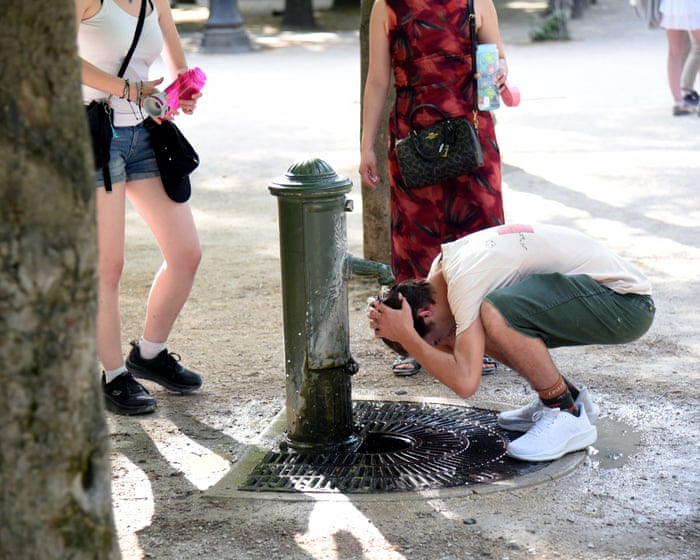
This summer, mayors gathered in London during a heatwave that, ironically, threatened to disrupt London Climate Action Week. As temperatures broke records across the UK and Europe—forcing some climate talks to be paused or cancelled—we found ourselves looking for shade and comparing how our cities deal with extreme heat: how we protect at-risk residents, communicate danger, and redesign neighborhoods for hotter summers.
Around the same time, Paris was managing its own crisis response as another intense heatwave swept through France. Across Europe, more than 14,000 people died because of the heat.
As mayors, we all face the same challenge: how do you protect millions of people when extreme heat is no longer a rare event, but an increasingly normal part of summer?
For Phoenix, that question has shaped city government for decades. For Paris and Milan, it is quickly becoming one of the biggest tests of urban leadership.
Some might find it surprising that two of Europe’s oldest and most respected cities are looking to a city in the Arizona desert for guidance. But rising temperatures are now a global problem, and we don’t have time for every city to figure out what works on its own.
Phoenix has learned—sometimes the hard way—that extreme heat can’t be treated as just a weather issue. It affects decisions about transport, housing, public health, public spaces, and emergency planning. Preparing for summer starts long before the temperatures climb.
Phoenix set up one of the world’s first city offices dedicated to heat response and prevention. This reflects an approach that focuses on both immediate relief from extreme heat—especially for the most vulnerable—and long-term resilience by using cooling solutions to make the city safer and more comfortable.
The city’s shade plans require that 75% of new developments in busy pedestrian areas be shaded, and there are programs to support schools, transit users, and those most at risk. To further reduce the urban heat island effect, Phoenix is applying cool surface treatments to buildings and roads, including more than 300 kilometers of neighborhood streets.
The city leads its region in heat response, including running a 24-hour cooling center with full support services to connect people with resources like housing, medical care, and even job placement. Landlords are required by law to keep indoor temperatures at or below 28°C (82°F), and companies that work with the city must have heat safety plans to keep workers healthy and comfortable. These measures save lives: during the summer of 2024—the hottest on record in Phoenix—the city’s coordinated heat response helped cut heat-related 911 calls by 20% compared to the previous year.
Paris and Milan bring their own expertise and face their own unique challenges.
Both are historic European cities where streets, buildings, and public spaces were designed for a different era and a different climate. Today, both are working to adapt.
Every Parisian now lives within a seven-minute walk of a cool spot. The city has more than 1,400 such places—including parks, gardens, and other public facilities—where people can escape the heat during a heatwave. The city also extends opening hours for parks, swimming pools, and public baths during high temperatures. In addition, Paris has built a network of 27,000 climate volunteers who help raise awareness in their communities about the climate crisis and heatwave strategies, alongside preventive actions.
The city is also preparing for a future that would have been unthinkable to Parisians just a few decades ago: “Paris at 50°C” was held in October 2023 to test how ready the city and its partners are, and to improve planning and coordination for future heat emergencies. This involved the whole community, utilities, media, and schools.This directly inspired Barcelona to carry out the same exercise in 2027.
As mayors, we all face the same question: how do you protect millions of people when extreme heat is no longer a rare event, but a regular part of summer? No city can simply copy another’s approach. Geography, history, and politics differ everywhere. But every mayor owes it to their residents to seek out the best ideas from cities around the world. Through the C40 Cities network, nearly 100 of the world’s largest cities are sharing climate solutions for our residents and businesses. Cities have always learned from each other. For generations, we have adopted successful transport systems, housing policies, and public health measures. Heat adaptation should be no different.
If one city finds a better way to protect outdoor workers, cool public spaces, or warn residents about risks, others should not waste years reinventing it. Good ideas should spread.
Inspired by Barcelona and Paris’s cool spaces initiatives, Milan is expanding its Piazze Aperte (Open Squares) and School Streets programs to include cool spaces by planting trees, replacing hard surfaces with green areas, and creating shaded spots. The city also runs a helpline and support services for elderly and vulnerable residents through Milano Aiuta (Milano Helps). Milan’s Air and Climate Plan sets a binding goal to keep local temperature increases to 2°C by 2050. They are one of the few cities in the world with such a temperature-related target, which is very ambitious.
Extreme heat already kills more than half a million people each year, making it the deadliest climate hazard. Cities are especially vulnerable because buildings, roads, and pavements absorb heat during the day and release it well into the night, leaving residents with no relief and making it hard to cool down. Older people, young children, outdoor workers, and lower-income communities often face the greatest risks.
Planting trees, cooling schools, redesigning streets, improving buildings, and expanding early warning systems are often called climate policies. But they are also public health measures, investments in local economies, and practical upgrades that make cities more livable all year round.
Meanwhile, heating and cooling account for nearly half of all energy use in Europe, with about 70% of heating still coming from fossil fuels. Cities have the power to lead a fair shift to clean heat. By investing in renewable energy and cleaner heating systems, they can cut emissions, improve air quality, and create local jobs, making sure the benefits reach those who need them most.
Cities are often the first to feel climate impacts but the last to get the authority, funding, and flexibility needed to respond. National governments should work with cities to create better adaptation strategies, expand early warning systems, and make it easier for local leaders to access the money needed to protect residents. These investments can save lives, boost economies, and lower future costs for the whole country.
This summer has given Europe a glimpse of what those in desert climates often experience, and what we can all expect to become our new normal in the age of climate crisis.
Extreme heat is not an individual problem; it is a shared challenge we must all face. The burden cannot fall on an isolated pensioner, a vulnerable child, or a construction worker. Heat is a political crisis that requires bold political action.
We must prepare and fight back. The climate crisis is rapidly changing what we consider “normal.” Our ability to learn from each other must move even faster.
Emmanuel Grégoire, Giuseppe Sala, and Kate Gallego are the mayors of Paris, Milan, and Phoenix.
Frequently Asked Questions
Here is a list of FAQs based on the statement from the mayors of Paris Milan and Phoenix framed as if a concerned citizen or journalist is asking
General Questions
Q Why are the mayors of Paris Milan and Phoenix working together on heat
A Because they all face the same lifethreatening problem extreme heat in cities By working together they can share solutions learn from each others mistakes and put more pressure on national governments and international organizations to take action
Q Is this just about having a few hot days in the summer
A No This is about a heat crisis which means prolonged periods of dangerously high temperatures that are becoming more frequent and intense Its a public health emergency not just a weather inconvenience
Q What exactly is an urban heat island
A Its the effect where cities are much hotter than the surrounding countryside Buildings roads and sidewalks absorb the suns heat and release it at night so cities dont get a chance to cool down
Q Who is most at risk during these heat waves
A The elderly young children people with chronic illnesses outdoor workers and lowincome residents who may not have access to air conditioning or green spaces are the most vulnerable
Solutions Strategies
Q What can a mayor actually do to cool down a whole city
A A lot They can plant more trees create new parks require green roofs on new buildings paint roads and roofs with reflective materials and set up public cooling centers for people to escape the heat
Q What is a cool roof and how does it help
A A cool roof is painted white or made with special reflective materials Instead of absorbing the suns heat it bounces it back into the atmosphere This keeps the building cooler inside and reduces the heat released into the streets
Q How do trees help beyond just giving shade
A Trees act like natural air conditioners They release moisture into the air through a process called evapotranspiration which cools the air around them They also absorb CO2 tackling the root cause of climate change
Q These are big global cities How can Phoenix a desert city share ideas with Paris