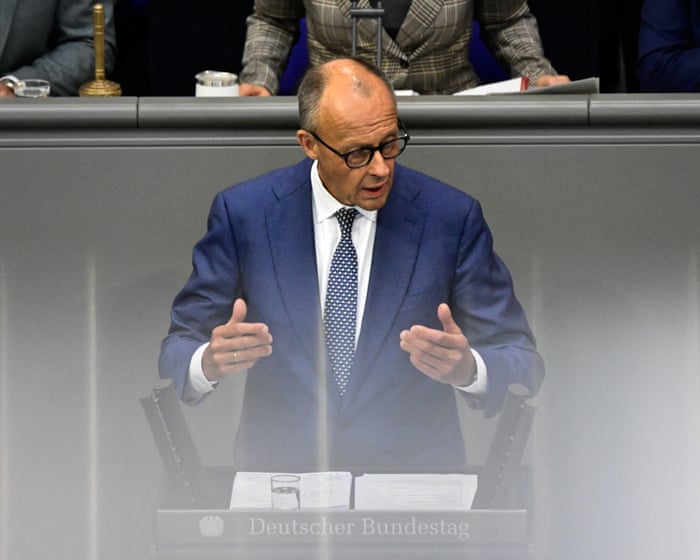
Germany’s chancellor, Friedrich Merz, has accused the far-right Alternative for Germany (AfD) of pushing an “ethnic cleansing” agenda through its “remigration” campaign, following the party’s major victory in a state election over the weekend.
In his first direct clash with the AfD since Sunday’s surprising result in Saxony-Anhalt, Merz told a heated parliamentary session that the far-right party would harm one of the key pillars of Germany’s economy with its racist push for mass deportations.
‘It breaks my heart’: far-right’s big election win sparks dismay in German state capital
Read more
“The term ‘remigration’ is nothing but a synonym for ethnic cleansing based on origin and skin colour,” he said on Wednesday, drawing applause from the other parties in the Bundestag, Germany’s lower house of parliament.
In a sharp speech aimed at the AfD parliamentary group, which repeatedly interrupted him with loud jeers and heckling, Merz said millions of working immigrants were vital to German society.
“If those working in Germany have to leave the country again because you are championing ‘remigration’,” Merz said, “then the skilled trades in Germany will no longer be able to function: not a single care home will remain open, not a single hospital in Germany will remain operational, and not a single restaurant in Germany will be able to stay in business.”
He said the AfD’s rhetoric, which helped it achieve the strongest showing for a far-right party in a German state since the Nazi era, “is exactly what is dividing our society so deeply.”
The AfD has repeatedly called for large-scale expulsions of irregular migrants, a policy that would face major legal hurdles under German law.
View image in fullscreen
(L-R) The AfD’s Tino Chrupalla, Ulrich Siegmund and Alice Weidel after the Saxony-Anhalt election win. Photograph: Clemens Bilan/EPA
In the election, the party rode a global wave of populism, nationalism, and discontent with mainstream parties, a trend underscored overnight by congratulations from Donald Trump.
In a post on his Truth Social platform, the US president praised the AfD’s “really big night” in Saxony-Anhalt. “They finally got tired of the absolutely horrible Immigration rules and regulations which have hurt Germany so badly,” Trump wrote.
Merz responded by cancelling a planned phone call with Trump on Wednesday. A spokesperson for the chancellor declined to explain why but noted that Merz had always objected “in general terms” to “interfering in or commenting on the domestic political situation, particularly regarding elections.”
Support for Merz, a conservative Christian Democrat, has dropped sharply in the 16 months since he took office leading a coalition with the centre-left Social Democrats, amid disappointment over slow progress on economic growth and the cost of living.
He has taken a tough stance on border policy in a struggling effort to win back AfD supporters, and acknowledged that Germany still had “problems in the area of migration.”
“We still have many people in Germany who should not have permanent residency. It is agreed within the [ruling] coalition that we need to deport more people,” he said on Wednesday.
“But we make a careful distinction between those who work in Germany, who contribute to our prosperity, and who are welcome here, and those who do not have permanent residency in Germany and who must leave our country. Unlike you [the AfD], we take great care to make this distinction.”
skip past newsletter promotion
Free newsletter | Weekly
Sign up to This is Europe
The most pressing stories and debates for Europeans – from identity to economics to the environment
Enter your email Sign up
after newsletter promotion
The AfD won nearly 44% of the vote in Saxony-Anhalt but fell three seats short of an absolute majority. Its lead candidate, Ulrich Siegmund, is now looking for support from other parties to get elected as state premier.
Anti-AfD prProtests sweep Germany as the far right closes in on two more states.
Read more
Merz, who admitted that his own unpopularity contributed to his party’s support being cut in half in the state, tried to put a positive spin on the defeat. “Fifty-six percent of voters in Saxony-Anhalt didn’t vote for you,” he told the AfD.
He accused Siegmund—whose party is labeled as right-wing extremist by domestic intelligence—of “electoral fraud” for breaking a campaign promise not to seek to govern the state unless he won an outright majority.
“And you won’t manage that in Germany either [at the federal level],” Merz told AfD co-leader Alice Weidel. “Nowhere in Germany will you get a majority. You are and will remain a destructive force.”
Merz also criticized the AfD for opposing military aid to Ukraine and accused it of siding with Russia, which Berlin claims is running a sabotage and disinformation campaign on German soil. He noted that despite “clear evidence” a failed drone bomb attack at Leipzig airport last month “had been planned in Russia for months and was specifically aimed at Germany,” the AfD had stayed silent on the matter.
Earlier, Weidel had celebrated her party’s overwhelming election win from the stage, saying the CDU had been “pulverized” and calling the result a referendum on Merz’s leadership. Attacking the government’s migration policy and blaming it for crime and other security issues, Weidel said: “Your time is up. The public want a change in policy, and they will get it,” repeating her party’s goal of forming a federal government in the near future.
Polls show Merz’s divided coalition would not win a majority in a general election, though the next national vote isn’t due until 2029. The AfD is leading in the polls at 28% to 29%, with momentum behind it ahead of two more state elections this month in Berlin and Mecklenburg-Western Pomerania.
Frequently Asked Questions
Here is a list of FAQs based on the scenario you provided The questions are written in a natural conversational tone and the answers are clear direct and easy to understand
General Questions
1 What is this whole ethnic cleansing accusation about
Friedrich Merz the leader of Germanys Christian Democratic Union has publicly accused the farright Alternative for Germany party of pursuing policies that amount to ethnic cleansing He is referring to their hardline stance on immigration and their proposals for the mass deportation of people with a migration background which he says goes far beyond legal deportation and targets people based on their ethnicity
2 Why did Merz cancel a call with Donald Trump
Merz canceled a scheduled call with former President Trump as a direct protest against Trumps recent endorsement of the AfD Merz felt that Trumps support for a party he views as a threat to German democracy and social cohesion made the call inappropriate at that time
3 Is the AfD actually calling for ethnic cleansing
The AfD denies this They claim they only want to deport people who have committed crimes or who are in the country illegally However Merz and other critics point to AfD policy papers and statements from leading members that suggest deporting naturalized German citizens and nonassimilated people which critics argue is based on ethnic origin rather than legal status
4 What does the AfD say about the accusations
The AfD has dismissed Merzs comments as hysterical and defamatory They claim he is trying to smear them ahead of upcoming elections because he is losing voters to them They insist their policies are legal and necessary for national security
Deeper Questions Context
5 Why is this such a big deal in Germany right now
This is a major deal because it represents a breaking of a longstanding political taboo For years mainstream German parties have maintained a firewall against the AfD refusing to cooperate with them Merzs strong language shows how the political center is trying to draw a clear moral line against the farright especially as the AfD gains popularity in polls
6 What is the firewall and does this break it
The firewall is the unwritten rule among