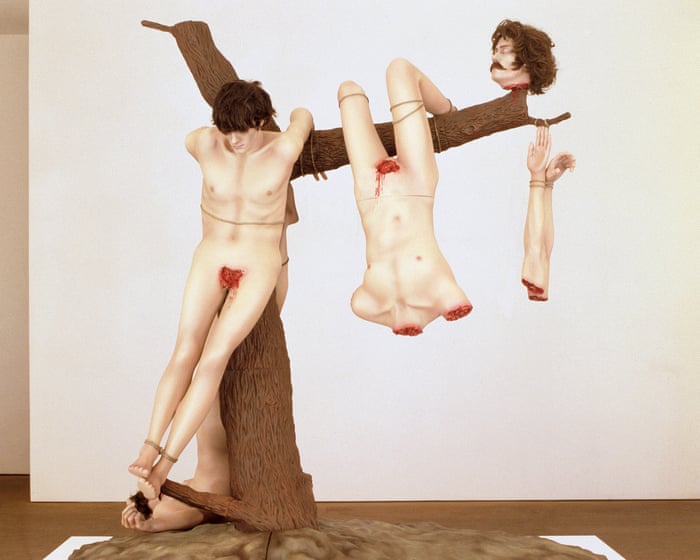
Even in the 1990s, some dismissed Jake and Dinos Chapman as overgrown adolescents peddling shock value for its own sake. Yet their work comes closest to giving this depressingly shallow exhibition a moment of real depth. Their sculpture Great Deeds Against the Dead, based on a Goya print depicting atrocities from the Napoleonic Wars, shows dismembered, bleeding nude corpses hanging from a tree. It raises questions about war and art, about how pain is represented, and about whether art can serve a moral purpose. The best British art of the 1990s was like that—brash, vulgar, and macabre on the surface, yet unexpectedly intelligent and emotional underneath. Unfortunately, this show is none of those things.
You would think Tate Britain would want to do justice to a decade in which these Millbank galleries played a starring role, hosting the Turner Prize in the years when bisected cows, concrete houses, and elephant dung had the nation arguing. At the start of the 1990s, no one considered Britain a leader in contemporary art. By the millennium, we were better known for new art than for new novels.
View image in fullscreen
Harmless … Two Similar Swimming Forms in Endless Motion (Broken), 1993, by Damien Hirst. Photograph: Damien Hirst and Science Ltd/DACS Images
An exhibition that spectacularly revisited fin-de-siècle British art would be an interesting prospect. Instead, former Vogue editor Edward Enninful has been invited to stage his own fantasy version of that decade, mixing art and fashion with a heavy emphasis on fashion. There is more about Isabella Blow than about Rachel Whiteread, who is represented by an early cast of the inside of a hot-water bottle. Damien Hirst has a couple of small, harmless-looking sharks balanced on a circular rail. From this, there is no way to understand how his early work seemed to confront the tiger shark’s gaping maw of death. Perhaps his 1990s art can still move us, or perhaps it has become silly with time, but there is not enough of it here to even begin to decide.
This is not a real exhibition. It is a magazine spread. Not only are there style magazines in the show, but its design has the breathless superficiality of a glossy layout hyping its glib theme—in this case, “The 90s”—through a glamorous sweep of strikingly juxtaposed images. But placing fashion photography alongside conceptual art is a terrible idea. If you take the fashion images seriously, you reduce the art to just another stylish pose. If, like me, you care about the art, the fashion looks pretty vacant.
Juergen Teller’s 1996 photograph Kristen McMenamy No 3 hangs next to Sarah Lucas’s 1997 work Chicken Knickers. Teller’s picture shows its subject naked and smoking, with a lipstick heart drawn on her body containing the word “Versace.” What is it saying other than “Buy Versace”? Now look at Lucas’s photograph of a raw chicken stuck to someone’s knickers. It is funny—a great deed against a dead chicken, from an artist with a genius for estrangement, as a Lucas sculpture of a “Bunny” on a chair with thin, stockinged legs reminds you.
View image in fullscreen
A genius for estrangement … Chicken Knickers, 1997, by Sarah Lucas. Photograph: Tate Photography/Courtesy the artist and Sadie Coles HQ, London
Teller is exposed as merely a clever stylist whose images lack poetry or meaning. His portrait of Kate Moss has none of the distance or mystery of Gary Hume’s painting of her with a shiny, metallic, mirroring face. Hume provides one of the few moments where fashion and art genuinely overlap—but as pop art, his Kate is more a baleful, Richard Hamilton-like comment on celebrity than a celebration of Cool Britannia.
Not that the show has much to say about that wider pop-cultural fizz. There is an entire room full of party photos depicting the club scene, but surely another point of the 90s was that mainstream British pop was revived. I suppose Enninful is too sophisticated to find room for Oasis or Blur, let alone Fat Les.
Instead, we get couture. You can obviously see Alexander McQueen as an artist. BBut honestly, the room dedicated to “body horror” is dominated by his costumes, which are simply affected and pretentious. If they express anything, it might be a hatred of women, whom he forced to walk catwalks in outfits made of wire and steel bouquets. In the same room, pompous, dreadful images shot by Sean Ellis for The Face cover an entire wall. Next to these, Jake and Dinos look remarkably profound.
View image in fullscreen
Pompous, dreadful images … The Dark Knight Returns, by Sean Ellis for The Face, 1998. Photograph: © Sean Ellis
Other fine artists don’t come off so well. Helen Chadwick gets two token eerie photoworks, while the death-obsessed art of Hamad Butt, shown beautifully at the Whitechapel not long ago, is crammed into the end of the gallery. Chris Ofili gets a mention with No Woman, No Cry; Tracey Emin gets one neon piece. Other artists are notable by their absence, from Jeremy Deller to Mat Collishaw to the late, much-missed Christine Borland.
Skip past newsletter promotion
Free newsletter | Weekly
Sign up to Art Weekly
Your weekly art world round-up, covering all the biggest stories, scandals and exhibitions
Enter your email
Sign up
After newsletter promotion
Hard parties, cheap rents and awful flats: how 90s art and fashion redefined British culture
Read more
Or am I wrong? Does Young British Art really deserve the dismissive treatment Tate gives it, even though Tate did so well out of these artists? Perhaps it really was a load of nonsense. But even if you don’t share my belief that some of the art from that time is powerful and lasting, surely it deserves enough space to be seen and judged.
After just seven rooms, it suddenly ends. I hoped what I’d seen was a prologue to more art, bigger art, with enough space to appreciate it. But no. That’s it. You leave as dissatisfied as you might after flipping through a 30-year-old copy of The Face in a dentist’s waiting room. The 90s is at Tate Britain, London, from 8 October 2026 until 14 February 2027.
Frequently Asked Questions
FAQs The 90s Art and Fashion Review This Isnt an Exhibition Its a Magazine Spread
1 What is The 90s Art and Fashion review about
Its a critical review of a project or show that claims to explore 1990s art and fashion The reviewer argues its not a real exhibitionits more like a glossy magazine spread all style and no depth
2 What does this isnt an exhibition its a magazine spread mean
It means the display looks pretty but lacks the research context and meaning a real exhibition should have Its more about visuals and vibes than ideas
3 Why would a show be called a magazine spread
Because its arranged like a fashion editorialcarefully styled images famous names and trendy aestheticsbut without the storytelling or scholarship of a museum exhibition
4 Is that a bad thing
Not always A magazine spread can be fun and visually exciting The criticism is that its being presented as something deeperan exhibitionwhen it isnt
5 Whats the difference between an exhibition and a magazine spread
An exhibition usually has a clear argument research and context A magazine spread prioritizes images mood and commercial appeal
6 What was the art and fashion scene like in the 1990s
It was a mix of grunge minimalism streetwear and high fashion Artists and designers crossed over a lotthink Helmut Lang Maison Margiela and photographers like Corinne Day
7 Why is 1990s art and fashion so popular now
Nostalgia The era feels raw and authentic to many people and its stylesbaggy jeans slip dresses minimalismkeep coming back
8 What are common problems with 1990sthemed exhibitions
They often rely on clichés and skip the politics economics and diverse voices of the decade
9 Can you give an example of a good 1990s art and fashion exhibition
The Fashion World of Jean Paul Gaultier or In America A Lexicon of Fashion handled context and craft well Smaller shows at places like the Fashion Institute of Technology also do this