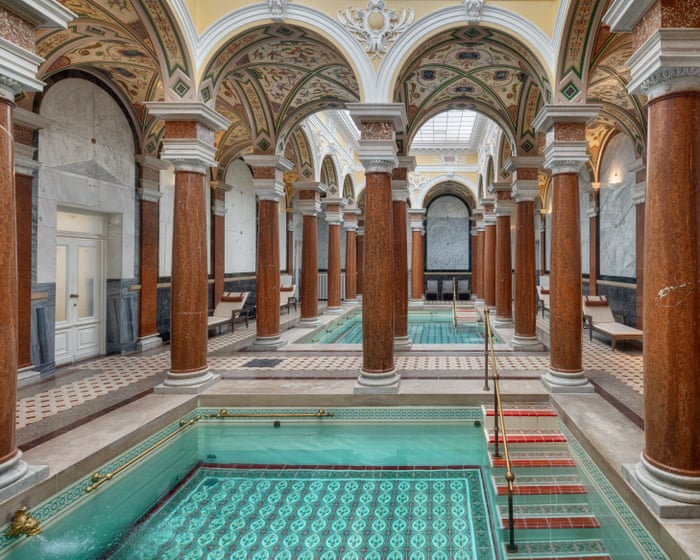
Mariánské Lázně, CzechiaIn 2021, Unesco named 11 historic spa towns across Europe as a single transnational world heritage site, recognizing their “exceptional testimony to the European spa phenomenon, which reached its peak from around 1700 until the 1930s.” This was the original wellness tourism, and these grand health resorts include Bath in England and the town of Spa in Belgium, as well as the west Bohemian spa triangle of Karlovy Vary, Františkovy Lázně and Mariánské Lázně.Of the three, Karlovy Vary is the best known and within a day trip of Prague, but Mariánské Lázně is arguably the prettiest. The town offers three natural healing traditions: mineral springs, carbon dioxide springs known as Maria’s Gas, and therapeutic peloids (mud and clay). Czech citizens are still prescribed weeks-long spa stays to recover from surgery, serious illness or chronic conditions, but anyone can check into the Nové Lázně hotel (doubles from €234 B&B, including spa access), a canary-yellow neo-renaissance building from 1896 that faces the central park.Its spa feels like a step back in time: baths surrounded by marble columns and intricately decorated treatment rooms, including one built for King Edward VII, who visited nine times. Join tourists and locals drinking the waters from special porcelain cups as they stroll along the colonnades, and don’t forget to pair it with a spa wafer – large, thin, crispy treats with sweet fillings such as hazelnut or chocolate. It’s not all virtuous.
Bad Kissingen, GermanyView image in fullscreenBad Kissingen in Bavaria is renowned for its architecture. Photograph: Moskwa/AlamyGermany is home to about 350 designated spa towns, including three of the Unesco Great Spa Towns of Europe: celebrity favorite Baden-Baden, quiet riverside Bad Ems and elegant Bad Kissingen in Bavaria. The latter’s striking architecture is arguably the most interesting of the three, with much of the central spa district rebuilt by star German architect Max Littmann in the early 20th century. This includes the grand fountain hall, with its stained-glass roof, where Brunnenfrauen (fountain women) dispense different mineral waters from bronze pipes, and the huge basilica-style Wandelhalle, where the town’s spa philharmonic orchestra performs several times a day.Music has always been part of the spa experience – the Staatsbad Philharmonie Kissingen holds the world record for the most concerts performed in one year (727!) – and the beautiful art nouveau-style Regentenbau houses one of the best concert halls in Europe.The modern KissSalis Therme (from €19 for two hours) on the southern edge of town is the main public bathhouse today, with indoor and outdoor thermal pools, mud treatments and various – clothing-free – saunas.At the more classical end of the spa spectrum, the Grand Hotel Kaiserhof Victoria (doubles from €209 B&B, including spa access) sits next door to the Wandelhalle on the town’s Kurgarten. The water used in the spa here is pumped up directly from the brine spring, while the inhalation room has a wooden graduation tower covered in knobbly salt deposits, which mimics the healing effects of mineral-rich sea air.
Bad Wildbad, GermanyView image in fullscreenA pool at Palais Thermal in Bad Wildbad. Photograph: Cavan Images/AlamyDeep in the north of the Black Forest, this spa town offers ways to immerse yourself in nature beyond soaking in thermal spring waters. Rising above the town, Sommerberg (meaning “summer mountain”) will get your pulse racing. A funicular railway whisks visitors to the top, the starting point for hiking and biking routes. For more heart-pumping views, the accessible Treetop Walk (€12.50) spirals above the dense pine trees to an observation tower 40 meters up, with a tunnel slide back down the middle for extra thrills, while the Wildline suspension bridge (€9.50) – with its 380-meter walkway – arches over the Enz valley for maximum views.Back in town, there are two thermal baths to dip into: the modern VitAt Therme, people with joint and back problems are prescribed movement therapy and spa treatments (€14 for three hours). At the historic Palais Thermal, pools are surrounded by marble pillars, statues of Venus, and Moorish tiles (€21 for three hours). Mokni’s Palais Hotel is connected to the Palais Thermal building, so guests can walk over in their bathrobes (doubles from €183 B&B, including spa access).
Bagnoles-de-l’Orne, France
Local legend says that after many battles, the medieval lord Seigneur Hugues de Tessé released his faithful warhorse Rapide into Normandy’s Andaines forest to live out its days in peace. To the nobleman’s surprise, the horse later returned stronger and full of life, then led him to the warm, sulphurous waters of Bagnoles’ spring. Centuries later, a spa resort grew up there so the Parisian bourgeoisie could also benefit from this fountain of youth, with belle époque villas arranged along the shore of a lake in the middle of the forest. Today, it is also conveniently less than an hour and a half from the ferry at Caen for British wellness seekers.
That belle époque quarter was the vision of local politician Albert Christophle, whose former hunting lodge on the edge of the village is now the very lovely five-bedroom Château du Gué aux Biches (doubles from €195 B&B). This summer, its Danish owners, Klaus Bentin and Soren Rasmussen, added a new restaurant in the old kitchen, serving smørrebrød (open sandwiches). The hotel partners with the nearby spa at B’O Resort, so Klaus or Soren will arrange your treatments, and there are bicycles to borrow so you can pedal a couple of kilometres over for a clay body wrap or hydromassage. The surrounding forest is crisscrossed with hiking, biking, and trail running routes. In autumn, take a more meditative approach by foraging for mushrooms among the more than 1,700 varieties growing on the Andaines forest floor.
Bad Gastein, Austria
This genteel town in the Hohe Tauern Alps was built on water; a roaring waterfall cascades right through the middle of it. The healing reputation of its radon-rich waters, which bubble up from the town’s thermal springs, led to grand hotels being built in the 19th century for the emperors and aristocrats, writers and thinkers (including Sigmund Freud) who came to be cured of their ailments. The fashion for “taking the waters” faded, but in recent years there has been something of a revival, with a cluster of new hotels opening. The Cōmodo (doubles from €188 B&B) is one of them, a sleek spot refashioned from a 1960s sanatorium. Bedrooms look out over the valley and mountains, as does the thermal water-filled indoor pool. There are several public fountains where you can still drink water straight from the source (warm, slightly salty, and metallic tasting), but perhaps more enjoyable is soaking at the brutalist Felsentherme public bath complex with its many pools (€40 for a day pass). Just as warming—but with fewer health benefits—is a bowl of Kaspressknödelsuppe (beef broth with cheese-infused dumplings) at the cosy cabin of Schafflinger Alm (soups from €4.50, mains from €17) after a brisk hike through the forest or a day on the Schlossalm-Angertal-Stubnerkogel ski area, where the season starts in late November.
Piešťany’s Spa Island, Slovakia
Just before crossing the Colonnade Bridge to reach Piešťany’s Spa Island, there is a statue of a man breaking his crutch, symbolising the healing powers of the town’s thermal waters and sulphurous mud, harnessed on this wellness enclave in the Váh River. The first simple wooden bathhouses were built on the island in 1778, but the opening of the Thermia Palace hotel and its Irma BalneotherapIn 1912, a house was turned into a health resort. Further hotels and spas are scattered among the trees, becoming more concrete and functional as you move away from the bridge. The Thermia Palace remains the fanciest option, offering a range of treatment programs in its spa, from extensive diagnostics and lab tests to mud packs and pools (doubles from €210 half-board, including spa access). The blue-black mud is applied all over the body at a warm 45C and left for about 10 minutes before being hosed off without ceremony. Outside, the spa park also feels restorative, with lily ponds, fountains, and free-roaming peacocks. In town, Elektrárňa Piešťany is a former power plant turned cultural centre that feels surprisingly vibrant, hosting film festivals and rock concerts, while the strikingly brutalist House of Arts features chamber orchestras and tango trios.
Rogaška Slatina, Slovenia
This town in eastern Slovenia is famous for Donat Mg, one of the world’s most magnesium-rich mineral waters, traditionally drunk for its digestive benefits. The company now sells millions of bottles each year, but here at the source you can sip it for free from the fountains in the Pivnica Drinking Hall – though its salty, fizzy, metallic flavour is an acquired taste. Like other towns of its kind, Rogaška attracted Europe’s elite in the 19th century, and its mix of architecture is a testament to that. A short stroll from the drinking hall, through immaculately trimmed gardens, the butter-yellow Grand Hotel Rogaška is straight out of the town’s golden age (doubles from €198 half-board include spa access). Bedrooms are traditional, but the spa has all the bells and whistles, from carbon dioxide baths and mineral water inhalations to reflexology and magnetotherapy. Fittingly for a town famous for its drinking water, Rogaška is also known for its glassware – visitors can tour the Rogaška crystal factory (€12) to see glass-blowing in action before buying glasses for their Donat Mg from the on-site shop. The surrounding wooded hills are perfect for autumn walks.
Salsomaggiore Terme, Italy
In Emilia-Romagna’s so-called “food valley”, not far from Parma, this small spa town will help balance out some of that indulgence. Last year, the Italian thermal brand QC Spa of Wonders reopened the beautiful art deco-style Terme Berzieri, where the gilded interiors – all frescoes, mosaics, majolica, and stucco – are as much of a draw as the salty spring waters, rich in iodine and bromide (five-hour spa sessions from €62). There are the usual thermal attractions, as well as a sauna cinema and infinity rooftop pool, while treatments in wooden barrels nod to the area’s winemaking. Try some of those wines at the Cantina Il Poggio vineyard in the hills outside Salsomaggiore, which produces a range of styles including the local sparkling Malvasia di Candia Aromatica (tastings from €30). Continue the tastings with a visit to a parmigiano reggiano producer, such as Caseificio Ugolotti (tour and tasting €23), before picking up some ham from Parma’s famous La Prosciutteria. Stop for a roast pork sandwich at the legendary panini place Pepèn, before feasting your eyes on the Pilotta Palace complex with the Galleria Nazionale, Palatine Library, and Farnese theatre, while the opulent Teatro Regio hosts the annual Verdi festival in October. The organic agriturismo Case Zucchi, about a 10-minute drive from Salsomaggiore, makes a suitably foodie base, with bedrooms named after herbs and the breakfast table piled with fresh bread, eggs, ham, cheese, and fruit each morning (doubles from £104 B&B).
Caldas de Monchique, Portugal
High in the Serra de MonchiqueNestled among mountains and surrounded by cork oak and eucalyptus forests, the whitewashed hill town of Monchique offers a slower-paced autumn escape than the nearby Algarve coast. Its cobbled streets are lined with craft shops, ceramic workshops, and simple taverns serving chouriço (smoked sausage) with a small glass of medronho (fruit brandy). In a wooded valley below the town, the spa village of Caldas de Monchique is little more than a handful of 19th-century buildings around a shaded square and park, where you can drink slightly warm spring water from the public fountain. Wallow in the alkaline waters a little longer at Caldas de Monchique Villa Termal Spa Resort (doubles from €84, thermal water circuit £17 for 90 minutes). The spa offers hydro rituals including a Vichy shower, massage and bath, or thermal water circuits around the pools, sauna and Turkish baths, before a dip in the outdoor pool. Afterwards, the 1692 restaurant, with its stained-glass windows, dishes up bacalhau à Monchique (salt cod stuffed with chouriço and ham). It’s not far from here to Fóia, the highest mountain in the Algarve at 902 metres. It’s worth the walk to the summit for the views, or hike on a further 2½ miles (4km) to the Barbelote waterfall, which cascades over a rocky cliff face in the wetter months. Chaves, Portugal View image in fullscreen Eco cabins at Pedras Salgadas Spa and Nature Park There’s a little run of spa towns in the north of Portugal near the Spanish border, a curative route through Pedras Salgadas, Carvalhelhos, Vidago, Carlão and Chaves. In Chaves, the waters are some of the hottest in Europe, coming out of the ground at a scorching 76C. The Romans built a large therapeutic bathing complex here, that was only rediscovered by accident in 2006 when work began on an underground car park. Now, the free Museu Termas Romanas de Chaves allows visitors to explore the pools and soaking baths, perfectly preserved thanks to an earthquake in the 4th century that sealed them for millennia. To take the waters today, head to the Aquae Salutem Thermal Complex (€30 for 90 minutes), a circuit of outdoor pools, saunas, steam and showers that opened in 2025. About half an hour down the road, the Pedras Salgadas Spa and Nature Park sits on the fringes of one of the other small spa towns. The owners have built 18 eco-houses and treehouses on stilts (doubles from £171 B&B, spa access additional £17 per room) among the pine trees at the source. Guests can do a spot of forest bathing before dipping into the spa – redesigned by one of Portugal’s most famous architects, Álvaro Siza – for a thermal water hydro-massage, or wander between the pink spring pavilions in the park. Pedras Salgadas is also a popular, naturally sparkling mineral water brand.
Frequently Asked Questions
Here is a list of FAQs about the best spa towns in Europe for an autumn break
1 What exactly is a spa town
A spa town is a destination that grew up around natural mineral springs People visit these towns to bathe in drink or receive treatments using the local thermal water which is believed to have healing properties
2 Why is autumn a good time to visit a spa town
Autumn is ideal because the summer crowds are gone prices often drop and the cooler weather makes soaking in hot thermal baths feel much more relaxing It is also a great way to boost your mood before winter starts
3 Which European spa towns are considered the best for a restorative break
Some of the top spots include Bath BadenBaden Karlovy Vary Budapest and Vichy Each offers a unique mix of history luxury and natural healing waters
4 What is the difference between a thermal bath and a spa
A thermal bath uses naturally heated water from underground springs A spa is a broader term for a facility that offers wellness treatments like massages saunas and beauty therapies which may or may not use natural thermal water
5 Are the healing waters in these towns actually good for you
Yes many people find relief from muscle pain joint stiffness and skin conditions like eczema The warm water helps relax muscles and improve circulation while minerals like sulfur and calcium can soothe the skin
6 Do I need to book treatments in advance
Yes especially for popular treatments like massages or mud wraps Autumn is less busy than summer but the best spas still fill up quickly on weekends Book at least a week ahead if you can
7 What should I pack for a spa town trip in autumn
Pack a swimsuit a light robe flipflops for wet areas and a waterproof bag for wet clothes Also bring warm layers for walking around town as autumn weather can be chilly and changeable
8 Is it safe to drink the mineral water directly from the springs
In many spa towns yesthere are designated drinking fountains However the water can have a strong taste and a laxative effect if you drink too much Start with a small amount and follow local advice