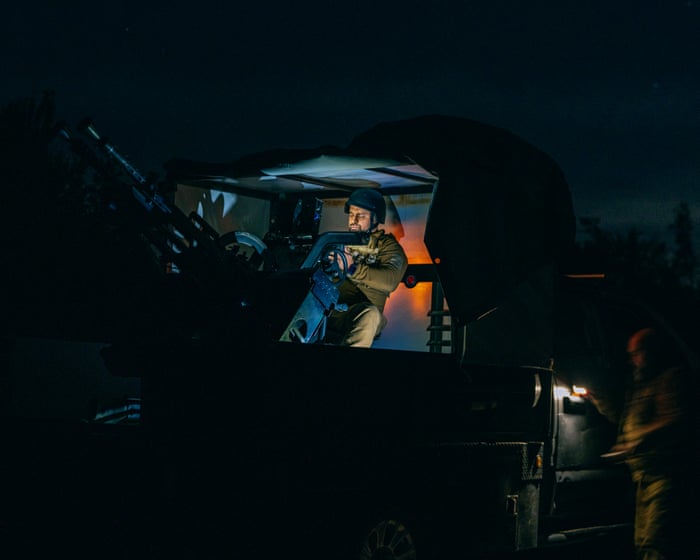
Several hours into Kyiv’s nightly curfew, much of the capital lay dark and quiet. High above, on the roof of a grey tower block on the city’s outskirts, a small group of men in uniform stood beside two heavy machine guns, scanning the horizon. Soon, a drone appeared. Once, its unmistakable buzz would have sent the men scrambling towards their weapons. Now, the air defence unit checks speed and altitude on a monitor before making a decision.
View image in fullscreen
The Mriya air defence crew on a rooftop in Kyiv.
View image in fullscreen
A Russian drone shot down over Kyiv.
View image in fullscreen
The Mriya air defence crew keep watch.
This one flew too high and too fast. It was one of Russia’s new jet-powered attack drones, a weapon that has transformed the battle for the skies over Kyiv in just a few months.
“They’re so fast, it’s extremely difficult to hit them. Our weapons simply can’t reach them. Often, we can hear them but can’t see them. It drives us crazy,” said the group’s commander, who goes by the call sign Sensei, looking over the city’s skyline.
Over three days and nights, the Guardian accompanied Mriya, Kyiv’s largest volunteer air-defence formation, across its network of outposts around the capital, from high-rise rooftops to truck-mounted machine gun positions in deserted fields on the city’s outskirts.
Since the start of Russia’s full-scale invasion, Ukraine has relied on unpaid volunteers, often armed with Soviet-era weapons, as one layer of the air-defence network protecting its cities, homes and families.
For years, they proved remarkably effective, emerging as a key part of the response to the Iranian-designed Shahed drones, which Russia calls Geran-2 and began launching en masse in late 2022.
View image in fullscreen
A ZPU-2 vehicle mounted with an American-made Browning M2, used for air defence, near Kyiv.
View image in fullscreen
A Browning M2’s sight on a ZPU-2 vehicle.
“We live a double life. During the day, I deal with paperwork. At night, I shoot down drones,” said Oleksandr, a lawyer, standing beside his truck-mounted machine gun in a field outside Kyiv. “It’s a strange duality. With time you get used to it.”
But warfare in Ukraine evolves at extraordinary speed and units such as Mriya are struggling to keep up.
Since the summer, Russia has increasingly deployed jet-powered drones that crews say can travel at about 600km/h (373mph), much faster than the original propeller-driven Shaheds, and reach altitudes of up to 10km (6 miles), far beyond the range of the volunteers’ guns.
Ukraine’s interception rate for the new drones is between 50% and 60%.
Graphic detailing the payload and range of Russian drones and missiles
“In 2023 and 2024, we were shooting them down in batches,” Artem, a 63-year-old military veteran, said proudly. On a good night, he added, a single crew could bring down three or four Shaheds.
‘The enemy is tearing our city apart’: terror in Kyiv as Russia ramps up attacks
Read more
Now, his unit had managed to shoot down just one jet drone after it slowed enough to come within range of their guns. “There’s this feeling of helplessness,” he added.
The problem, Artem explained, was that the guns’ sights were designed for slower targets. Jet drones fly so fast that gunners must aim beyond the sight to hit them. “The Shahed no longer fits inside our aiming grid,” he said.
Ukraine’s air defences operate as a layered system, with different weapons matched to different threats. Volunteer machine gun teams work alongside interceptor drones to hunt slower, low-flying Shaheds. More sophisticated weapons, including the country’s scarce US-made Patriot batteries, are needed against cruise and ballistic missiles.
View image in fullscreen
Sensei rests between patrols near Kyiv. Ukraine relies on unpaid volunteers as one layer of the air-defence network protecting its cities.
View image in fullscreen
Ruslan havinTaking a break during a shift with the Mriya air defence crew.
View image in fullscreen
Sensei during a rest break.
For now, the main answer to jet drones has been fighter aircraft, including F-16s, which are expensive to fly and put their pilots at risk.Russia’s introduction of new drones came at an especially difficult moment for Ukraine. With its ground offensive making slow progress, Russia has sharply intensified its air campaign, striking Kyiv almost daily in an effort to make the capital unlivable as winter approaches.In the last week, jet-powered drones have repeatedly struck bridges across the Dnipro in Kyiv, prompting restrictions on several of the city’s main crossings. Russia launched another large-scale bombardment across Ukraine on Wednesday, firing dozens of missiles alongside drones and causing fresh disruption to electricity and water supplies in the capital.The attacks have upended daily life in a city that, for much of the war, was considered relatively safe compared with those nearer the front. Anti-drone netting, long a familiar sight in frontline towns, has begun to appear around Kyiv, and during the heaviest attacks some people have taken to sleeping in metro stations.Moscow has also begun sending waves of jet drones throughout the day, a break with years of assaults taking place mostly overnight.”Every hour, two or three come in,” said Oleksandr, the lawyer, who joined Mriya early last year. His mobile group once deployed from base as drones approached the city, but now spends hours at a time waiting in fields.”They’re fast and they keep our groups constantly moving. Some days, it feels like Russia has an endless supply of them,” he shrugged.View image in fullscreen
Oleksandr prepares some tea during the night shift near Kyiv.
Mriya’s volunteers are something of a mirror of Kyiv. The crews that the Guardian accompanied included in their ranks an advertising creative director, a man who repairs intercoms, a hand-to-hand combat coach and the former head of a design institute.The military supplies the units with heavy machine guns, including American-made Browning M2s and Soviet-era DShKs, both designed before the second world war. But the volunteers pay for their own vehicles, fuel and other equipment.What united them, they said, was that the stakes felt close to home. “If we let a drone through, that means it flies to the city and can kill our families,” said Ivan, a university professor in Kyiv.Ivan joined the unit after a Shahed struck the courtyard of his home about a year and a half ago. “It badly frightened my family and destroyed my property,” he said. “So I had a personal score to settle as well. I have two children. The more of this filth that is destroyed on the approach to Kyiv, the lower the chance that my children will be hurt.”When a shift runs into the morning, he teaches his class online from the position, on his phone. Others described volunteering as a way of reclaiming a measure of agency over a war that has left millions of Ukrainians feeling powerless.View image in fullscreen
The volunteer soldiers training at a shooting range.
View image in fullscreen
The volunteers pay for their own vehicles, fuel and other equipment.
“In the city you can’t do anything. People sit in basements, bomb shelters or apartments and wait: will you be lucky or not, will it hit or not?” Oleksandr said. Out on the position, he said, there was at least a chance of shooting one down.Help, though, may be on its way. Back in the field, Artem pulled out a tablet showing a live map of drones over Ukraine.Among the moving icons were ones the volunteers have begun to see more often: Ukraine’s new generation of high-speed interceptor drones, designed to hunt down their Russian counterparts.He pointed to two Ukrainian interceptors travelling at more than 600km/h. Moments later, each brought down a Russian drone and disappeared from the screen.Across the country, the Ukrainian government and private defence companies hUkraine has been thrust into a race to build jet-powered interceptors capable of matching Russia’s newest drones. “We have to admit that these jet-powered Shaheds caught us off guard,” said Stanislav Hryshyn, co-founder of General Cherry, one of Ukraine’s largest drone manufacturers, which is developing the new interceptors. The long-range drone war: Ukraine and Russia compete for dominance in the skies. Read more. The biggest obstacle, he said, was a shortage of the small jet engines that power them, which Russia buys in bulk from China. Hryshyn said neither Ukraine nor Europe had built the industrial capacity to produce them in the needed quantities. Hryshyn estimated it would take three to four months before Ukraine could produce enough interceptors to match Russia’s jet drones. Even if Ukraine deploys thousands of new interceptors in the coming months, any advantage may be short-lived. Russia has repeatedly adapted its drones, changing their speed, altitude, and flight paths in response to Ukrainian defenses, and Hryshyn said each new countermeasure sparked another innovation. “It’s a constant race over who gets there first,” Hryshyn said. “A life-or-death race.”
Frequently Asked Questions
Here is a list of FAQs about the volunteers defending Kyivs skies from jetpowered drones
Beginner Questions
What does lifeordeath race mean in this context
It refers to the urgent highstakes effort to shoot down new jetpowered drones before they can hit their targets in Kyiv The volunteers have to adapt faster than the drones can be improved
Who are these volunteers
They are mostly ordinary Ukrainiansdrivers IT workers mechanics studentswho joined territorial defense or volunteer airdefense units Many had no military experience before the war
What are jetpowered drones
Unlike slower propeller drones these drones use small jet engines They fly much faster often over 500 kmh and are harder to hear and shoot down
Why are they defending Kyivs skies
Kyiv is the capital and a major target If drones get through they can kill civilians destroy power plants and break morale The volunteers help stop that
What weapons do they use
Mostly machine guns antiaircraft guns and sometimes shoulderfired missiles Some units also use nightvision gear and searchlights to spot drones in the dark
Intermediate Questions
What makes jetpowered drones harder to stop than regular drones
They are faster fly higher and give less warning A propeller drone might be heard from far away a jet drone can appear suddenly That leaves volunteers only seconds to react
What are the main benefits of using volunteers for this
Volunteers add numbers and local knowledge They can be posted across the city react quickly and free up professional military units for other fronts
What are common problems volunteers face
Lack of training old equipment poor communication and exhaustion Many also struggle with the psychological stress of constant night attacks
Can you give an example of a successful volunteer defense
In several attacks volunteer machinegun crews on rooftops spotted and shot down jet drones before they reached central Kyiv In one case a team using a searchlight and a heavy machine gun downed a drone over the Dnipro River
How do volunteers know where the drones are
They get warnings from military radar and airraid alerts Some units also use their own spotlights thermal cameras and sounddetection apps