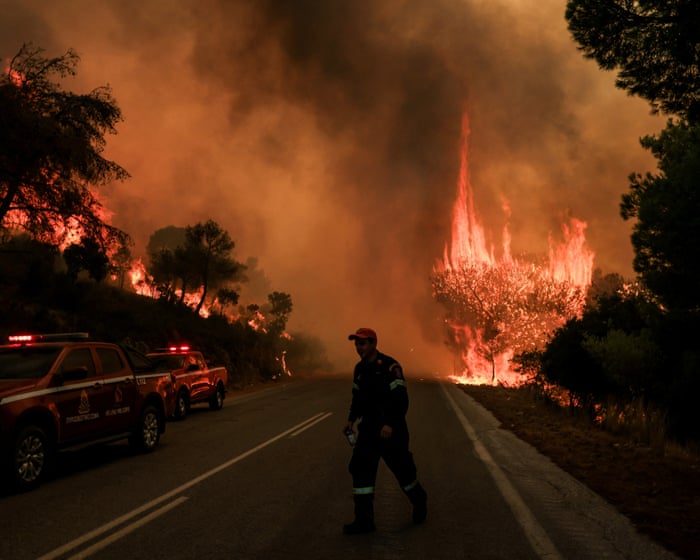
Europe’s wildfire crisis unfolded along sharply different fronts on Sunday: gale-force winds pushed flames deeper into the Athens region and triggered new evacuations, France kept watch over a still-burning scar four times the size of Paris to prevent it from spreading again, and Spain’s major fires finally stopped advancing.
The immediate danger was centered on Greece. Strong winds drove flames deeper into western Attica, the region that includes the capital, threatening villages and an industrial area outside the city of Megara. The violent gusts also stopped firefighting aircraft from collecting water from the sea.
But the easing emergency further west offered little sense of an ending. France’s largest wildfire remained contained after 224,000 people were forced to flee, possibly the largest peacetime evacuation in French history. Yet active pockets of fire still burned across 420 square kilometers (162 square miles) of destroyed forest.
Thousands of people were still unable to return home, and nearly 3,000 firefighters were deployed against the Gironde megafire and a second blaze in Provence that had stopped advancing but was not yet under control.
Fires in France and Spain alone have driven roughly a third of a million people from their homes and holiday spots, emptied communities at the height of summer, and stretched firefighters, aircraft, and emergency services across simultaneous disasters.
The crisis is unfolding on the world’s fastest-warming continent. Europe has heated at more than twice the global average since the 1980s, according to the EU’s Copernicus Climate Change Service.
Higher temperatures and prolonged drought leave forests and scrubland drier and more flammable, allowing fires to spread faster and burn more intensely. Human-caused climate breakdown doubled the likelihood of the extreme fire conditions that fueled the French blazes, scientists at World Weather Attribution calculated in a rapid analysis on Thursday while the fires were still burning.
Greek authorities ordered the evacuation of three more communities on Sunday as flames advanced through western Attica, threatening villages along the Geraneia mountains and an industrial area outside Megara.
Nearly 500 firefighters and 23 aircraft were deployed, but gale-force winds strengthened the fire while crippling the response. The winds drove flames through dry forest and made it impossible for some aircraft to descend to the sea for water.
Smoke rose over the mountains as evacuation orders were issued for the communities of Kandili, Agia Skepi, and Toutouli. The prime minister, Kyriakos Mitsotakis, was briefed on the operation, with authorities particularly concerned about Porto Germeno, a seaside community on the Gulf of Corinth.
The fire began on Friday near Agios Vasileios before sweeping toward Porto Germeno and into the forested mountains west of Athens.
Firefighters evacuated 254 people by sea from Agios Vasileios on Friday and another 12 from Porto Germeno on Saturday — an escape route of last resort in coastal communities where fire and smoke can cut off the few roads out.
A wildfire meteorologist, Theodore Giannaros, estimated on Saturday that the blaze had affected 40 to 50 square kilometers (15 to 19 square miles), though authorities had not issued an official figure.
“A pristine forest, a paradise, was surrendered to the hands of the fire,” a local farmer, Minas Tzortzanis, said on Saturday. “There are no words to explain what has happened. Destruction. Total destruction.”
The danger carried grim resonance in Greece. In 2018, a wind-driven wildfire trapped residents in the seaside community of Mati, east of Athens, killing 104 people in Europe’s deadliest wildfire this century.
In south-western France, the Gironde megafire remained conThe fire was still burning on Sunday but had already destroyed 420 square kilometers (162 square miles) of forest in just 10 days.
View image in fullscreen
Le Temple, Gironde: the fire is contained, but the entire region remains on high alert. Photograph: Yves Herman/Reuters
“The fire is now fixed, which does not mean that the fire is extinguished,” the Gironde prefecture said on Sunday, using the French firefighting term for a blaze whose advance has been stopped and whose perimeter has been contained.
Skip past newsletter promotion
Free newsletter | Every day
Sign up to Headlines Europe
A digest of the morning’s main headlines from the Europe edition emailed direct to you every week day
Preview latest
Enter your email
Sign up
After newsletter promotion
Weather tracker: Why Europe’s wildfires are proving so fierce and difficult to stop
Read more
The region remained under France’s highest red forest-fire alert. Dry conditions and soaring temperatures around Bordeaux, combined with afternoon winds, created a continued risk of renewed flames.
Additional firefighters from Ukraine, Lithuania, and French Polynesia were expected on Sunday and Monday to reinforce the operation.
View image in fullscreen
A deer in the forest in Le Temple, Gironde. Photograph: Yves Herman/Reuters
Hundreds of miles away, nearly 1,500 firefighters were battling a separate fire in the south-eastern Var department that tore through roughly 18 square kilometers (7 square miles) in little more than a day.
Authorities said the fire in the Gros Bessillon hills was stabilized on Sunday morning, meaning its perimeter had not expanded overnight. But unlike the Gironde fire, it had not yet been declared contained.
Firefighting aircraft supported crews working to keep the flames away from villages among the vineyards, olive groves, and wooded hills of the region known as Green Provence.
About 2,500 people were evacuated as the fire threatened communities.
View image in fullscreen
Smoke above Montfort-sur-Argens, near Correns, in Var. Photograph: Manon Cruz/Reuters
The blaze was the fourth major fire to strike the central Var since July 19. A separate, smaller fire near Brignoles earlier in the week forced the Hollywood actor George Clooney and his family, along with about 700 other residents, to evacuate before it was brought under control.
The prime minister, Sébastien Lecornu, said France’s wildfires were generally under control but cautioned that conditions remained highly changeable.
He also announced that a national coordinator attached to the prime minister’s office would oversee reconstruction in fire-ravaged areas.
More than 1,170 square kilometers (452 square miles) have burned across France since the beginning of the year.
Frequently Asked Questions
Here is a list of FAQs about the wildfire crisis in Greece written in a natural and accessible tone
General Situational Questions
Q What is happening in Greece right now
A Greece is experiencing a severe wildfire crisis Large fastmoving fires have broken out most dangerously near Athens forcing thousands of people to evacuate their homes and businesses The fires are being fueled by extreme heat strong winds and dry conditions
Q Why is this happening near Athens
A The area around Athens has a mix of dry pine forests and urban development which is a dangerous combination When you add recordbreaking heatwaves and strong dry winds any small spark can quickly turn into a massive uncontrollable fire
Q Is this a normal occurrence for Greece
A Greece has always had wildfires during the hot dry summer months However scientists and experts agree that climate change is making these fires more frequent more intense and lasting longer than in the past This is now considered a crisis because of the scale and the threat to major populated areas
Q How many people have been evacuated
A The numbers change hourly but its in the thousands Entire towns and suburbs northeast of Athens have been ordered to evacuate Local authorities and the police are going doortodoor to make sure people leave dangerous zones
Q Are people getting hurt
A Yes unfortunately While mass casualties have been avoided so far there are reports of injuries mostly from smoke inhalation and minor burns The main focus is on getting people to safety before the fire reaches them
Fire Safety Questions
Q What is causing the fires to spread so fast
A The main culprit is the wind which can reach galeforce speeds This wind fans the flames carries burning embers miles ahead of the main fire front and starts new spot fires The extremely dry vegetation acts as instant fuel
Q What does an evacuation order mean
A It means you must leave the area immediately It is a mandatory instruction from authorities for your safety You should grab your essentials pets and important documents and go to the designated safe area or shelter