We’re sitting at a corner table in a breakfast spot in Chelsea. Joseph Fiennes is across from me on the banquette with his Jack Russell, Noa. “Dog duty,” he says, apologizing. Noa looks at me with brown eyes that also seem sorry. They’ve been in Hyde Park, he explains, and he lost track of time—didn’t have a chance to take her home. Nature is where he feels most at ease, where he feels clean, connected, and observant. His sentences are as elaborate as that. “That’s when I’m happiest—on long, rain-soaked walks. Hot cheeks, freezing hands.” In a perfect world, he’d be hiking or wild swimming in the rugged Tramuntana mountains in Spain. But if he has to be in London, “nothing beats Hyde Park.” Fiennes looks neat in a cashmere cardigan and thick twill chinos. Noa wears a stylish yellow collar. Anyway, she’s well-behaved, he says: “Aren’t you, Noa?” She curls up to prove it. The whole scene feels like a lesson in relaxed, wholesome living. Until he says Noa will attack me if I’m mean.
The Guardian’s journalism is independent. We may earn a commission if you buy something through an affiliate link. Learn more.
Fiennes first became famous as the wide-eyed, long-lashed 28-year-old star of Shakespeare in Love, opposite Gwyneth Paltrow. He’s modest about his career since then, telling one interviewer it left him stuck with “flouncy shirts and horses” for a decade, and telling me he’s “pretty much been a supporting actor for an actress the whole time.” While he’s worked with impressive women—Cate Blanchett, Helen Mirren, Elisabeth Moss, Rachel Weisz, Eva Green—his own standout roles include the chilling Commander Waterford in The Handmaid’s Tale (whom he calls “insidious”). Now 55, he jokes that he mostly plays “dads.” That includes playing Young Sherlock’s dad in the Amazon series—young Sherlock is his real-life nephew, Hero Fiennes Tiffin—and a gripping role as Richard Ratcliffe, husband of Nazanin Zaghari-Ratcliffe, who was held hostage in Iran for six years, in Prisoner 951.
View image in fullscreen: With Yvonne Strahovski and Elisabeth Moss in The Handmaid’s Tale … Photograph: Sophie Giraud/Hulu
View image in fullscreen: … with real-life nephew Hero Fiennes Tiffin (fourth from left) in Young Sherlock … Photograph: Daniel Smith/Prime
View image in fullscreen: … and with Narges Rashidi in Prisoner 951. Photograph: BBC/Dancing Ledge
We’re here to talk about Dear England. Fiennes played England manager Gareth Southgate at the National Theatre in London, and now the team behind the stage production (Fiennes, writer James Graham, director Rupert Goold) has adapted it into a four-part series for the BBC. The story focuses on Southgate’s “quiet revolution”—how missing a penalty in 1996 changed his life’s direction and thinking, and how he used that insight to transform the England squad. It deals with mental health, racism, huge expectations, and, as Fiennes says, “national pain versus performance.” Among other things, Southgate brought in a performance psychologist, journaling, and boot camp commando training to help the team break free from the curse of missed penalties and “two world wars and one World Cup.”
Remembering Euro 96: Gazza’s goal, Three Lions … and penalties | Simon Burnton
Read more
While the play was set against the backdrop of changing “English” identity—Graham constantly updated it to reflect rising nationalism in the UK—Fiennes says it’s been revised again for the screen and “framed much more as a drama.” That said, his portrayal of Southgate hasn’t changed much. Each morning while the play was running, he got up at 4:30am to shut himself in a small room and rehearse his script (he had decorators in, and the sound of drilling or Capital FM would break his focus if he started any later). Then each evening, he’d set aside two hours.Before the curtain went up, he was preparing to become Gareth Southgate—or at least his version of the man. Southgate himself called Fiennes “generous casting.” Fiennes wore a prosthetic nose, yellowed teeth, and a trimmed beard. He studied Southgate’s quiet restraint, copied his gestures, and listened to Southgate’s audiobook Anything Is Possible to pick up on his blurry consonants and hesitant speech patterns. But it wasn’t just imitation. He found “an emotional connection to what this extraordinary coach was dealing with. I don’t know why.” He felt Southgate was “innately there,” one of those rare times when a character “just settled in an effortless way.”
Back then, he hadn’t even met Southgate. Last June, he was presenting at The King’s Trust awards when he felt a tap on his shoulder. “I was about to go on stage, looking at the introduction card in my hand, and I turned around and there was me—but not me. Me, the person I’d been playing for two years. And in the kindest, most unassuming voice, he just said, ‘Hello.’ I said, ‘Gareth, hello!’ and completely fell apart. I was way too gushing. He was very cool and calm. I said, ‘I thought you might be annoyed that I didn’t quite…’ I never ask for photos, but I asked for one of us together.”
Fiennes doesn’t really like being interviewed. Today, he’ll gently steer our conversation into a friendly two-way chat (“And what about you, do you have a process for interviewing?”). But he sits up straight with a calm confidence, doesn’t flinch when a fire alarm goes off, and looks me right in the eye—unlike his brother, Ralph Fiennes, whom I interviewed in 2016. Ralph sat hunched and far away on a sofa, and I had to coax him—“A little bit closer still”—just to hear what he was saying.
To understand any of the Fiennes children, you probably need to know something about their unusual background. Their mother was the painter and novelist Jennifer “Jini” Lash (the author Dodie Smith called her “almost too interesting to be true”). Their father, Mark, was a photographer and illustrator. All the siblings are high achievers: besides actors Ralph and Joseph, there are film directors Martha and Sophie, composer Magnus Fiennes, and Joseph’s twin Jake, who works as a conservationist at the 25,000-acre Holkham Estate in Norfolk. There’s also their adopted brother, archaeologist Michael Emery, and explorer Sir Ranulph is their third cousin. (Joseph Fiennes has made two National Geographic documentaries recreating “Ran’s” greatest journeys—an expedition down the Nile and a 1,500-mile trip from British Columbia to Vancouver.)
The children grew up moving around a lot, trying to escape what Fiennes sees as their “very precarious” financial struggles. “There were seven bodies to clothe, seven mouths to feed, and very little, if any, income.” He remembers going to the post office with his mom to collect the family allowance: “But, God, it was only enough for a pint of milk and butter or something. It was tiny, and when males are hungry at that age…” Still, his parents “understood the value of nature,” and he describes a wild, adventure-filled childhood, partly in the West Country: “Muddy and messy, camps in the woods, never washing your hands. Snotty noses, jumpers with holes. It was pure liberation, freedom—nature. It was damp and cold, splitting logs or filling up the coal, gardening or washing potatoes and feeding the dogs. We were always on the go, and I loved it.”
Aging? It’s all in the knees. In my head, I sometimes feel like I’m still in my 20s—like I can run over there and climb that.
View image in fullscreen
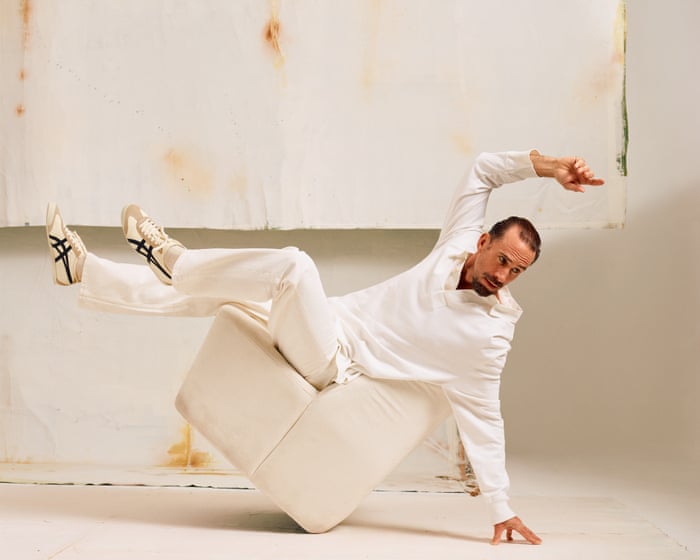
Photograph: Felicity McCabe/The Guardian. Top, trousers and belt: Paul Smith. Socks: Falke. Trainers: Onitsuka Tiger
He says there was no time for sibling rivalry, “just the thrill of being physical.” And anyway, their…Their personalities were “fiercely different.” Jake—he smiles as he says this—was into roadkill. “You’d open the freezer and there’d be a ferret, an owl, a piece of fox, or something he was trying to taxidermy. I found that disgusting.” He describes navigating country lanes on a hand-me-down girl’s bike that was “far too big for me,” roaming free for “seven, nine hours. Out. Gone. No phone. In winter, it was slushy runs down hills on a plastic bag; in summer, playing on Stonehenge slabs.”
The freedom at home was a sharp contrast to school. He went to 14 schools in total, and the boys were disciplined with belts, rulers, and canes—”not for being rude, not for swearing. For being ‘enthusiastic,’ for being ‘energetic,’ for being alive as a young boy in Tisbury in 1982.” In Ireland, where they moved, he experienced “horror beatings” by nuns in Kilkenny, as well as the idyllic village life in Kilcrohane. “The sweet shop owner gave my twin and me a glass jar of lollipops for the journey back to the UK. God, we must’ve been so high on the worst kind of sugar.” Their transport was a VW campervan, “painted a crazy color, either bright blue or yellow. It was how we escorted our mother’s coffin, covered in ribbons,” he adds. Jini died of breast cancer at age 55.
My mother never hid anything. In explosive moments, she would say, ‘Why do we have so many children?’ right in front of us.
I ask how it feels to be that exact age now. “I feel every day like my life is just beginning—this or that opportunity comes in for work, and I keep evolving and pushing. That she was robbed of that haunts me. My mother is deeply etched into my creative psyche. Not a moment goes by without her influence.” His brother Ralph talked about being “in the frontline of her pain” as the firstborn, and of her “emotional fragility.” He was very aware of her frustration, he said, of her wanting to paint, to write, of the conflict between motherhood and the creative drive. “My mother never hid anything,” he said in 2016. “In a way, it makes you quite responsible [as a child]. Their problems were our problems: ‘We have no money, we don’t know what to do, we’ll have to sell this, we’ll have to go there.’ Or in those explosive moments, when it’s all too much, she would say, ‘Why do we have so many children?’ right in front of us.” At the same time, Ralph was funny about how chaos turned him into a neat freak—turning jars so the labels face out, worrying over crumbs, spills, damp tea towels; how an unmade bed or clothes-strewn floor had him repeating “Accept!” Right now, Joseph is brushing white dog hairs from his lap, saying of Noa, “Her hair gets everywhere. I feel really embarrassed.”
In some ways, he renewed his mother’s connection to Spain when he met and married Maria Dolores Diéguez, an actor and model, and moved to Mallorca to raise their two daughters, aged 16 and 14 (and Noa, of course, who is six). His wife’s family is from Galicia, he says, and there’s “a Celtic magic there and some very wild places.” They’ve also walked parts of the Camino de Santiago routes with the children. “Before my mother passed, she spent a year walking through France and Spain, and then to Santiago where she wrote her book On Pilgrimage, so serendipitously, it’s been a way to quietly connect with her as a pilgrim.”
The family moved back to London a couple of years ago, partly because Brexit rules ended freedom of movement. Right now, his home is filled with GCSE artwork, and marbling technique sends him into a spiral about paint dripping on the carpet. Does he feel more English or European? “Depends on the day. The compassion in my house is clearly European.” They gather for every meal, for instance. “We’ve had breakfast, lunch, and supper together every day since the girls were born.””We’re at the table and we talk. No devices.”
His daughters only use social media “when I allow them to. I’m the one in control.” He jokes that people often say the two toughest jobs in the country are Prime Minister and England coach, but he’d add parent to that list. “It’s impossible. We’re up against the absolute nightmare of tech companies and devices, and the way they mess with brain chemistry, hijacking our kids during the most valuable and sensitive part of their lives – their childhood. On the way here, I’m walking the dog, picking up poop, and at the same time trying to manage screen time while getting bombarded with messages: ‘Can you release my phone?’ It’s so hard to say no and insist on no devices in the bedroom after a certain time. But I do that, yes, 100%.”
He calls social media “the great manipulation,” the single biggest factor in the rise of extreme politics, including Trump in the US and Reform in the UK. “And it’s driven by big business, by billionaires.” Here he rants about the assault on kids his children’s age. Cosmetic companies target young girls on platforms like Instagram, “because children as young as 10 are trying to buy beauty products that make them look really young… It’s crazy. As a parent, you’re not just up against someone else influencing your child. You’re up against Zuckerberg’s team of scientists. So how the hell are you going to win? You’re not. And it’s a daily struggle, a daily event, and it’s exhausting, and we need help.”
The lack of proper regulation on vapes also blows his mind. Earlier this week, he was with his friend, hypnotherapist Max Kirsten, whose treatment rooms are filled with huge plastic containers of vapes that patients have given up during treatment. You can see how the marketing has evolved, he says, starting with the sleek black early vapes like Juuls, which looked like computer parts. Gradually, they shifted to “crayon” colors, pineapple ice or blueberry flavors, and so on. “You can see what these companies are saying: ‘Let’s target the kids, get them hooked as early as possible.’ And I’m furious about it. I hate it. This is where a government [should step in].”
He gives examples of issues that cause a huge uproar in Britain, like taking the knee in sports (which he supports). If they’re going to make a fuss, why not about this? “Let’s block fucking social media. Let’s stop companies from targeting kids. Young, fragile minds. Don’t flip-flop around. Where is the government? Why aren’t they bringing in strong laws against these companies? Stand up, Keir, this is your kids’ generation.”
He pauses and looks at his hands, neatly clasped on the table. “Sorry. It just drives me crazy. I might be quiet about some things, but I’ll be very loud about others.”
Since he’s not a smoker, I ask what he was getting hypnotherapy for. He hmms, his eyes drifting to the window for a moment, then says he wanted to support his friend but wasn’t sure what to be treated for. “I said, ‘You know what, Max? I eat way too fast, and I think it comes from growing up around a table with so many kids, and the idea that if I don’t get in there, it’ll all be gone.’ And it usually was,” he adds, “because there were bigger hands. If you wanted seconds, you had to be quick. So I said, ‘Max, NLP me, reprogram my awful habit of just inhaling food way too fast.'” He’s very lean – did it work? “Let’s just say, I still eat…”Really fast. But in Max’s defense, I only did one session.”
[Image: Gwyneth Paltrow in Shakespeare in Love, 1998. Photo: Universal/Sportsphoto/Allstar]
Like Ralph, Joseph Fiennes went to art school before deciding to act, and he accepted a spot at the Guildhall School of Drama in London. From there, he trained at the Young Vic and did two seasons with the Royal Shakespeare Company. Interestingly, he had auditioned for a small role when Shakespeare in Love was first cast with Julia Roberts and Daniel Day-Lewis as the leads. That production fell apart. Director John Madden came on board, along with playwright Tom Stoppard, who worked his magic on the script. Meanwhile, Fiennes had done two films and a West End production, and was working at The Pit theatre in London’s Barbican when he was approached again to audition—this time for the lead. Was it stressful? “Are you kidding me? It was hugely nerve-racking. Suddenly I’m in New York. I mean, nothing to lose, no expectations, just giving it my all in a chemistry reading with Gwyneth. That in itself was a win. And then getting the news, I was on cloud nine. I thought, ‘OK, research.’ My process! I’ll start with the books.” He was in John Sandoe’s bookshop, a stone’s throw from where we are now, “trying to buy all these books I couldn’t afford, on Shakespeare and his identity, whether he was the Earl of Oxford or Francis Bacon or whatever. I wanted to deliver.” He laughs. “And literally, across the pile of books I was looking at, I saw Tom Stoppard. I did a double-take. I was like, my God, wow. Do I dare pluck up the courage? I was only 20-odd. So I went over and said, ‘Um, hello Mr Stoppard. I’ve just been offered a part in a film you’re writing or have written, um, Shakespeare in Love?’ And he said, ‘Yes! Well. Joe. Why don’t you come to tea? What are you doing right now?'” “Er, nothing. Oh my God.” “Why don’t you come over? We can have a think and talk in my library.” “So I went along to his place, which I thought would be Victorian with a wood-panelled library, leather-bound books—something out of a film set. And it was the opposite. Sort of 80s modern in Chelsea Wharf.” Fiennes remembers Stoppard chain-smoking, never finishing a cigarette before putting it out. “He had such a wonderful, charismatic, relaxing presence,” he says of the writer, who died last November. “And a fierce intellect, a knowing playfulness. He left me with this tiny bit of knowledge: ‘Joe, forget these books. There’ll be one brilliant academic who cancels out another brilliant academic and it’ll go on until you’re down a rabbit hole. Put it aside. The best way to the truth? Fantasy.'”
After Shakespeare in Love, Fiennes appeared to have the world at his feet. He was a brilliant young actor, intelligent, smouldering, who could handle comic bite. Harvey Weinstein, now serving a 23-year sentence for sex crimes (which Fiennes was unaware of at the time), but whose company Miramax made the film, offered him a five-picture deal (similar to the one Matt Damon signed after Good Will Hunting, which took him on to The Talented Mr Ripley and Dogma). So what happened? For years, Fiennes dodged the question with vague answers about stage being his first love. Yes, he made good films such as Enemy at the Gates, The Merchant of Venice, and Hercules, but no one understood why he mostly placed his talent in independent movies like Leo, Luther, and The Escapist, as well as theatre.
In 2023, Fiennes finally described at least some of what happened when he was summoned to meet Weinstein in his hotel room, contract and pen, we assume, on the table in front of him. Weinstein, he said, told him he was in charge of his career now, that he had to sign the deal or he would not work in Hollywood again. “The way he explained it was a shock,” Fiennes said. He looked at Weinstein, aware thatNes says calmly, “Imagine being hit with this kind of hate while you’re trying your best. You’re only 18 years old, facing huge expectations and racism. Of course you want your politicians to support you.
“It’s all well and good for Theresa May to come out and say how lovely it is that Gareth is doing so well with the boys when everything’s going fine. But let’s look beyond the good times. Let’s talk about how it really works—the psychological pressures on elite athletes representing their country. If you’re a second-generation player from another part of the world and you’re questioned about your race and abused because of it, how do you then feel passionate about identifying with the flag? You need support from everyone—not just fans, other players, and coaches, but also from the government. So yes, that’s my answer.”
Dear England is coming later this month to BBC iPlayer and BBC One.
Frequently Asked Questions
Here is a list of FAQs based on Joseph Fiennes comments about parenting politics and banning kids from social media framed around his quote Stand up Keir this is your childrens generation
BeginnerLevel Questions
1 What did Joseph Fiennes say about banning kids from social media
Answer He strongly supports banning children under 16 from social media calling it a public health emergency and urging the government to act now
2 Who is Keir in his quote Stand up Keir this is your childrens generation
Answer Hes referring to UK Prime Minister Keir Starmer telling him to take responsibility for protecting the next generation from social media harms
3 Why does Fiennes think social media is bad for kids
Answer He says it harms their mental health sleep selfesteem and reallife social skills and that it exposes them to bullying grooming and addictive algorithms
4 What does this is your childrens generation mean
Answer It means that the decisions politicians make today will directly affect their own kids and all young people growing up right nowso they should act urgently
5 Is Joseph Fiennes a parent
Answer Yes he has children and often speaks from personal experience about the challenges of raising kids in the digital age
Intermediate Questions
6 Did Fiennes suggest an outright ban or just limits
Answer He called for an outright ban on social media for children under 16 similar to proposals in the UK and Australia not just time limits or parental controls
7 What examples did he give of social media harming kids
Answer He mentioned anxiety depression body image issues cyberbullying and kids being exposed to harmful content like selfharm or extremist material
8 How does he connect parenting to politics
Answer He argues that parents cannot fight big tech alonegovernments must step in with laws because social media companies prioritize profit over childrens safety
9 What does Fiennes say about screen time vs real time
Answer He encourages parents to replace screen time with outdoor play family conversations and hobbies saying realworld connections are vital for development