French lawyers and rights groups report that multiple teenagers have suffered severe, war-like injuries from police weapons during school protests, and an unprecedented number of children have been taken into police custody, with some alleging they were struck or racially insulted.
France is now in the fourth week of its largest youth protest movement in decades. Hundreds of high schools across the country have been blockaded as students demand replacements for absent teachers and repairs to crumbling buildings.
Interior Minister Laurent Nuñez told the Senate that police have opened internal investigations into 36 allegations of officer violence against demonstrators. These include four children allegedly “mutilated” by explosive weapons, six who suffered “significant injuries,” and other complaints involving physical blows, insults, or alleged sexual assault.
Evan, a 15-year-old carpentry student at a vocational high school, lost a hand when a police stun grenade exploded outside a school protest in Lens, northern France, on 5 October. His lawyer, Bertrand Wattez, said: “His injuries resemble war injuries.”
Wattez said Evan had gone to school for class and found a protest underway. He said Evan was not involved in violence and denied the Béthune state prosecutor’s claim that the grenade had been picked up from the ground. When it exploded, Evan lost his left hand and several fingers on his right hand, and suffered injuries to other parts of his body. Wattez said Evan remained in hospital “in a very difficult condition,” and his family had filed a criminal complaint.
Another boy, Eden, 14, who had been near a school protest in Saint-Ouen-l’Aumône, northwest of Paris, suffered extensive facial injuries, including two jaw fractures, the loss of his bottom teeth, and all his top teeth broken after he was allegedly hit by a shot from a grenade launcher.
His lawyer, Elsa Marcel, said the grenade launcher was fired at close range, from 1.5 metres away. “This is the equivalent of war weaponry,” she said. The family has filed a legal complaint for attempted murder.
Eden’s parents said he had gone to school but found it blockaded and wanted to go home. Video footage appeared to show him facing three riot police officers. One officer swung a truncheon toward him, and Eden kicked in the direction of the police before a grenade was fired. An officer has been suspended and placed under official investigation.
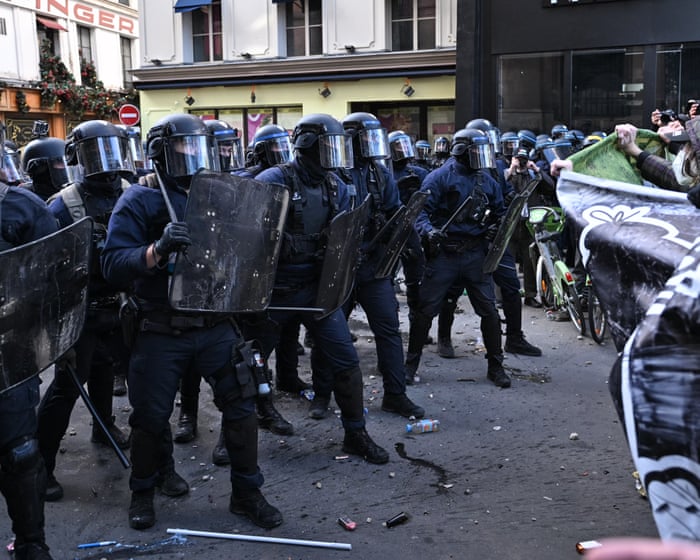
View image in fullscreenProtesters take part in a demonstration in Paris. Photograph: Firas Abdullah/EPA
This week, a police officer in the western city of Tours was charged with aggravated battery after Maël, a 16-year-old at a vocational high school, allegedly lost the use of his eye from a shot fired by a type of rubber-bullet launcher. The officer denies the charges. The family’s lawyer said Maël had not been involved in any violent confrontation with police but had simply been present at a school protest, and that the family felt a sense of “injustice.”
For several years, France has faced scrutiny over police use of explosive weapons, particularly after serious injuries were reported during the 2018-2019 gilets jaunes (yellow vests) street demonstrations, including allegations that people had lost eyes and had their hands and feet mutilated.
The current wave of protests has also led lawyers to raise concerns that an unprecedented number of children have been arrested and placed in police custody, with some lawyers reporting that teenagers said they were hit, humiliated, or verbally abused during arrests.
Since the school protests began in mid-September, a total of 6,773 under-18s have been taken into police custody after arrest, the justice ministry said. For more than 1,000 of those children, no charges were brought; 2,190 are facing legal action, and almost 2,000 were given an alternative to further legal action, such as a citizenship course, without their case being heard at trial.Lawyers said the accusations against children included gathering with intent to commit violence, violence against police, and property damage. Nathalie Tehio, a lawyer and president of the French Human Rights League, said that only a minority of children’s cases would go before a judge, raising concerns that arrests could be unfounded. She said: “There are a record number of arrests … Often, the legal files are empty. In reality, this is more about stopping people from demonstrating. I think there is a sense of hitting hard to try to dissuade people and scare them.” Tehio said: “We have received reports of racist comments. Lawyers have told us that their clients say they have been humiliated or treated violently or pushed.” Romain Boulet, co-president of France’s Association of Criminal Lawyers, said: “Criminal lawyers are worried and raising concerns about the potential misuse of police powers to dissuade citizens under 18 from demonstrating.” Mohamed Jaite, president of the Paris branch of the leftwing union Syndicat des Avocats de France, has represented several teenagers stopped in Paris and its suburbs. “I have seen one youth limping in a police station,” he said. “Some have reported being humiliated or receiving racist and sexist insults.”
Prisca Ancion, a lawyer from the leftwing lawyers’ group Collectif d’Action Judiciaire, which demonstrated this week in front of a high school in Saint-Denis, in the northern suburbs of Paris, said: “There have been racist insults during arrests, as well as homophobic, sexist comments or sexual touching. We encourage families to file complaints.” Another lawyer from the collective, Romane Bartoli, who assisted several teenagers after their arrest, said: “Youngsters told us they were slapped, kicked or punched.”
One 16-year-old from a high school in a suburb north of Paris described being arrested 100 metres from his school on the day of a blockade in late September. He plans to study medicine at university and said he had intended to go to class before he saw there was a protest. Answering questions from the Guardian with his lawyer, he said he had been held in police custody for more than 12 hours, mostly with two others in a police cell with two mattresses. “It was hard psychologically because I felt I hadn’t done anything wrong,” he said. “I was hit with a truncheon and punched.” He said a police officer told him to “shut his mouth” and said: “It’s always you lot,” which he understood to be a racist insult. He was released after a state prosecutor instructed him to carry out a citizenship course as an alternative to facing legal action.
The justice ministry and the interior ministry, which oversees policing, did not comment on allegations of insults or violence in police custody. In parliament, Nuñez denied any form of excessive policing or police repression. He suspended the use of stun grenades at school demonstrations. Audrey Bailleul, a magistrate and national representative of the Union Syndicale des Magistrats, said it was hard to have a clear view of events at this stage. She said: “There is nothing to show that there has voluntarily been a massive intention to not respect [legal] procedure.”
Frequently Asked Questions
FAQs Allegations of WarLike Injuries to Teenagers During French School Protests
Beginner Questions
1 What is this controversy about
French police have been accused of using excessive forcesuch as rubber bullets and flashball gunsagainst teenage protesters at school demonstrations causing severe injuries
2 When did these protests happen
Most allegations come from protests in recent years especially the 2023 pension reform protests and earlier student demonstrations over school reforms
3 Who is making these accusations
Students parents teachers unions human rights groups and journalists have raised concerns
4 What kinds of injuries are reported
Reports include head wounds eye injuries broken bones and in some cases permanent damagedescribed as warlike injuries
5 What weapons are police accused of using
Mainly rubber bullets flashball guns tear gas and baton strikes
6 Are these injuries confirmed
Many injuries are documented by hospitals lawyers and rights groups though police disputes some claims
Advanced Questions
7 What is a flashball gun
A weapon that fires large rubber projectiles Its meant for riot control but can cause serious injury if aimed at the head or fired at close range
8 Why are teenagers specifically affected
School protests often involve minors and critics say police tactics designed for violent crowds are being used on young mostly peaceful students
9 What do French laws say about police use of force
French law allows force only when strictly necessary and proportionate Critics argue this standard is often violated
10 Have police faced consequences
Rarely Investigations are opened but convictions against officers for protest injuries are uncommon
11 What do human rights groups say
Groups like Amnesty International and Human Rights Watch have criticized France for excessive force and called for independent oversight
12 What do police unions say
They argue officers face violent organized troublemakers and that force is justified for public safety
13 How common are these injuries
Dozens of serious cases have been documented though exact numbers are disputed
14 What practical steps can injured students take
Seek medical care document injuries with photos and witnesses and contact a lawyer or rights group to file a complaint