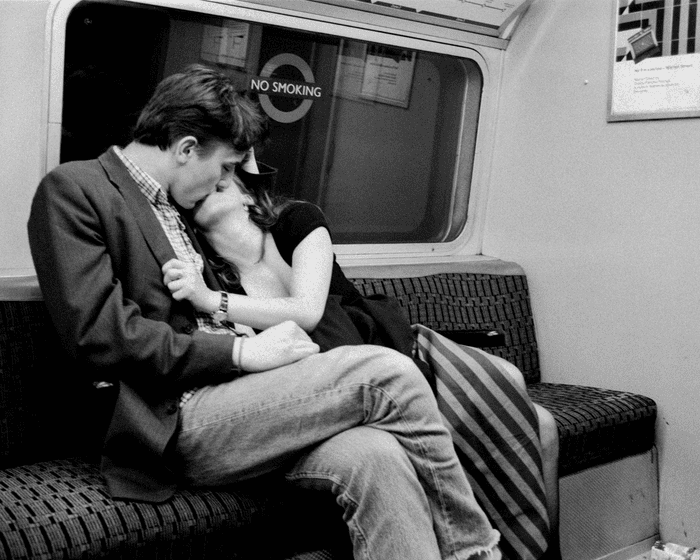
Mark McEvoy’s tube photographs, taken on London Underground carriages around 11pm on Friday and Saturday nights from 1992 to 1995, capture moments that might seem trivial at first glance, but could actually be the most meaningful ones in our lives. These are the golden hours at the end of the week, when friendships are made and cemented; lively chatter flows with the rocking of the carriages; and new couples meet up on the way for what might be a brief fling or the start of a lasting relationship.
Everyone gets caught up in the rush to catch the last tube – a frantic scramble that ended when all-night services began on some lines ten years ago this month. The night tube arrived just as my days of going out all weekend were winding down, and it gave me a slight sense of missing out. Looking at photos of other people’s social lives can have that effect too; at the same time, it’s easy to see ourselves in these tired, happy, and thoughtful faces.
These images feel so natural partly because McEvoy wasn’t just an observer but a participant in London’s mid-90s nightlife. Living in a shared flat in Camden Town, north London, he was part of the city’s music scene, describing himself as “slightly hippy-ish, trendy, kind of casual, into funk, jazz and reggae”; he “smoked a lot of weed.” One night, traveling home from Brixton, he was struck by being surrounded by a very London mix of people of different ages, races, sexualities, and pop-cultural scenes – the tube carriage became a beautiful stage. “We’ve all been there,” he says of the underground train. “We can immediately relate to that space.”
Inspired by this, he spent the next two years going underground around traditional pub closing time on Friday and Saturday nights. Most of the pictures were taken after McEvoy had asked his subjects for permission, and he found that usually they’d pose for a shot, then just go back to what they were doing before.
The images are anchored in their time by the old wooden-floored trains and tube seat patterns, and by the fashions of London’s subcultures: casuals, rockabillies, goths, and punks doing their punk thing and responding to photo requests by baring their backsides. McEvoy documented the last years of the fiercely tribal nature of British youth culture before the internet smoothed it all out, as streaming made music tastes more uniform.
The lack of smartphones in these photos is striking. Yet the energy in them feels oddly universal, capturing a particularly British shedding of reserve and the joy of closing time and just before, when a good night brings the feeling that there’s always the potential for something more.
Even today, with gen Z drinking far less than their predecessors, you still see similar scenes on the underground, although at 4am the train rattles along more quietly, carrying more wreckage. The life in the faces that McEvoy captured three decades ago lives on in a new generation, and even in those of us who are old enough to know better but still sometimes find ourselves rushing for the night tube. How could it not? It’s the eternal energy of London, written on skin and flesh; rage and laughter, smiles and tears.
‘We’ve all been there, we can all relate’: Mark McAvoy on five of his night tube photographs
(Main picture, above) “This couple were nuzzling up to each other, and when I asked if I could take a picture, they said yes right away and started kissing. It was kind of a performance, but then it wasn’t. They thought: oh, this guy’s asked to take a picture; come on, let’s give him this. Or maybe they were about to kiss anyway.”
View image in fullscreen
Sunglasses at night … An American Londoner on the Northern line, 1992. Photograph: Mark McEvoy
“This passenger told me he’d just moved from the States. The big reason was because he got shotHe was hit in the shoulder during gang crossfire. We started talking about the differences between America and England, and he said things were getting just as bad here. I guess he was feeling the tension in London.
View image in fullscreen
Mind the gap … A passenger seeming to pray on the Piccadilly line, 1994. Photograph: Mark McEvoy
“The other side of my photography is capturing these moments. This is one of my favorite pictures in a way, because I obviously didn’t ask him to sit there, and he may or may not be praying. There were a few candid ones like that; people just crashed out, maybe having a rough time.”
Skip past newsletter promotion
Free newsletter | Weekly
Sign up to The Guide
Get our weekly pop culture email, free in your inbox every Friday
Enter your email Sign up
After newsletter promotion
View image in fullscreen
Subway sect … Punks larking about on the Northern line, circa 1990. Photograph: Mark McEvoy
“I was very aware of all these different lives just passing each other, different backgrounds, ages, groups, tribes. I wanted to try to capture the variety of that: the wide range of British culture in that space at that moment.”
View image in fullscreen
Train in vain … Revellers look for the party on New Year’s Eve, Jubilee line, 1994. Photograph: Mark McEvoy
“These guys were running through the compartments. New Year’s Eve had just struck, so they thought: well, we’re not going to be able to make it up to Trafalgar Square, so let’s go crazy here.”
View image in fullscreen
Uninvited guest … A lairy fellow traveller on the Northern line, 1993. Photograph: Mark McEvoy
“He was drunk. As I stood up to get off, he said he wanted to be my assistant and followed me everywhere I went. He started talking to this Irish couple. I didn’t even know what they said, but within five seconds they started punching each other; it was mayhem. Then the train stopped. I just backed off the train very slowly and watched the doors close and the whole commotion disappear.”
Mark McEvoy’s zine London Underground 1992-1995 is out now. A selection of the tube series photos is planned for display at the London Transport Museum in spring 2027.
Frequently Asked Questions
Here is a list of FAQs about the photographer who captured late nights on the 90s London Tube
General Background
1 Who is the photographer behind these iconic 90s Tube photos
The photographer is Bob Mazzer He worked as a projectionist at a cinema in Kings Cross and traveled home on the Night Tube with his camera capturing the people he saw
2 When exactly were these photos taken
Most of the famous shots were taken between the late 1970s and the early 1990s but the 90s era specifically refers to the period between roughly 1990 and 1995
3 Why did he take these photos
He wanted to document the real unfiltered energy of London at night He was fascinated by the contrast between the sterile harsh lighting of the tube carriages and the raw emotional and often chaotic behavior of the passengers
4 Was he a professional photographer at the time
No He was an amateur His day job was as a cinema projectionist This meant he was on the same late shift as his subjects which made him invisible to themhe was just another tired worker going home
The Photos The Subjects
5 What kind of people did he photograph
Everyone He captured punks skinheads drunks couples kissing exhausted shift workers football fans people sleeping and people fighting His photos are a crosssection of workingclass London life
6 Are the photos staged
No they are completely candid He used a small quiet camera and relied on the flash to freeze the moment He didnt ask for permission he just shot from the hip or eye level capturing people in their natural state
7 Why do the photos look so gritty and flashheavy
Thats the beauty of the work The direct flash created harsh shadows and stark highlights which amplified the drama and the raw emotion of the scene It wasnt a technical flaw it became his signature style
8 Did he ever get into trouble for taking these photos
Occasionally yes Sometimes people would get angry and try to grab the camera But because he was a regular on the route many people recognized him and just ignored him or even posed for him