Thousands of Germans have taken to the streets to protest the far-right Alternative for Germany (AfD) party after its historic win in a state election, with warnings that it poses a threat ahead of two more votes later this month.
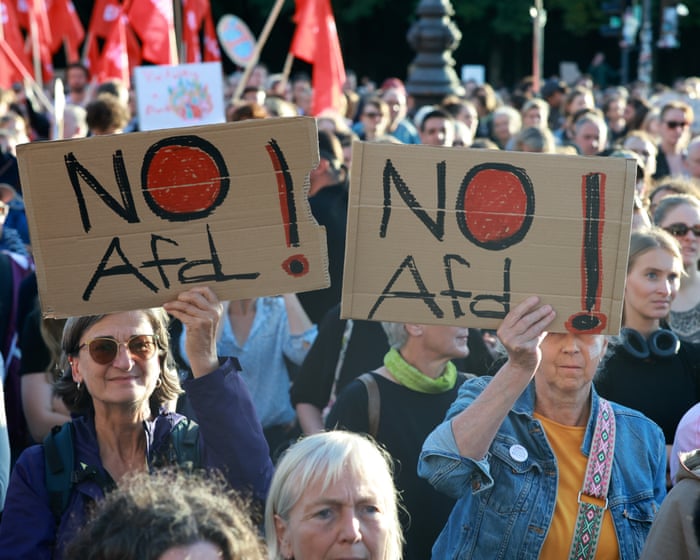
Demonstrators gathered at Berlin’s Brandenburg Gate for a peaceful pro-democracy rally, speaking out against the anti-immigrant, pro-Russian AfD, which has pushed for mass deportation of asylum seekers and cuts to state support for renewable energy and public broadcasting.
On Sunday, the party achieved its best-ever result in a state election in the former communist eastern state of Saxony-Anhalt, gaining strong momentum as regional elections approach in Berlin and Mecklenburg-Western Pomerania on the Baltic coast on September 20.
Police estimated around 5,000 protesters took part, while organizers claimed more than 14,000 people joined the effort to rally voters against the AfD. Signs in the crowd read: “Fascism is no alternative,” “Stop the Nazi AfD: end racism and cuts to social services,” and “History has its eyes on us.”
With less than two weeks until election day, speakers at the Berlin rally urged people not to give in to despair or cynicism following Sunday’s shocking outcome.
Jens-Christian Wagner, director of the memorial at the former Nazi concentration camp Buchenwald, called the AfD’s nearly 44% vote share in Saxony-Anhalt—the strongest result for a nativist party since the Nazi era—a “disgrace that makes you furious and stunned.”
Wagner warned that although the AfD fell just short of an absolute majority, it was close to taking power in Saxony-Anhalt, which would be a first for the far right since World War II. That, he said, “should not be accepted in silence.”
Max Schneller, a 17-year-old member of the far-left Linke party from Saxony-Anhalt, said activists in the state would resist any attempts by an AfD government to target minorities. “We will not start categorizing our neighbors by their origin, religion, or skin color—we are too humane to hate,” he said to loud applause.
The AfD is just three votes short of the support needed to form a government under its candidate, the media-savvy firebrand Ulrich Siegmund, who hopes to win over dissenters from other parties willing to act as kingmakers.
Germany’s domestic intelligence agency has classified the party’s state chapter as right-wing extremist since 2023, saying it threatens democratic norms.
Hundreds of anti-AfD protesters also gathered in Potsdam, near Berlin, with additional rallies held in Münster, Göttingen, Dresden, Aachen, Bamberg, Darmstadt, and Halberstadt in Saxony-Anhalt, where the AfD captured nearly half the votes, according to local media.
In Halle, the region’s second-largest city, leftist groups and civil society organizations have been running a protest camp since election day.
The AfD leads in voter intention polls in Mecklenburg-Western Pomerania with about 35%. However, the center-left Social Democratic Party (SPD) of state premier Manuela Schwesig has made a strong comeback over the summer and is now polling above 30%.
In Berlin, one of Germany’s 16 federal states, the situation is more mixed, with several parties competing for the top spot. The city is currently run by a coalition of the conservative Christian Democratic Union (CDU) and the SPD.
The CDU, led by Chancellor Friedrich Merz, whose record unpopularity is said to have weighed heavily on voters in Saxony-Anhalt, holds a very slim lead in the capital at around 20%.
Close behind are the Linke, which has focused its campaign on rising housing costs, and the AfD, followed by the SPD and the Greens, both polling in the mid-teens.
Merz has pledged to stay in office and push forward with a major package of tough reforms, arguing that the only way toTo defeat the AfD, the key is to get Europe’s largest economy moving again and fix its struggling social welfare system. However, the SPD, his junior coalition partner, has signaled it’s open to reversing some of the most unpopular policies to boost support for the embattled government. Analysts warn that this disagreement could further weaken the already fragile coalition.
Frequently Asked Questions
Here is a list of FAQs about the spreading AntiAfD protests in Germany written in a clear and natural tone
General Questions
1 What does AfD stand for and who are they
AfD stands for Alternative fr Deutschland It is a farright political party in Germany known for its strong antiimmigration stance Euroscepticism and criticism of Islam Parts of the party are officially classified by German intelligence as rightwing extremist
2 Why are people protesting against the AfD right now
The protests have surged because the AfD is currently polling at record highs and is projected to win state elections in two eastern German states in September 2024 Many Germans are worried that the partys growing influence threatens democratic norms and social cohesion
3 Where are these protests happening
They are happening nationwide not just in big cities Large rallies have taken place in Berlin Hamburg Cologne and Munich but also in smaller towns across the country The protests are particularly visible in the eastern states where the AfD is strongest
4 Who is organizing these protests
There isnt one single organizer The movement is largely grassroots driven by a broad coalition of civil society groups churches trade unions environmental activists and ordinary citizens who have formed local alliances called Omas gegen Rechts or Seebrcke
5 Are the protests violent
No the vast majority of protests are peaceful and familyfriendly Organizers emphasize nonviolence However there have been isolated incidents of clashes between police and a small number of counterprotesters or farright groups but the main demonstrations remain orderly
Questions about the Political Context
6 What does winning two additional states actually mean for the AfD
It means winning the most votes in the state parliaments of Thuringia and Saxony While this would not automatically give them control of the government it would give them a blocking minority on key decisions and significantly increase their political platform and resources
7 Why is the situation in eastern Germany different from the west
The east has specific grievances including higher unemployment