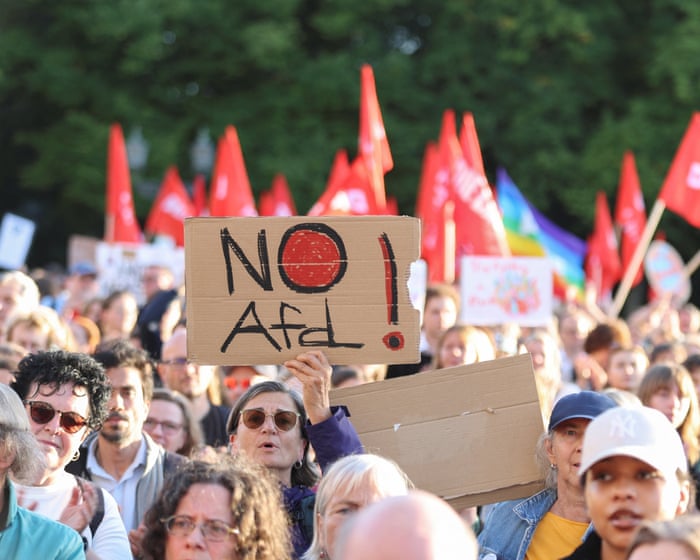
The shock of the far right’s sweeping victory in a German state election was still echoing on Sunday, but not everyone was upset. Just moments after the first exit polls from Saxony-Anhalt came in, Donald Trump shared the results on his Truth Social platform, clearly pleased by the damage done to the centrist-conservative Christian Democrats (CDU) and the rise of the far-right Alternative for Germany (AfD).
It was a real blow for CDU leader Friedrich Merz, whose party lost more than half of its seats in the state parliament, while the AfD jumped from 23 to 39 seats. This was the exact opposite of what Merz had promised when he ran for office. He had insisted that with good governance under his leadership, he would easily cut the AfD’s support in half. The AfD’s co-leaders didn’t waste the chance to highlight this historic upset in their victory speeches, with Alice Weidel even boasting that the CDU would “never win an election again.”
Putting aside the AfD’s arrogance, this is a political earthquake with effects that reach far beyond a small state in central Germany. The shockwaves are still spreading. For starters, it’s unclear whether Merz can hold his coalition together and keep his position as chancellor, and for how long.
True, the losses in Saxony-Anhalt aren’t directly his fault. But that’s only because he’s so unpopular that his own party didn’t want him to campaign. Merz’s face wasn’t on any posters, and when he visited the state capital, Magdeburg, the public was carefully kept away. That says everything about his standing within his own party.
Two more elections are coming up on September 20, in Berlin and the Baltic coastal state of Mecklenburg-Western Pomerania. Based on current trends, the CDU is facing two more defeats. Merz’s leadership has become a burden, and it will likely be challenged sooner rather than later. For now, only the lack of a convincing alternative and the many constitutional hurdles to sudden leadership changes in Germany are protecting him.
He is the public face of a crisis of confidence in Germany’s leadership, but he’s not the only cause. The scale of this moment goes far beyond party politics. Germany is entering a period of political turmoil where the core values of the postwar republic are being questioned.
Most strikingly, this extends to the anti-fascist consensus of “never again,” built over decades through intense debates about the Holocaust and the crimes of the Wehrmacht. The AfD has managed to attack the national agreement that confronting the Nazi past is essential for democracy in Germany. The party’s message is the opposite: that the culture of remembrance is an “identity disorder” holding Germany back. A central part of the AfD’s platform is that it can “heal” the country by downplaying its guilt and focusing instead on German greatness.
This is why Charlotte Knobloch, a 93-year-old Holocaust survivor and former head of the Central Council of Jews in Germany, expressed “horror” at the results. Knobloch said she “struggled, on days like these, to recognize my homeland,” adding: “In my worst nightmares, I could not have imagined that right-wing extremists would win elections again in this way.” She is right to be worried. The Saxony-Anhalt branch of the AfD is confirmed by domestic intelligence to be among the most radical in the country. Hardcore former neo-Nazis hold influential positions.
A distinctive feature of Germany’s far right, compared to France or Italy, is often overlooked. The AfD is clearly different from other right-wing populist parties in Europe: it becomes more radical the closer it gets to power. The leadership in Magdeburg employs several former members of banned neo-Nazi groups. These people could soon serve in high offices in the state, controlling the police, the domestic intelligence service (Verfassungsschutz), the judiciary, and education. It’s a sign of how things are deteriorating.In my country, political norms are such that this shocking outcome barely registered in the election’s aftermath. The German taboo against far-right extremists holding executive power is starting to fade.
The AfD’s attacks on mainstream parties, which they call the “old parties,” have a distinctly Weimar-era feel, echoing the hateful propaganda against the despised “system” from a century ago. It’s no surprise that books about the end of the Weimar Republic are selling well right now.
The AfD is not a typical party. It should be seen as a (counter)revolutionary movement aiming to change the system from within. Its leaders’ goals go beyond specific policy changes. Look at migration, a key issue: asylum applications are dropping fast—down 48% in July 2026 compared to the same month last year—partly due to restrictive measures from Merz’s government.
Still, the hard right is both growing and becoming more extreme. At its core is the idea of a German ethnostate with as few foreigners as possible. The party’s call for “remigration” targets not just “illegals” but all immigrants (and their descendants) with unwanted foreign backgrounds.
The leadership has coined a term for what they want to avoid: they vow not to become “Melonised” (like Meloni). Giorgia Meloni, despite her neo-fascist past, surprised many by moving toward the mainstream—supporting Ukraine, backing the eurozone, NATO, and free movement within the EU.
The AfD, in contrast, promises to leave the EU and the eurozone and end the Schengen agreement. It is strongly pro-Russian and wants to cut all support for Ukraine, including sending refugees back. Fear of escalation with Russia played a big role in the election. Recent hybrid attacks on Leipzig airport and other infrastructure may have tipped the scales: Merz blamed Russia and vowed to “make the perpetrators pay.” This turned out to be perfect material for the AfD’s campaign. Abandoning Ukraine, warming up to Russia, and reopening the Nord Stream pipeline in the Baltic were all framed as a “policy of peace.” This is also a win for Vladimir Putin.
What happens next? Without an absolute majority, the AfD may need help from a small splinter party. The leadership of the Sahra Wagenknecht Alliance (BSW), which broke away from the hard-left Die Linke, might be willing to assist. They represent a new kind of leftist nationalism that is fiercely anti-immigrant and pro-Russian—in that sense, they align with the AfD. Still, forming a government in Magdeburg won’t be easy, and it’s a long way from there for the AfD to take Berlin.
One hopeful sign is that civil society is starting to mobilize now that the initial shock has passed. We can expect big demonstrations in major cities. A quiet anti-fascist majority is beginning to organize. But it will be tough to break the dark spell this victory in a troubled state has cast over Germany’s political scene.
One thing is certain: the coming weeks will test the political imagination, not just for Germans.
Jörg Lau is an international correspondent for the German weekly Die Zeit.
Do you have an opinion on the issues raised in this article? If you’d like to submit a response of up to 300 words by email for possible publication in our letters section, please click here.
Frequently Asked Questions
Here is a list of FAQs based on the articles premise written in a natural clear tone
FAQs The AfD Victory and Friedrich Merzs Trouble
1 Wait what is happening with Friedrich Merz Is he in trouble
Yes he is Hes the leader of the conservative CDU party and hes under a lot of pressure He recently pushed a migration bill through parliament with the help of the farright AfD party which broke a longstanding political taboo in Germany This has caused massive internal backlash and many believe his leadership and his path to becoming Chancellor are now in serious jeopardy
2 Why is everyone so upset about him working with the AfD
In Germany all mainstream parties have a strict firewall against cooperating with the AfD which is seen as extremist By relying on their votes to pass a law Merz broke that firewall Many voters and politicians see this as a betrayal of democratic principles making him look untrustworthy and damaging the CDUs reputation
3 The article says the AfDs victory is earthshaking What victory are we talking about
The article refers to a major political win for the AfD By successfully forcing the CDU to depend on them to pass legislation the AfD has proven they can influence national policy from the opposition They are no longer just a protest party they are now a kingmaker that has broken the mainstream parties unity against them
4 If Merz is in trouble why isnt that the real reason this is so important
Merzs personal political problems are a symptom not the cause The real earthshaking event is that the political firewall has been breached It shows that the AfD is now a permanent and powerful force in German politics and that the traditional parties are willing to abandon their core principles to push through their own agenda It changes the entire political landscape for years to come
5 Can someone explain the firewall in simple terms
Think of it as a big unspoken rule All the major democratic political parties in Germany agreed they would never form a coalition or make deals with the AfD because of their extreme nationalist and antiimmigrant views This rule was meant to keep the farright isolated and powerless