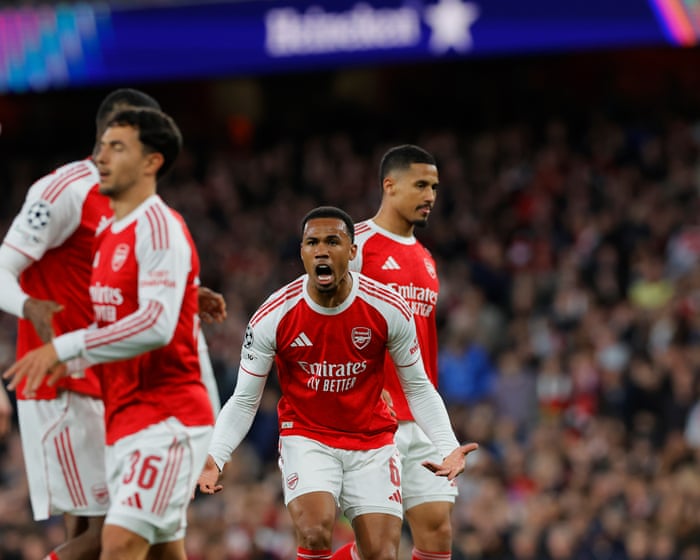
And so I have become a meme. Towards the end of this game, already cautioned for standing on the touchline whirling his arms in a balletic, perfectly groomed pose of horror—like an oversized wedding cake topper at the world’s most distressing wedding—Mikel Arteta could be seen pulling his jumper up over his eyes to block the view. Not so fast, Mikel. We’re all in this together, you know.
At the final whistle, with a controlled, job-done 0-0 safely secured, Arteta strode out in front of the post-match line of Arsenal players, conducting the crowd—an urgent, compact, dark-haired figure who, from a distance, had something of a business-casual Tom Cruise about him.
And by that stage, the dominant feeling inside the Emirates was relief: relief at a successfully navigated second leg, and also, it must be said, relief that it was simply over. This was, once again, a difficult watch.
Sporting are the kind of team you have these kinds of nights against—gnarly and obstructive, a sort of footballing knotweed. And Arsenal will be hugely pleased with this result. Eight clean sheets. Another hurdle cleared. They’re in the semi-finals now, with Atlético Madrid and one other team standing between them and a first Champions League title. This is only positive. Maybe this is just how you win things. Even if, in the moment, it didn’t exactly feel like it.
Amid all this, it’s worth talking about the Arsenal crowd, who have become the spectacle around this club—its most theatrical element—and who have been unfairly criticized as a whole. From the outside, it’s easy to assume the entire Arsenal fanbase is in the grip of some kind of category error.
There have been boos and early walkouts. But this could still be the best season in the club’s history. More importantly, football is meant to be about fun, collectivism, warmth, and drama. So why does it instead feel like watching someone have their toenails very slowly peeled off with a pair of pruning shears?
Why the state of total fear, an anxiety that seems outsized, entirely disproportionate to the actual event? But it’s also wrong to blame the fans for this. If only because what Arsenal are producing is a genuinely strange spectacle. Arteta’s football is a unique version of possession-based control, breaking the game down.
It can feel like trying to win by default, by drowning slightly more slowly than the other guy. Nobody has ever advanced on so many fronts playing quite like this.
Here, Arteta started with four career centre-backs, including Cristhian Mosquera—an excellent one-on-one defender, but a clear step down from Jurriën Timber as a ball-playing full-back. And from the start, there was a sense of absence. Arsenal’s play in the final third was all slightly discordant notes.
Passes were just the wrong weight or line. Early crosses were avoided. It’s tempting to say Arsenal miss Martin Ødegaard in these moments. But they miss the previous Martin Ødegaard—the one Martin Ødegaard himself probably misses, too.
Rui Borges was up on his touchline straight away in a putty-coloured gilet and high-end cappuccino trousers, like a global ambassador for the colour light beige. His Sporting side are well-drilled and physically robust. Morten Hjulmand ran the midfield for a while.
Cue the first real tremor of muttering voices and individual shouts of dismay. Victor Gyökeres had a close-range chance on his left side and nudged at it weakly with his right foot. Being one-footed only really works when your good foot is a wand, a paintbrush, a sniper rifle, or at least quite good.
And at that point, a single goal was all it would have taken to turn a slow-burn holding job into a disastrously passive display. Just imagine, if you will, the sheer naked horror of this Arsenal team taking part in a penalty shootout—the kind of content that should probably require a warning.Proof of age, or simply a blur of pixels. ‘Shattered’ Rice impresses Arteta by rising from his sickbed to hold Sporting at bay.
Yet the crowd remained engaged. There were efforts to stir up noise, to find moments worth cheering. At halftime, the Emirates played “I Feel For You,” which felt fitting. Watching this has become an ordeal—something to be endured, like observing a self-driving car stuck in fourth gear, still stubbornly on track. How should one even feel about it?
There was a slight easing of tension as the match dragged toward its conclusion. Arsenal finally built some sustained pressure around the hour mark, with Gabriel Martinelli eventually shooting over the bar. The applause that followed was almost tender, the kind you might give a nervous seven-year-old nephew finally braving the slide. No one left early. Arteta was able to orchestrate the final moments. And so Arsenal grind on, in this strange, slow-burn race toward some kind of finish line—a spectacle truly unlike any other.
Frequently Asked Questions
FAQs Arsenals Tough to Watch Style Winning
Beginner General Questions
1 What do people mean when they say Arsenal are tough to watch
It means their matches can be tense cautious and lowscoring focusing more on control and defensive solidity than freeflowing attacking flair Its not always the thrilling endtoend football some fans prefer
2 Is this a new style for Arsenal
Yes in recent seasons Under Mikel Arteta the team has evolved from a more open attacking side to one that prioritizes structure discipline and minimizing mistakes especially in big games
3 Why would a team play in a less entertaining way
The primary goal is to win and compete for titles This style is often adopted to be harder to beat to grind out results in difficult matches and to build a platform for success even if it sacrifices some entertainment value
4 Can this style actually help win trophies
Yes absolutely Many successful teams in history have built titlewinning campaigns on being defensively excellent and winning ugly in crucial games Consistency from a solid base is often more important than occasional brilliance
Advanced Strategic Questions
5 What are the specific tactical hallmarks of this tough Arsenal style
Key features include a very structured defensive shape controlled possession to manage game tempo fewer risky passes in dangerous areas and an emphasis on setpieces as a primary attacking weapon
6 Whats the main benefit of playing this way
It reduces variance By conceding fewer chances and controlling the games rhythm Arsenal makes the outcome less dependent on individual moments of magic or error leading to more consistent results over a long season
7 What are the common criticisms or problems with this approach
Lack of creativity It can stifle creative players and lead to predictable attacks
Overreliance Struggles to break down deeplying defensive teams that are happy to concede possession
Fan frustration It can feel passive or fearful especially at home leading to tension in the stadium if the team isnt winning
8 Are there examples of other successful teams that played like this
Many Sir Alex Fergusons later