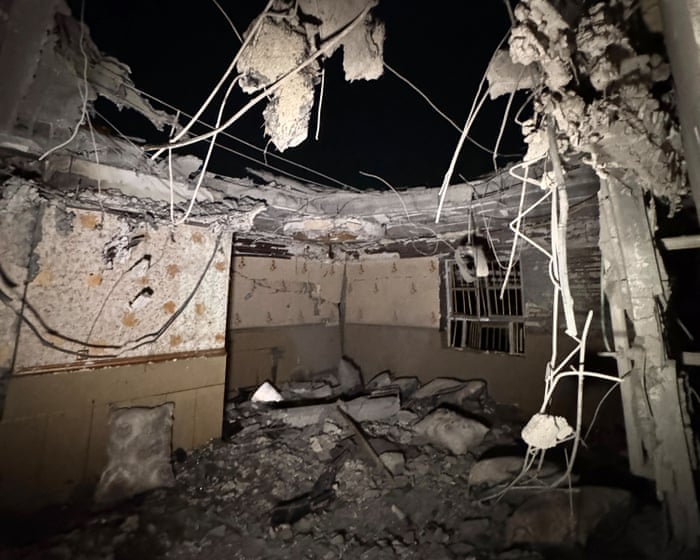
Iran has accused the United States of committing a “war crime” after a missile strike killed at least four people and wounded 68 others at a wedding held in a private home in a coastal city in southern Iran. The attack has raised fears of a broader renewal of hostilities between the two countries.
According to Iranian media, the wedding was taking place in a house in the city of Kuhestak, in Hormozgan province, late on Tuesday when a US missile hit the area. Shrapnel and debris from the blast killed and injured several people.
Among the dead were a four-year-old child, Amir-Ali Karimi, and a 16-year-old named Mohammad Mollahi.
“It’s a terrible thing. I’m extremely worried and upset about what happened – really upset,” Ali Mollahi, the father of the bride, told Mehr News.
Footage from the aftermath shows a collapsed roof, shattered windows, and debris scattered across the ground.
Ahmad Nafisi, deputy of the provincial government, said first responders rushed to the scene and transported the wounded to hospitals.
Iran’s foreign ministry spokesperson called the US attack a “war crime” and said Iran “will respond to these savage crimes with firmness.”
Mohammad Baqer Ghalibaf, Iran’s chief negotiator, said the attack had killed families with children and referred to the US as the “great Satan.”
“If a power acts like Satan, picks targets like Satan and kills like Satan, it’s Satan. Shields a junior Satan that does the same? It’s THE Great Satan,” Ghalibaf wrote in a post on X.
The strike on Kuhestak appeared to mark another round of escalation in the US-Iran conflict.
Tuesday’s US attacks ended a month-long uneasy truce between the two nations and signaled a possible return to escalating tensions. US Central Command (Centcom) said the overnight strikes targeted Iranian military sites, including air defense systems, radars, and maritime assets.
In response, Iran launched drones and missiles at US bases across the Middle East, including in Bahrain, Kuwait, and the UAE. Iran’s military spokesperson, Lt Col Ebrahim Zolfaghari, vowed “heavier, broader, and more crushing and devastating” retaliation.
Videos from the scene show a caved-in roof, blown-out windows, and ground covered in debris, along with walls pockmarked with what appear to be shrapnel holes. Footage from a nearby hospital shows women in wedding attire watching as injured children receive treatment.
“When we arrived there, an explosion occurred. It was very intense. Bricks, stones and cement hit me in the face and head, and many others were injured,” a child injured at the wedding told the state-affiliated Fars news agency.
Tim Hawkins, a Centcom spokesperson, said the US was aware of reports of civilian casualties but stressed that “the US military never targets civilians, unlike the [Iranian Revolutionary Guards Corps].”
In February, a strike on an elementary school killed at least 156 people, including more than 120 children. Independent investigations concluded that the US likely carried out the strike with the help of AI, though the US government said the incident was still under investigation.
A separate strike in Kuhestak hit a communications tower about 150 meters from the home where the wedding was taking place.
Pictures of shrapnel collected at the site of Tuesday’s attack were published by Iranian state media and appeared to show internal components of US munitions. Trevor Ball, an independent weapons analyst, identified some of the remnants as belonging to the Standoff Land Attack Missile-Expanded Response (SLAM-ER), made by the US company Boeing. The SLAM-ER is a 1,5A 2,000-pound, GPS-guided bomb that Boeing claims is “extremely accurate.” It’s unclear whether the wedding venue was hit directly or if a missile landed nearby, with debris striking the house and those inside. Security camera footage shows at least six strikes in the area within a minute. Another strike appeared to hit a communications tower about 150 meters from the home.
The US has been targeting communications and radar systems along Iran’s coast to disrupt its blockade of the Strait of Hormuz—a narrow passage that, before the US-Iran war, carried at least 20% of the world’s oil supply. Iran has largely shut down the strait since the conflict began, frustrating President Donald Trump, who faces midterm elections amid high gas prices and widespread inflation.
In recent weeks, the US has stepped up efforts to weaken Iran’s ability to attack ships in the strait, aiming to reopen the waterway to traffic.
Frequently Asked Questions
Here is a list of FAQs based on the provided headline written in a natural tone with clear simple answers I have categorized them for easier reading
Understanding the Incident
Q What exactly happened
A According to reports a missile strike hit a wedding ceremony killing four people Iranian officials are stating that the attack was carried out by the United States
Q Where did this strike take place
A While the prompt doesnt specify the exact location it is important to note that this type of accusation typically occurs in the context of conflicts in the Middle East For the most accurate location you would need to check the specific news report you read
Q Why is Iran calling this a war crime
A Under international law a war crime includes acts that deliberately target civilians or civilian objects during a conflict Iran is alleging that the US deliberately or recklessly struck a civilian gathering which would violate the rules of war
Legal and Political Implications
Q Is a war crime accusation the same as a legal conviction
A No It is an official accusation or legal claim For it to become a formal conviction an international court or a recognized tribunal would need to investigate gather evidence and hold a trial
Q What happens now that Iran has made this accusation
A Politically it increases tensions and could lead to diplomatic fallout or calls for international investigations Legally Iran could file a complaint with the UN or international courts but enforcement and jurisdiction are often complicated because the US does not recognize the ICCs authority over its citizens
Q Could the US actually be prosecuted for this
A In practice it is highly unlikely The US is not a party to the Rome Statute Furthermore the US often argues that such strikes are aimed at militant targets and that civilian deaths are accidental collateral damage which is a major point of dispute in these cases
Common Arguments and Counterpoints
Q The US says it fights terrorist groups How does this fit in