In the early days of cinema, music was essential to the audience’s experience, with a live pianist or organist accompanying the silent film. However, it wasn’t until the arrival of synchronized sound that viewers could be assured of a consistent musical presentation.
This shift is often traced to 1926’s Don Juan, a silent film that wasn’t a true soundtrack in the modern sense. Warner Bros. used the Vitaphone system, which played a recorded disc alongside the picture. The same method was used for 1927’s The Jazz Singer, the first film to synchronize voices as well. Since playing a disc was unreliable, the industry soon moved to printing sound directly onto the filmstrip itself, giving birth to the proper soundtrack.
Film music as we know it quickly developed in the early 1930s, largely thanks to European émigré composers who brought stylistic and narrative influences from opera, symphony, and music hall. Songwriters from Tin Pan Alley and Broadway followed, enriching the musical foundation that would define Hollywood for decades. Today, nearly a century later, the basic role and function of a film’s musical soundtrack remain largely the same. But which scores have advanced the art form and changed how we listen to movies?
Sunrise: A Song of Two Humans (1927)
German expressionist director F.W. Murnau made this Oscar-winning film in Hollywood. Though considered a late silent film due to its use of title cards, it featured synchronized sound effects and music through Fox’s innovative Movietone system. For the first time, a film’s sound was printed directly onto the film, allowing audiences to hear recorded music by composers like Chopin and Gounod.
King Kong (1933)
Austrian-born composer Max Steiner refined the function of a film score with this classic. His meticulous use of the orchestra to shape narrative, structure, setting, and emotion was key to the film’s impact. King Kong established the foundation for all symphonic Hollywood film music that followed, and its influence endures.
Citizen Kane (1941)
This was Orson Welles’ directorial debut and composer Bernard Herrmann’s first film score. Both had backgrounds in New York radio drama. In Hollywood, Herrmann stood out among the predominantly European composers. For Citizen Kane, he avoided the typical “Hollywood” symphonic style and instead crafted a unique sound world that emphasized mood and atmosphere.
Blackboard Jungle (1955)
This film delivered one of the first major blows to traditional symphonic film music. MGM licensed Bill Haley and His Comets’ “Rock Around the Clock” as the main musical theme for a story about rebellious teens at an inner-city school. The song’s popularity caused a stir among concerned parents, became a global hit, and showed studios how music could be used to market their films. This paved the way for jazz scores.
Forbidden Planet (1956)
Years before the BBC Radiophonic Workshop, pioneers Louis and Bebe Barron were creating experimental sounds using magnetic tape. While Hollywood had previously dabbled with electronic instruments like the theremin—used by composers such as Dimitri Tiomkin—Forbidden Planet featured a groundbreaking entirely electronic score.The Thing from Another World and Bernard Herrmann’s score for The Day the Earth Stood Still (both 1951) used innovative sounds. For Forbidden Planet, however, Louis and Bebe Barron created the first completely electronic film score. Its blend of sound effects and music surprised and delighted audiences, inspiring a new generation of composers.
By the 1960s, pop music and jazz had fully infiltrated movie soundtracks, with composer Henry Mancini as one of its greatest champions. For Breakfast at Tiffany’s (1961), Mancini delighted producers by crafting not only the hit song “Moon River,” but also a score that perfectly captured its era. Mancini had a flair for “symphonic pop,” merging traditional melody with contemporary upbeat sounds. His scores for films like Hatari! (1962), Charade (1963), and The Pink Panther (1963) all benefited from this musical fusion.
A twist of fate gave us one of the most brilliant and impactful film soundtracks of all time for 2001: A Space Odyssey (1968). Although composer Alex North wrote an original score for Stanley Kubrick’s sci-fi masterpiece, the director ultimately scrapped it, having grown fond of the classical pieces he used temporarily. While one sympathizes with North, it is hard to imagine Kubrick’s enigmatic film without its powerful mix of music by Ligeti, Richard Strauss, Khachaturian, and Johann Strauss II.
Before Star Wars, George Lucas had another hit with American Graffiti (1973). The film captures a night in the lives of California teenagers as they listen to rock ‘n’ roll, race cars, and ponder life and love. Featuring more than 40 carefully placed songs from the era, heard through car radios and in diners, the film’s popularity and chart-topping soundtrack album inspired a new wave of song-driven soundtracks.
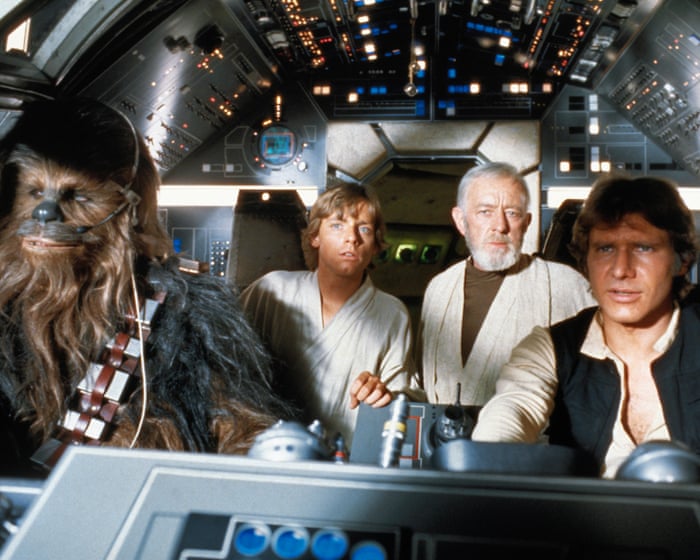
While Lucas’s American Graffiti challenged symphonic film music, his 1977 sci-fi smash Star Wars: A New Hope revitalized it. On Steven Spielberg’s recommendation, Lucas approached composer John Williams to write music for what was intended as a loving pastiche of a bygone era. Williams created an old-fashioned symphonic score with playful nods to Holst, Walton, and Korngold, ultimately making Hollywood and audiences fall in love with the symphony orchestra all over again.
Hans Zimmer revolutionized Hollywood film music, with Crimson Tide (1995) representing the peak of that shift. It showcased the massive, powerful sound that would become his signature. While electronic music was always central to Zimmer’s artistry, his fusion of it with the emotional weight of live orchestra and choir, as heard here, became uniquely his own—and with it, the sound of modern Hollywood film music was born.
Michael Beek is the artistic director of the London Soundtrack Festival, running from 9-12 April.
Frequently Asked Questions
Of course Here is a list of FAQs about the topic Trailblazers Trumpets and the Theremin 10 Soundtracks That Transformed How We Hear Films designed to cover a range of questions from beginner to advanced
General Beginner Questions
1 What is this list actually about
Its about 10 specific movie soundtracks that were groundbreaking They introduced new instruments recording techniques or compositional styles that permanently changed how music and sound are used in film
2 Why are trailblazers trumpets and the theremin mentioned in the title
These are examples of the innovations covered Trailblazers Trumpets and the Theremin
3 What is a theremin and why is it important for film
The theremin is one of the first electronic instruments played without physical contact Its eerie wavering sound became synonymous with 1950s science fiction showing filmmakers could use unconventional sounds to create specific moods
4 Can you give me one clear example of a soundtrack that transformed things
Yes Jaws John Williams used a simple repeating twonote motif played on the tuba and double bass to represent the shark This proved that a minimalist rhythmic idea could be more terrifying and iconic than a traditional melodic score
5 Whats the benefit of understanding these transformative soundtracks
It helps you listen to movies more actively Youll start to notice how music manipulates your emotions builds tension and becomes a character itself deepening your appreciation for film as an art form
Intermediate Advanced Questions
6 Beyond the theremin what are other key instrument innovations in film soundtracks
The Mellotron the haunting use of the ondes Martenot the integration of full synthesizers and the use of nonWestern instruments to define a films world