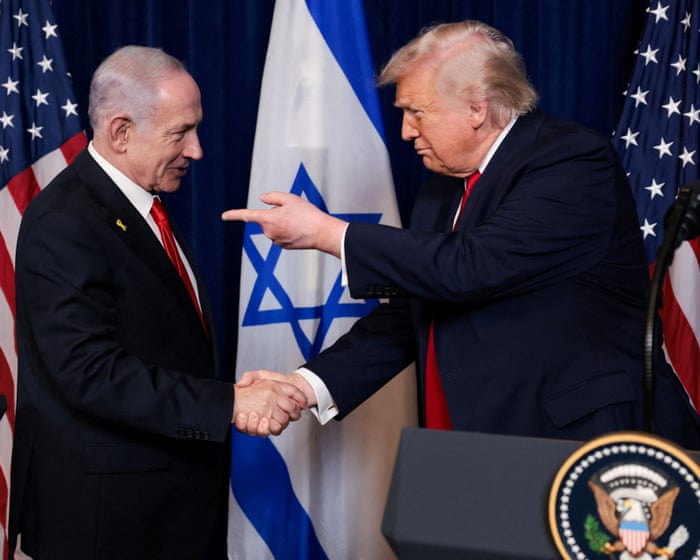
When Benjamin Netanyahu visited Donald Trump’s Mar-a-Lago club on December 29 last year, the Israeli prime minister came with a request—and a not-so-subtle incentive.
After months of replenishing air defense and other missile stocks following a 12-day conflict in June—during which the U.S. joined in bombing Iran’s nuclear facilities—Israel was ready to act again, this time with more ambitious goals.
At a press conference held by the two leaders, Trump seemed to dutifully repeat Netanyahu’s familiar talking points. “Now I hear that Iran is trying to build up again,” Trump said. “Then we are going to have to knock them down. We’ll knock the hell out of them. But hopefully, that’s not happening.”
Like others before him, Netanyahu had come prepared with an appeal to Trump’s ego: offering him Israel’s highest honor, the Israel Prize, rarely awarded to non-Israelis, for his “tremendous contributions to Israel and the Jewish people.”
According to The Atlantic, Netanyahu also suggested a final benefit to the famously transactional president: defeating Iran would allow Israel to reduce its heavy reliance on U.S. military aid.
That meeting, as multiple accounts have since revealed, was one of many contacts between Netanyahu and Trump in the following weeks. Netanyahu sought to secure U.S. involvement in a broader conflict against Tehran, with far greater ambitions than the previous round of fighting.
An assessment prepared by Mossad, Israel’s intelligence agency, argued that Iran’s fragile and unpopular regime was ripe for toppling, shaken by internal protests—with Iranians furious over the deadly crackdown on demonstrators.
It was portrayed as a historic opportunity requiring only a short campaign. According to some accounts, Netanyahu also hinted that Trump could take revenge for alleged Iranian plots against his life.
What has since become clear is that Netanyahu—who styles himself as an “expert” on Iran—and the wider Israeli military establishment were fully committed to selling the idea of an easy war.
On February 28, the first day of the war, unnamed Israeli officials told Haaretz that the Iranian threat would diminish within days as Iran’s last missile launchers were eliminated.
Another article in the same newspaper stated that Israel’s military planners had stockpiled missile interceptors for a war they expected to last no more than three weeks.
Viewed as a separate conflict, this war is as much America’s as Israel’s—but it is part of Israel’s broader war; the latest front in Netanyahu’s state of permanent conflict that began with Hamas’s attack on Israel on October 7, 2023.
That attack changed the country’s strategic calculations. In the expanding regional conflicts that followed—in Gaza, Lebanon, and now Iran, as well as with the Houthis in Yemen and in Syria—a common theme has emerged: Netanyahu has repeatedly declared victories that prove to be fleeting and overconfident.
In Gaza, despite a horrific campaign of death and destruction, a weakened Hamas still persists among the ruins. In Lebanon, where Hezbollah was declared defeated, the group retains the ability to fire rockets across the border. Israel has once again resorted to occupying southern Lebanon—a policy that failed before and originally led to Hezbollah’s rise.
In Iran, despite the killing of Supreme Leader Ali Khamenei and other senior officials, a “decapitation” strategy has not delivered Netanyahu’s promised quick regime change. Instead, it hasAt the very least, there appears to be a consolidation of the regime around the Islamic Revolutionary Guards Corps.
Even if the exact dynamics of influence and persuasion remain unclear, it is evident that senior Trump administration officials believe Netanyahu overpromised. This perception is reinforced by disputed accounts of a tense conversation between Vice President JD Vance and Netanyahu to that effect. Axios, quoting a U.S. source using Netanyahu’s nickname, reported last week: “Before the war, Bibi really sold it to the president as being easy, as regime change being a lot likelier than it was. And the VP was clear-eyed about some of those statements.”
Others are more cautious. Daniel C. Kurtzer, a former U.S. ambassador to Israel, and Aaron David Miller wrote in a post for the Carnegie Endowment for Peace that Trump was “a willing and full partner.” They noted, “He was risk-ready and caught up in a self-generated aura of military power and invincibility after taking President Nicolás Maduro from Venezuela.” While they concede that “Netanyahu may have determined the timing of conflict,” they argue Trump was “likely already on his way to war.”
As the war enters its second month with no end in sight, and with the global economy reeling from the closure of the Strait of Hormuz, the damaging consequences of Netanyahu’s promise of an “easy” war are spreading far beyond the immediate region. In this context, the perception of Netanyahu’s role—following his years-long advocacy for the conflict—matters as much as Trump’s own willing involvement.
As security experts Richard K. Betts and Stephen Biddle wrote in Foreign Affairs last week: “In just its first weeks, the war has cost many billions of dollars in direct expenditure, reduced support for Ukraine, put dangerous strains on inventories of the most advanced U.S. weapons, and shocked the global economy.”
The conflict has also undermined NATO while potentially emboldening China, Russia, and North Korea. And while Netanyahu has boasted in biblical terms of hitting Iran with “10 plagues,” it has not been lost on some that the Iranian and Hezbollah missiles still landing on Israel mean Passover will be spent with one eye on the bomb shelter.
For Netanyahu and Israel, there are likely to be longer-term consequences in terms of diplomacy and public opinion, which—alongside the Iran question—have long preoccupied Israel’s prime minister. Already viewed with caution, if not outright distrust, in many foreign capitals, Netanyahu and his war threaten Israel’s détente with the Gulf states, as seen in the Trump-mediated Abraham Accords.
“Some Arab states may blame Israel for being thrust into a war they didn’t choose,” said Raphael Cohen, director of the strategy and doctrine program at the RAND think tank. He suggested that while the geopolitical landscape of the Middle East may change as promised by Trump and Netanyahu, “at least insofar as which countries are on Israel’s side—[that] may look very different once the dust settles.”
Outside the Gulf, French President Emmanuel Macron last week reflected a more widespread view that U.S. and Israeli strikes on Iran would not provide a durable solution to Tehran’s nuclear program. “A targeted military action, even for a few weeks, will not allow us to resolve the nuclear issue in the long term,” Macron said in South Korea, describing a military operation to open the Strait of Hormuz as “unrealistic.” He added, “If there is no framework for diplomatic and technical negotiations, the situation can deteriorate.”He added, “Try again in a few months or a few years.”
More immediately challenging to measure is how the rapidly declining support for Israel might influence domestic politics worldwide—a trend already visible in the widespread opposition to the scorched-earth tactics of Israel’s far-right government in Gaza and now Lebanon.
In the U.S., polls indicate that support for Israel has fallen across the political spectrum, most notably among Democrats and young voters. A Gallup survey released just before the U.S.-Israeli strike on Iran revealed that, for the first time since Gallup began tracking the question in 2001, Americans expressed more sympathy for Palestinians than for Israelis.
Since then, the decline in support has persisted, even among American Jewish voters. A survey commissioned by J Street found that 60% of Jewish voters opposed the military action against Iran, and 58% believed it weakened the United States. One-third said they thought the war would undermine Israel’s security.
Rahm Emanuel, who served as Barack Obama’s chief of staff from 2009 to 2010 and is a former U.S. ambassador to Japan, told Semafor that this shift could eventually mean Israel will no longer enjoy unique privileges in receiving U.S. military aid.
“They’ll face the same restrictions as any other country that buys our weapons. They’ll be one country among many… It’s a different game now, and you won’t have U.S. taxpayers footing the bill for you.”
Frequently Asked Questions
Of course Here is a list of FAQs about the topic framed in a natural tone with direct answers
Beginner Definition Questions
1 What is this about What was Netanyahus promise
This refers to reports and analysis suggesting that before the 2020 US election Israeli Prime Minister Benjamin Netanyahu privately assured thenPresident Donald Trump that a military strike on Irans nuclear program would be a swift contained and easy operation with minimal fallout
2 Did Trump actually start a war with Iran
No a fullscale war did not occur However tensions escalated dramatically The US assassinated Iranian General Qasem Soleimani in January 2020 bringing the two countries to the brink of direct conflict Iran retaliated with missile strikes on US bases in Iraq
3 So what does fail to see through mean in this context
It means critics argue that Trump may have been too credulous or politically aligned with Netanyahu to critically evaluate the promise Seeing through it would mean recognizing the high risk of a miscalculation that could trigger a widespread difficult war across the Middle East
Context Motivations
4 Why would Netanyahu present the war as easy
Analysts suggest several reasons to encourage a US strike that Israel couldnt undertake alone to permanently degrade Irans nuclear capabilities and to strengthen the USIsrael alliance against a common adversary Framing it as easy was likely meant to overcome US hesitation
5 What was Trumps stance on Iran and Israel
Trump was consistently hawkish on Iran having withdrawn from the Iran nuclear deal and imposed a maximum pressure sanctions campaign He was also the most proIsrael US president in recent history moving the US embassy to Jerusalem and brokering the Abraham Accords
6 Did Trump believe Netanyahu Did he agree to strike
While he clearly shared Netanyahus goal of countering Iran Trump ultimately did not order a largescale preventive strike on Irans nuclear facilities He authorized the Soleimani strike which was a different type of operation Reports indicate he was wary of starting another endless war in the Middle East
Analysis Advanced Questions