From submarine cables to conversations entrusted to AIs, via the candidates’ skeletons in the closet, the day draws a single pattern: what we believe to be private always ends up being seizable. In the meantime, we will have talked about sovereignty, corruption and model performance.
There are days when you think you are leafing through unrelated subjects, and when you discover a single thread. Today, that thread is seizure: what circulates, what is transmitted, what is preserved. Stéphane Morico opens the ball with a theme of cyberdefense and hackers which, for lack of provided details, immediately raises the question of who keeps control over infrastructures. Dima Rubanov follows with a blunt observation, “Europe can’t escape US tech”: European digital sovereignty comes up against a dependency that cannot be decreed away. And Le Monde, via Marie Baléo’s interview around “La Guerre silencieuse”, reminds us that submarine cables have become a major geopolitical issue. Three entries, one and the same reality: the pipes matter as much as the speeches.
The most intimate pipe is perhaps the one we think about least. Pierre Jean Duvivier dit Sage precisely dismantles the idea that ChatGPT and Claude would be “snitches”: no, no little agent in a raincoat calling the tax authorities; yes, companies that, between January and June 2026, disclosed content to OpenAI following 88 government requests, and two content requests to Anthropic in the second half of 2025. His formula deserves to be remembered: a conversation can be private without being secret, excluded from training while being retained, encrypted while remaining accessible to the operator. He specifies that he found no public proof that a tax administration had actually obtained a taxpayer’s conversations, while stressing that nothing allows one to affirm that it would be impossible. The point is not conspiracy, it is the legally seizable infrastructure to which millions of people entrust what they used to reserve for their diary.
This misplaced trust has an economic counterpart. Jérémy Lacoste recalls that 300 billion dollars are spent each year on AI, half of which comes solely from 2% of companies: concentration is the exact flip side of the democratic promise. Julien Mutzenhardt raises the question of the company 100% run by AI, between myth and reality, and one guesses that the answer lies less in fantasy than in the distribution of tasks. Pierre Jean Duvivier dit Sage, for his part, provides concrete figures with a test on OpenCode Go at 10 dollars per month: six models confronted with a PHP script consuming an XML of 100,000 entries. GPT-6 Luna produces the tightest code in 29 seconds for 0.00156 dollars; DeepSeek v4.1 Flash signs the fastest script with 528,000 entries per second and 189 ms to parse the file; Claude Haiku 5.5 generates quickly but executes less quickly; Grok is very expensive, twenty times more than DeepSeek, and comes second in performance. His conclusion is the most useful: the most expensive model is not necessarily the best, and orchestration becomes the issue.
From technique to politics, the same word keeps coming back: the ball and chain. Pierre Jean Duvivier, known as Sage, discusses Édouard Philippe and a possible story of a corruption pact reported by the book “Judith contre Goliath,” concerning an incubator in Le Havre deemed problematic. He himself recalls the presumption of innocence and that nothing is proven, before proposing a common-sense rule: do not let people who are already dragging around ball and chains present themselves, citing Zemmour and the sexual harassment complaints against him, Marine Le Pen and her conviction, Philippe and these suspicions. His argument is not moralizing but professional: in many professions, serious suspicions are enough to rule out a candidate.
Corruption, precisely, deserves better than a slogan. In a first post, he stresses that studies show little connection between the pay awarded and political corruption, the latter being permanent in all systems, with a few European exceptions countable on the fingers of one hand; power attracting people who are already poorly centered, it is better to prevent them from staying there long, which is the opposite of our customs. In a second, he insists on the very practical cost of embezzlement: rigged contracts, ineffective public policies, taxes plugging the holes, social movements for lack of budget lines. His formula is clear: probity is 100% or 0%. He accepts that these arguments will have little effect on some of the RN’s fans, and says so bluntly.
The political climate, moreover, is no better than the economic climate. Jean-Michel Menant judges that “this is no longer acceptable in this day and age” and raises the question of Gaullism in the 21st century in the face of voters who no longer recognize themselves in it. Agnieszka O. challenges Marine Le Pen on the rule of law and her rhetoric, under the title “Madame sans gêne!” Arnaud Touati, for his part, makes a remark that applies to all camps: as soon as you are nuanced, you are treated as a coward, whereas the real easy way out is radicalism. There is a definition of intellectual courage that should be posted in newsrooms and constituency offices.
Next, we must address what upsets people. Pierre Jean Duvivier, known as Sage, returns to police violence around a young girl, at the center of the outpouring he describes, and recalls the upbringing he received: you don’t beat a woman, even with a rose. He calls these CRS officers despicable. The same author reports that in Dijon, far-right militias would stand alongside the police who tear-gas the demonstrators opposite, and that these scenes would have occurred elsewhere in France; he links this to the Trappes affair, where the killer would not be considered a terrorist but “mad” and would therefore not be tried, and believes that six months before the presidential election, the country seems to be tipping over. These assertions are his own and must be read as such.
On Trappes again, he mocks an RN “out of control” that accuses the State of being behind the attack, already imagining a CNews report finding Macron’s portrait under the schizophrenic’s pillow. The phrase is ferocious, the analysis serious: accusing the State without proof means replacing the investigation with the narrative. And he completes his picture with a jab at improbable ministers — Patrick Bruel for gender equality, Jean-Luc Lahaye for child welfare — before expressing astonishment that people vote for a convicted delinquent for fraud who talks about an anti-fraud ministry. The irony targets the situation, not the people.
What remains is the economy, which does not like tensions. Pierre Jean Duvivier, known as Sage, relays Alexandre Bompard, CEO of Carrefour, on the acts of vandalism and looting that affected several stores: estimated losses of between 70 and 200 million euros for the quarter compared with forecasts, and thefts mainly involving strong spirits, far from the fantasy of food insecurity. He draws from this a reading of the economic “climate,” with its self-fulfilling effect: sustained pessimism kills consumption, which reinforces pessimism. He takes the opportunity to take a swipe at Macron, whose handling of conflicts he considers costly, from the Yellow Vests to Covid to the riots. On another note, he observes that Revolut has overtaken BNP Paribas, and that this would have happened faster without financial regulation that he believes mainly protects established monopolies.
Finally there is Switzerland, where Pierre Jean Duvivier, known as Sage, wonders, with pointed irony, about a “systematic” bankruptcy filing and about possible imported French entrepreneurs who hate entrepreneurs too much. Tanguy Saïas, for his part, announces the end of DesignSquad, his design agency, in a context where AI is shaking up established models. Two endings, two ways of looking at the same movement: what falls is not always what we thought was fragile.
The day thus closes on a rather uncommercial lesson: what we believe to be private is seizable, what we believe to be sovereign is dependent, what we believe to be high-performing is sometimes the cheapest, and what we believe to be solid falls. One constant remains, the one Pierre Jean Duvivier, known as Sage, hammers home regarding probity: it is either 100% or 0%. The rest, like the cables under the sea, is only seen when it gives way.
My bestiary of the day
The pens and voices crossed in this edition:
- Agnieszka O.
Madame Shameless! - Arnaud Touati
“As soon as you are nuanced, you are called a coward. Yet the real easy way out is radicalism.” - Dima Rubanov
“Europe can't escape US tech.” - Jean-Michel MENANT
This is no longer acceptable in this day and age - Julien Mutzenhardt
 A company 100% run by Artificial Intelligence: Myth or Reality?

- Jérémy Lacoste
We spend 300 billion dollars a year on AI. And half of it comes from just 2% of companies. - Le Monde
Author of “La Guerre silencieuse. Enquête sur les câbles sous-marins”, Marie Baléo recounts, in an interview with “Le Monde”, how these structures have become a major geopolitical issue, and by - Pierre Jean Duvivier dit Sage
The bankruptcy filing is even systematic…have the Swiss imported too many leftist French people who hate entrepreneurs just as much? · At the center of the outpouring of gratuitous police violence, it is indeed a young girl. · ChatGPT and Claude are snitches! · In #Dijon, far-right militias stand next to the police, who tear-gas the protesters facing them. · The #RN running wild, accusing the State of being behind the Trappes attack….. · With Patrick Bruel as Minister for Gender Equality and Jean-Luc Lahaye for the reform of the ASE I suppose (Aide Sociale à l’Enfance). · Incidentally, studies also show that there is not much connection between the remuneration granted and political corruption; the latter is permanent in all systems. (There exists · Have you ever looked at the code produced by your favorite LLM? · The champion of the right — Édouard Philippe — is dragging around a nasty affair, with a possible story of a corruption pact. · Alexandre Bompard, CEO of Carrefour, looks back on the acts of vandalism and looting that affected several stores of the group. He estimates the losses for this quarter at between 70 and 200 million · Revolut has overtaken BNP Paribas. · I know that these arguments will have no effect, because the majority of #RN fans want one single thing: for Rachid to leave France with Mamadou in May 2027. - Stéphane Morico
cyberdivision - Tanguy Saïas
DesignSquad®, it’s the end.
Editorial summary produced with the assistance of DeepSeek from the publications listed above.
The post Cables, scandals and confidences: the day everything leaked appeared first on the pens that bite.
Frequently Asked Questions
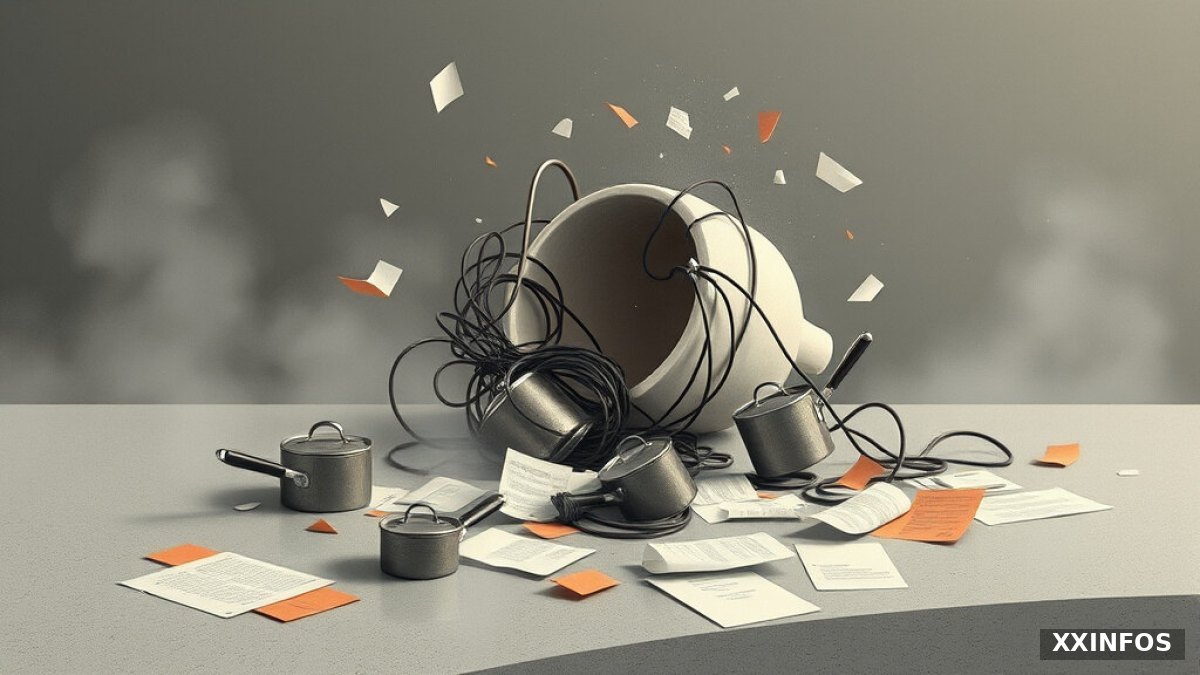
Heres a set of FAQs for Cables Saucepans and Confidences The Day Everything Leaked a story about a day when cables cookware and secrets all failed at once
Beginner Questions
1 What is Cables Saucepans and Confidences The Day Everything Leaked about
Its a story about one chaotic day when three things go wrong at the same time electrical cables fail saucepans leak and secrets people trusted each other with get exposed
2 Is it a real event or a fictional story
Its a fictional story The title uses leaked in three senses cables leaking power or signal saucepans leaking liquid and confidences leaking out as gossip
3 Who are the main characters
The characters are ordinary people connected to each other neighbors coworkers or family whose cables kitchens and secrets all intersect on the same day
4 What does confidences mean in the title
Confidences are private things people tell each other in trust When a confidence leaks that trust is broken because the secret gets out
5 Whats the main theme
The theme is that small failures add up and trust is fragile One leaky cable one leaky pot and one loose tongue can unravel a whole day
6 Do I need technical knowledge to follow it
No The cable and saucepan problems are described in plain language and the story focuses on how people react rather than on technical detail
7 Whats a simple example of a leak in the story
A pot left on the stove boils over and ruins a meal a frayed cable shorts out the power and a secret told to one person spreads to everyone by evening
Advanced Questions
8 How are the three types of leaks connected
They mirror each other A cable leak is a physical failure a saucepan leak is a domestic failure and a confidence leak is a social failure and in the story each one makes the others worse
9 What common problems cause cables to leak or fail
Frayed insulation loose connections water damage and overloaded circuits Practical tip check cables for cracks keep them away from water and dont overload sockets