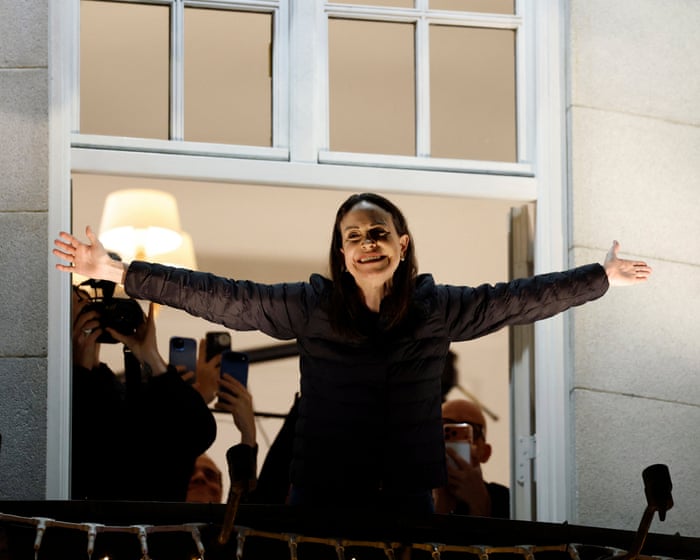
The American who claims to have led the operation described María Corina Machado’s escape from Venezuela as a long, “scary,” and very wet nighttime sea crossing made in total darkness.
Bryan Stern, a U.S. special forces veteran who heads a nonprofit rescue organization, detailed the mission in a CBS interview published Thursday. This came after the Venezuelan opposition figure appeared in Norway following the Nobel Peace Prize ceremony.
“It was dangerous. It was scary,” Stern said, describing the dark and rough conditions that also provided useful cover for the escape. He recalled meeting Machado at sea after she left Venezuela, where she had been in hiding since August 2024, fearing persecution by President Nicolás Maduro.
According to CBS, she boarded his boat for a 13- to 14-hour journey to an undisclosed location to catch a plane. The mission had been planned just four days earlier.
“The sea conditions were ideal for us, but certainly not water that you would want to be on … the higher the waves, the harder it is for radar to see,” Stern explained. “This was in the middle of the night – very little moon, a little bit of cloud cover, very hard to see, boats have no lights. All of us were pretty wet. My team and I were soaked to the gills. She was pretty cold and wet, too. She had a very arduous journey.”
“She was very happy. She was very excited. She was very tired,” Stern added, noting that about two dozen people were directly involved within his team.
A representative for Machado confirmed to CBS that Stern’s company, the Grey Bull Rescue Foundation, was behind the operation, which began on Tuesday.
This account follows a Wall Street Journal report that Machado wore a wig and a disguise to flee her hideout in a suburb of Caracas, Venezuela’s capital. Stern did not reveal details about the land operation, citing his company’s future work in Venezuela.
He told CBS the mission was financed by “a few generous donors” – none of whom were U.S. officials. “The U.S. government did not contribute a single penny to this operation, at least not that I know of,” Stern said. However, he added that his group did “unofficially collaborate” with the U.S. military regarding positioning and plans, largely to avoid being targeted by airstrikes.
Machado stated on Thursday that she had U.S. support to leave Venezuela. She has announced plans to return home, though it is unclear how or when she will do so.
Stern said his group would not be involved in that return operation, as they only work on getting people out of countries, not back in. “That’s for her to determine and for her to decide. But I think she should not go back. But she wants to. Maria is truly inspirational,” he said.
Frequently Asked Questions
Of course Here is a list of FAQs about the reported escape of Venezuelan opposition figure María Corina Machado framed around the story of a US special forces veterans alleged involvement
BeginnerLevel Questions
1 What is this story about
This story reports that María Corina Machado a prominent Venezuelan opposition leader banned from running for president secretly left Venezuela with the help of a retired US Army Green Beret She described the journey as dangerous and scary
2 Who is María Corina Machado
She is a Venezuelan politician and former legislator She is the main opposition candidate who overwhelmingly won a primary election to challenge President Nicolás Maduro but was later barred by the government from holding public office
3 Why did she need to escape Why not just take a flight
As a banned candidate facing government pressure she was likely under surveillance and her movements were restricted A clandestine escape via an overland or maritime route was seen as the only way to leave the country without being detained by Venezuelan authorities
4 Who helped her and why is that significant
Reports indicate she was helped by a retired US Army Special Forces veteran This is significant because it suggests a level of professional clandestine operational planning typically associated with highstakes extractions rather than a simple border crossing
Intermediate Advanced Questions
5 What does dangerous and scary likely refer to in this context
It refers to the highrisk nature of evading Venezuelan state security military and colectivos while traversing remote and often lawless border regions Risks included arrest interception or physical danger during the journey itself
6 What possible routes could they have taken to escape Venezuela
While not confirmed the most speculated routes are
Overland through Colombia Crossing the vast porous and often guerrillacontrolled border
By sea from a remote coastline A small boat journey to a nearby island like Aruba or Curaao or to Trinidad and Tobago
Through Brazil Using the remote Amazonian border region
7 Is it legal for a former US special forces soldier to do this
Its a legal gray area A private citizen can generally travel and offer