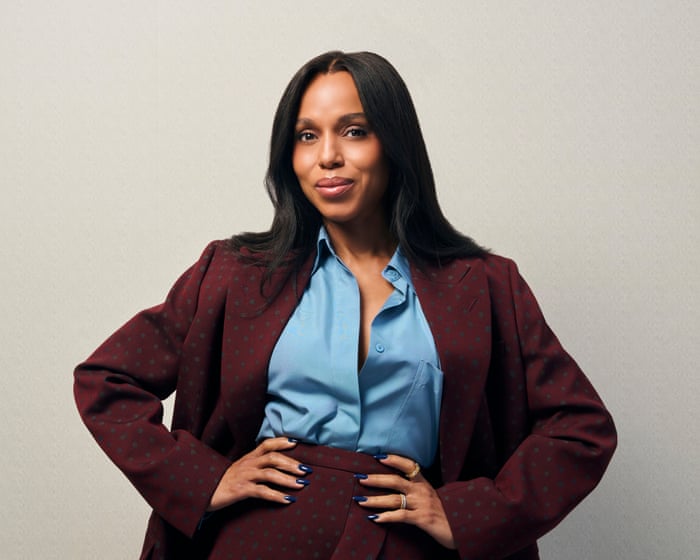
To say Kerry Washington acts with teeth is a fitting double entendre. Literally, her dramatic facial expressions have become internet staples, immortalized as reaction GIFs and favorites among online impressionists. But it also speaks to the roles she chooses—complex women with bite who defy easy categorization. Her portrayal of Olivia Pope, the sharp political fixer in ABC’s Scandal, became a global phenomenon and marked the first time in nearly 40 years a Black woman led a network series.
Now Washington returns with a project featuring not one but three complicated leading women. Imperfect Women, Apple TV’s adaptation of Araminta Hall’s novel, pairs Washington with Elisabeth Moss and Kate Mara in a glossy murder mystery centered on female friendship—its love, loyalty, secrets, and rivalries.
“In the world we live in, there’s so much pressure for women to look a certain way, behave a certain way, to please and conform,” Washington reflects during our meeting in London. “So when we break the rules, when we get messy, it’s riveting.”
Imperfect Women has already drawn comparisons to hits like Big Little Lies and The White Lotus. Like the former, the drama unfolds among the wealthy in California, but here the connection is three old college friends: Eleanor (Washington), an award-winning philanthropist from a wealthy family; Nancy (Mara), whose marriage into high society masks her humble origins; and Mary (Moss), a stay-at-home writer and mother married to a professor. It presents a “choose your fighter” lineup of idealized womanhood—until, much like in The White Lotus, family secrets, trauma, and enduring divides of class and race come to light.
Fans of Washington’s expressive range will relish her performance as Eleanor veers from one high-stakes emotional moment to another—betrayed by a loved one, disbelieved by authorities, all while grappling with the unease of being watched and judged (a pressure that feels distinctly female). These are classic themes of psychological thrillers, though it raises the question: in an age of social media, isn’t this loss of privacy now the norm? Aren’t we all living this nightmare—Washington especially, as a celebrity?
“When something goes viral, it’s so overwhelming,” she says. For Washington, living without privacy—”with the inability to control something once it’s out there”—is deeply frightening. She recalls filming a scene where her character’s romantic life is leaked online: “People from my production company said, ‘We’ve never seen that side of you—the anger and terror coexisting in your body.’”
How does a show like Imperfect Women, which aims to create fully three-dimensional female characters, navigate audience reactions to “messy” women? It’s often said that while male antiheroes on TV are allowed moral ambiguity (think Tony Soprano or Walter White), antiheroines still must be ultimately “good”—redeemable, with their actions psychologically explained—to keep viewers engaged. Did this show face the same pressure to make its “imperfect” women sympathetic?
Washington challenges that notion. In Imperfect Women, she explains, there is no single fixed truth; viewers are invited to see events from multiple perspectives.Each of the women’s perspectives is, as Washington says, “one of the really important elements”—to consider a point of view other than your own. “At a time when we are so tribal and so unwilling in our culture to see things from somebody else’s perspective, I think allowing an audience to actually walk through a set of facts from multiple points of view is a real exercise in empathy and sympathy—and a service.”
With all this talk of meaty characters, one might think there is a glut of complex female roles these days. “It’s better than it was. And I think it’s mostly better because so many of us have become producers.” Washington is an executive producer on Imperfect Women through her company Simpson Street (which was also behind her work on the multiple Emmy-nominated Little Fires Everywhere—another book-to-TV adaptation that focuses on messy female relationships). The same goes for Elisabeth Moss and her company, Love & Squalor Pictures. “We’re not sitting at home waiting to be invited to the party. We’re throwing our own parties, and our parties center us. That’s part of why there are more of these stories. It’s not by any means equitable. But it’s a lot better.”
I’m curious whether she feels the same about roles for women of color. It’s said that the only reason the much-loved character of Olivia Pope in Scandal was allowed to remain a Black woman was because she was based on a real-life Black woman, Judy Smith, George W. Bush’s deputy press secretary. Otherwise, chances are the network would have found it too risky. Has that changed since she herself rewrote the formula of who can be a leading lady?
“A little, but there’s also tremendous backlash. There’s a denial of DEI and reversal of policy, so though I think it had gotten better, there’s a lot of pulling in and retreating from inclusivity.”
In the original novel, the three main women are white. They’re also British in the book (they meet at the University of Oxford), but in the TV show they’re all from the U.S. (though I suspect that bit of creative license is unlikely to attract the same ire from those furious about colorblind casting). What would she say to people who might take umbrage at these tweaks?
“I mean… do I have to say anything to them, or do I just let them be on their merry way?” she replies wryly. It is a pleasure to see her bat this—and perhaps in turn, them—away so elegantly.
But she gives a little more. “It is what it is. It adds something. It adds more complexity and more depth, and I don’t think there’s a right or wrong. I just think we’ve cast a Black woman in this role, and it allowed us to play with some different themes and ideas. I also had to ask myself: who is this Black woman who only has white friends? Why?”
I tell Washington that in my research for this article, I came across an interview with her for Bloomberg where she pressed quite strongly that her work with Simpson Street is not political. (“It’s just human,” she says in the interview.) Yet much of what we’ve discussed is quite clearly political. Why did she feel the need to say that?
“People need to be challenged on what it means to create political work. Because when they see work that centers somebody that exists on the margins, they insist that’s political. But I think it’s just inclusive. So when I center myself, I’m not carving out a space to say something political. I’m just honoring that I’m a human and I deserve to have my story told.”
“To say to artists of color that centering ourselves is an inherent political act, as opposed to a creative one, feels unfair.”Courtesy of Apple
It’s worth noting that, setting aside grand debates about the relationship between politics and art, Washington is political in the partisan sense. She has campaigned for Democrats and worked to encourage voter registration. Surely she doesn’t object to the label?
“I don’t mind it. I said this when I spoke at the Democratic National Convention a long time ago: ‘You may not be thinking about politics, but politics is always thinking about you.’
“Really, everything is political. Centering white characters is also political from my perspective. Encouraging empathy and compassion—which I believe the show does—is political. I just don’t think the responsibility should fall only on women or artists of color who do that. Everyone telling a good story is engaging in that political act.
“So I don’t mind the association, but I also want to be able to be an artist without being accused of having an agenda.”
Time is short, but before I leave, I have to ask her about the memes. “It’s an accolade!” I say brightly.
She doesn’t seem as enthusiastic. “Is it? Why?” she asks.
It seems obvious to me: it shows a unique acting talent. After all, not many have that extra visual storytelling ability—but I also have a theory that in the age of Botox, women having expressions is really important.
Washington agrees. “There’s a study about young men struggling to embrace emotion from their female partners because they grew up with mothers who didn’t express feelings.
“Actors are such strange people. We wait at home for a phone call asking us to cry. But feelings are good. I like having feelings. I’m not afraid of a dermatologist—I love a laser, and I think being proactive about aging gracefully is beautiful. But I also know my job is to have feelings.”
Imperfect Women is on Apple TV starting March 18.
Frequently Asked Questions
FAQs Kerry Washington on Ageing Gracefully
BeginnerLevel Questions
1 What does ageing gracefully mean
It means embracing the natural process of getting older with a positive proactive attitude It focuses on overall wellbeingmental physical and emotionalrather than just fighting visible signs of ageing
2 What is Kerry Washingtons main message about ageing
Her message is to be proactive about your health and selfcare but to also embrace your imperfections and find joy in the journey Its about balance not perfection
3 What does proactive mean in this context
It means taking steps before you feel you need to like establishing healthy skincare fitness and mindfulness habits early on to support your longterm wellbeing
4 Does she use Botox or other treatments
While she hasnt ruled anything out she emphasizes that her approach is about overall health and selfacceptance first She is more focused on feeling good than on adhering to strict beauty standards
5 Whats the deal with the memes she mentions
She talks about laughing at memes that poke fun at the ageing process Its an example of not taking yourself too seriously and finding humor in shared experiences
Advanced Practical Questions
6 How can I be proactive about ageing if Im in my 20s or 30s
Start with sunscreen daily develop a consistent skincare routine prioritize nutrition and regular exercise and cultivate stressmanagement practices like meditation Building these habits early has longterm benefits
7 What does embracing imperfection look like in practice
It means challenging the idea that you must look a certain way It could be going without makeup sometimes not digitally altering your photos or speaking kindly to yourself about lines or changes in your body
8 What are the benefits of this mindset over a purely antiageing one
It reduces anxiety and shame associated with getting older It leads to a more sustainable holistic form of selfcare that improves your quality of life not just your appearance It fosters resilience and selfconfidence
9 How do I handle societal pressure to look young
Curate your social media feeds to follow people who promote body positivity Practice affirmations that value your experience and character over just your looks