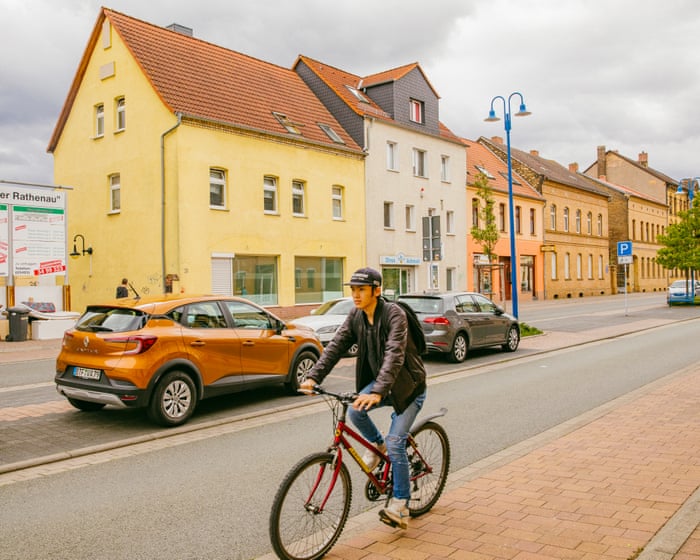
“Bitterfeld, Bitterfeld, where dirt falls from the sky,” people used to say. Situated in the heavily industrialized Chemical Triangle of East Germany, Bitterfeld was known by the 1980s as Europe’s dirtiest town. Its chemical plants and lignite mines poured toxic waste into rivers, and the air carried concentrations of sulfur dioxide about 40 times higher than today’s levels.
Europe was soon shaken out of its postwar dependence on heavy industry, turning instead to cheap imports from overseas. In the final days of East Germany, environmental activism delivered the final blow. The 1988 release of the undercover film Bitter Things from Bitterfeld exposed the shocking living conditions in the Chemical Triangle, and the city’s chemical plants were quickly shut down.
Since then, a deep-seated belief has taken hold across Europe: the noise, grime, and smoke of heavy industry represent a stage of development to be left behind. Old factory districts and docks have been transformed into cultural spaces, while tourists now raise glasses in urban squares that were once parking lots. Picturesque European cities regularly top global livability rankings, and more than 40% of UNESCO World Heritage sites are located on the continent. Germany’s Chemical Triangle was reborn in the early 2000s as Solar Valley, revitalized as a photovoltaics hub that once produced world-leading solar cells.
Europe sent much of its industry away, but we still enjoy its benefits: global supply chains deliver cheap goods in neat packages. And while our cities are beautified with good intentions, they are increasingly becoming markets for consuming that beauty—streetscapes fill Instagram feeds just as homes turn into Airbnbs. Meanwhile, the average resident, faced with shrinking job opportunities outside tourism, is being priced out of their own hometown. When heavy industry moved offshore, its jobs went with it.
Today, a staggering share of the products Europe consumes are made elsewhere. As of 2023, China accounts for over 80% of global solar manufacturing and a majority of wind turbine installations. At the same time, much of the vital digital infrastructure that powers both work and leisure originates on the U.S. West Coast. Sadly, Bitterfeld’s Solar Valley has fallen on hard times, its startups overwhelmed by subsidized foreign competition. The reality today is that Europe’s “quality of life” has become a subscription service provided by others, powered by coal from Xinjiang and energy-hungry data centers in Virginia.
This creates serious vulnerabilities for Europe, and warning lights are flashing in the halls of power. Since Mario Draghi’s 2024 report on European competitiveness, Brussels has been anxiously debating how to bring productivity back to the continent. The most significant outcome is the Industrial Accelerator Act, which will set quotas for European-made components in public contracts and subsidies. Mindful of both environmental concerns and self-sufficiency, it aims to support sectors like solar and wind energy and battery production. Yet lawmakers hesitate to force businesses to buy from smaller European suppliers, and there will be much debate over whether to push for “Made in Europe” or settle for “Made with Europe.”
Without the scale needed to achieve efficiency and affordability, European reindustrialization risks becoming merely a vanity project. Consider the solar panel, that symbol of sustainability. Europe’s largest factory is Enel’s 3SUN Gigafactory in Catania, Sicily. This 60-acre site opened recently with great fanfare and can produce 3GW of solar capacity per year—enough to power roughly a quarter of London’s buildings. The EU currently aims to produce ten times that amount: 30GW of solar panels annually.Building three more factories the size of 3SUN would meet the annual production target. The challenge is that a solar panel assembly plant is just the final, smallest step in a much longer chain. A photovoltaic panel begins largely as sand, which must be melted at extreme temperatures over several days to produce polysilicon ingots—an energy-intensive process currently operating at a very small scale in Europe. These ingots are then sliced into wafers, the wafers are cut into PV cells (steps Europe also doesn’t perform), and finally the cells are assembled into panels.
To understand the scale required, consider JA Solar’s facility in China, which is designed to produce—from sand to finished panel—roughly the EU’s annual goal of 30GW of solar capacity. It spans 172 hectares, seven times larger than the Tango site in Sicily and about half the size of central Amsterdam. It also demands enormous amounts of energy, since nearly 90% of the solar value chain’s energy is consumed before panel assembly. Coal plays a major role in China’s electricity supply, providing 6,300 TWh annually—double the EU’s total electricity generation—and powers about 60% of its combined solar panel production. If Europe were to move away from coal, where would this energy come from?
Solar panels are just one example. Similar complex supply chains exist for wind turbines, batteries, and computer chips. Behind any product “made in Europe” lies a maze of ordinary intermediaries—whether it’s Russian fertilizer for Spanish tomatoes, Middle Eastern plastics for German medical devices, or Chinese vitamin B1 to fortify cereals made in France. Our industrial backbone has its own sprawling, massive backbone: it is largely located outside Europe and is currently far less environmentally friendly than we like to admit.
Given Europe’s limited available land, reindustrialization would require new approaches to construction and some truly creative thinking. Could future production be woven into landscapes or even integrated into our cities in novel ways? What if a factory could relocate or adapt to build products where and when they are needed? What if infrastructure also served as protective habitats for plants and animals? Could we redesign our technologies to harness overlooked local resources, like the kinetic energy from traffic and pedestrians? (Tourist foot traffic could take on a whole new purpose.) Current necessities could indeed give rise to significant innovations.
Even if such new forms become possible, the vast industrial areas needed would inevitably alter many picturesque views. But it’s worth remembering that the heritage sites we cherish in Europe today were often practical engineering solutions to past needs. Georges-Eugène Haussmann’s grand Parisian boulevards organized transport and sanitation in an unsanitary medieval city; the canals of Venice were originally trade routes and production lines for the ships that underpinned the Republic’s dominance. Designing modern industry closer to our daily lives could well create the heritage of tomorrow.
Europe is starting to confront the material reality that supports its way of life. Will we accept that a livable future isn’t just about green spaces, but will also require a substantial measure of grey industry?
Hans Larsson is an architect at OMA/AMO
Frequently Asked Questions
Of course Here is a list of FAQs about achieving clean green European cities alongside a thriving industrial revival framed in a natural conversational tone
Beginner Foundational Questions
1 What does a clean green city actually look like
Its a city designed for people and nature Think excellent affordable public transport abundant parks and green spaces clean air energyefficient buildings widespread cycling lanes and effective recycling systemsall powered by renewable energy
2 Can industry really be green Isnt that a contradiction
Not anymore A green industry focuses on producing goods with minimal environmental harm This means using renewable energy recycling materials designing for longevity and developing new technologies like carbon capture or green hydrogen
3 Why is creative thinking so important for this goal
Because the old modelwhere industry pollutes and cities clean up the messdoesnt work We need creative solutions that see industry and city life as interconnected parts of a single system where ones waste can become the others resource
4 Whats the benefit for me personally
Healthier living with less pollutionrelated illness lower energy bills in efficient homes more pleasant and quieter public spaces and new job opportunities in emerging green sectors
Intermediate Practical Questions
5 Whats a concrete example of this creative thinking in action
Imagine a factory where its waste heat is captured and piped to warm nearby homes and offices Or a data center that uses its excess heat for a vertical farm growing local vegetables This turns a cost into a resource
6 Whats the biggest obstacle to making this happen
Often its siloed thinking City planners industrial companies and energy providers work separately with different goals and budgets Creative thinking requires breaking down these barriers and fostering collaboration
7 Wont this green transition just move pollution and jobs to other countries with weaker rules
This is a major risk known as carbon leakage The creative answer is to develop such advanced efficient and desirable green technologies and products that they become the global standard keeping highvalue manufacturing and innovation in Europe
8 How can old industrial cities with legacy infrastructure possibly adapt
This is where creativity is key It can involve rep