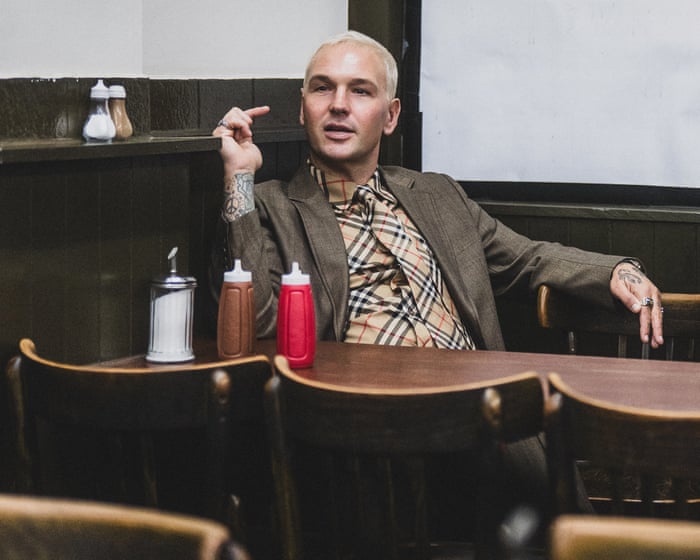
“I hated being famous,” Samuel Preston says. “I hated, hated, hated it.” Twenty years ago, Preston—who went by his surname in a nod to Morrissey—was experiencing a particularly intense kind of fame. He had first gained recognition through NME with his Worthing band, the Ordinary Boys, whose socially aware, ska-inflected indie-punk built a devoted cult following known as the Ordinary Army, thanks to hits like “Boys Will Be Boys.” But it was his appearance on the 2006 season of Celebrity Big Brother, and the public’s fascination with his on-again, off-again relationship with fellow contestant Chantelle Houghton—the “fake” celebrity planted among the B-listers—that catapulted him to a new level of notoriety.
After leaving the show, he recalls, “I was on loads of Prozac. I was in a weird space.” Now, after spending years on and off in the U.S., building a successful career as a songwriter for hire (working with artists like Kylie Minogue, Cher, Olly Murs, Liam Payne, and Jessie Ware), and surviving a near-death experience and an OxyContin addiction, Preston is reviving the Ordinary Boys. The band’s new single, “Peer Pressure,” is their first release since 2015, aside from a Christmas single with Olly Murs.
“I’m very experiential,” he says. “I’ll do anything twice.” Dressed in a Martin Parr T-shirt, with his hair cropped and bleached, the 44-year-old Preston is sitting upstairs at east London’s Strongroom venue. Two days earlier, the Ordinary Boys played their first gig in a decade there. While he feels no nostalgia for the mid-2000s UK indie scene (“literally the only time there’s been no redeeming music except for about three bands”), he admits that revisiting the band’s 2004 debut, Over the Counter Culture, and its 2005 follow-up, Brassbound, made him realize they had something to say. “Every song on the debut was: don’t get a job, capitalism is bad. We were a political band in our way.” He hadn’t fully recognized it at the time. “Billy Bragg rang me up and said, ‘I think you’re doing something really important.’” He smiles. “But then two months later, I went on Big Brother.”
When the offer came, he accepted immediately. “I’m very experiential,” he repeats. “I’ll do anything twice.” His bandmates were unhappy, but he defended the decision—to them and to himself—as “some kind of Warholian, ironic art piece.” That season of CBB featured a memorable cast: Pete Burns (“the coolest guy ever”), George Galloway (“evil energy”), and Michael Barrymore (“a sweet guy, he made the best toad-in-the-hole I’ve ever had”). Jimmy Savile made a brief guest appearance. “Horrible. The evil radiated off him.”
But it was Preston and Houghton’s flirtation that truly captivated the public—especially since everyone knew Preston had a girlfriend, Camille Aznar, waiting at home. It thrust him into a tabloid storm. “It quickly became a nightmare,” he says.
One of his first moves after Big Brother was a tell-all story and photoshoot for the Sunday Mirror. “They made me take my clothes off. And I didn’t want to. It was so uncomfortable.” He appeared on the front page topless, sandwiched between photos of Houghton and Aznar, framed as a man torn between two women. His mother has a framed copy of that front page hanging in her downstairs toilet. “I don’t think she realizes quite how triggering it is every time I take a piss.”
He married Houghton in August 2006, eight months after they met. “Of course we fell in love. We trauma-bonded through this intense experience.” They became the celebrity “it” couple of the moment, and despite his claims today, Preston seemed to relish the attention at the time: TV appearances, glossy magazine covers, film premieres. He and Houghton…The Houghtons sold their wedding photos to OK! Magazine for a reported £300,000 each. “I stand by that,” he says. “All these footballers would do it, why not me?”
Preston claimed—and still does—that the band’s third album in 2006, How to Get Everything You Ever Wanted in Ten Easy Steps, was a commentary on celebrity from inside the machine. Written quickly with help from his “great friend” Will Self to capitalize on his newfound fame, he says, “I said, ‘I’m gonna make an album about this insane world.’ But I scaled the walls to find it intense and cruel and weird. I think that’s why that album sounds so strange. That’s what ‘Lonely at the Top’ is about. Suddenly there’s a million people around you and you don’t even know if they like you or not.”
But rather than being a self-satirizing participant in some Warholian experiment, I suggest he actually appeared to be straightforwardly fame-hungry. “I think that’s very fair, but I don’t know if those things cancel themselves out,” he replies. “Because there’s fame-hungry and there’s being curious. It wasn’t, ‘I can’t wait to be famous. I’m gonna have a really expensive car.'” He seemed to think acceptance into the club was a validating achievement in itself. “I was a nerd at school. A spiky-haired, total background guy. No one ever fancied me. So when I stepped out of Big Brother it was like, ‘I’m in, I’ve made it!'”
However, “then I found that world completely unchangeable. And the only way to survive seemed to be to contort myself to a shape that fitted within the boundaries of whatever they wanted. I relinquished control.”
He was constantly followed by paparazzi, and had people going through his trash. “It was that Nuts and Zoo Weekly magazine era. The way that people were talked about—’Preston looks fat today’—it was just awful.” Moreover, his phone was hacked. In 2018, Preston was one of 16 celebrities who settled phone-hacking claims with News Group Newspapers, receiving substantial damages. “Phone hacking was a huge part of that whole ordeal,” he says. Going somewhere only to find paparazzi already waiting for them “really made me doubt everyone. ‘Who the fuck told you that we were going to be here?'”
In January 2007, he made his infamous appearance on Never Mind the Buzzcocks, walking off mid-show after host Simon Amstell mockingly read passages from Houghton’s memoir, Living the Dream. Houghton was in the audience. “That’s a proud moment,” Preston says. “It was actually cruel and classist. I really don’t know what other choice I had.” But by the end of the year, his marriage had fallen apart, and in early 2008 the Ordinary Boys broke up. The initial post-Big Brother career surge—with Brassbound going gold and three Top 10 singles—declined just as sharply. “We hated each other by that point,” he says of his bandmates.
He bought a one-way ticket to Philadelphia, his mother’s home city, and tried to launch a solo career with a single, “Dressed to Kill,” which sampled Siouxsie and the Banshees. After it failed to chart, he retreated into songwriting-for-hire: Cher later covered “Dressed to Kill,” and a song from his scrapped solo album, “Heart Skips a Beat,” became a No. 1 hit for Olly Murs.
In 2015, the Ordinary Boys returned with an almost entirely ignored self-titled pop-punk album—”a great record, but we didn’t engage with it”—and two years later, Preston nearly died the night before a songwriting camp in Denmark. Drunk on free champagne, he took a sleeping pill andHe fell from a second-floor balcony and was airlifted to the hospital, where he was told he would never walk again. “I remember just thinking, ‘Come on, don’t be daft,’” he says. He used a wheelchair for six months and has several metal plates in his body. He stands up and pulls down one side of his trousers to reveal a large scar running down his leg. He says he’s now in better shape than ever, but during his recovery, he became addicted to OxyContin. “I got four different doctors to prescribe me the maximum amount I was allowed,” he says with a rueful smile. “I’m an idiot for doing that.” After a year of “dread and horror,” he quit cold turkey. “I had a weekend where I vomited and shook in bed, convulsing. It was awful.”
He wrote a song about his accident called Live Forever and gave it to his good friend and collaborator, Payne. The One Direction singer released his version in 2019. “And then he falls off a balcony and dies,” Preston says, shaking his head in disbelief. “There are certain things that happen in your life where you just cannot believe this is a real set of circumstances.”
He describes Payne as “a very funny, sweet, kind guy. Misunderstood. A great talent.” But he acknowledges that the songs Payne co-wrote with him were often “undisguised cries for help.” The two would discuss the pressures of fame together. “I saw a lot of him in me, because we both suffered. I massively wish I’d been able to do more. But as for some kind of intervention, I don’t think I had that role in his life.” He says Live Forever “was me trying to say, ‘Look, man, this thing happened to me.’ But it’s hard to give people advice if they’re not ready to receive it.”
For the past three years, Preston has lived in LA—“the land of inequality”—writing hits for Sum 41 and the K-pop band Tomorrow X Together. But he recently asked himself: what would really make me happy? “With the songwriting, I felt as if I was following someone else’s dream. I’ve had 20 years of messing around in studios trying to write music I didn’t necessarily like.”
As for regrets, he says, “I see my peers that have carried on”—mid-2000s NME bands like the Kooks and the Wombats—“are selling out huge arenas.” It sounds as though he’s still chasing the fame he claims to despise, but he makes a distinction. “I like people being into my music. Being a famous musician is totally different. If I’d put in more hard work, maybe I could have done that instead, and I would be in a very different position.”
After Peer Pressure—which he calls “me trying to write the quintessential Ordinary Boys song”—he’s now working on the band’s comeback album. “The main thing in my life now is making some really good stuff.” He says it will be political, focusing on “the things I feel passionate about”: billionaires, AI, the manosphere, and “the general hellscape that the world has become.”
He admits he’s unsure how the comeback will go. “I’ve had a very confusing career. I’ve alienated my fanbase over and over again.” But he’s finally committed to the Ordinary Boys once more. “This has focus,” he says. “I want to do it again. I want to do it bigger. I’m really ready.” Peer Pressure is set for release on 17 April via Scruff of the Neck Records.
Frequently Asked Questions
FAQs Preston The Ordinary Boys Fame Fallout Reunion
1 Who is Preston and what is he known for
Preston is the frontman of the British indie band The Ordinary Boys He became widely known in the UK after appearing on the reality TV show Big Brother in 2006 which catapulted him and the band to sudden intense fame
2 What does fame quickly turned into a nightmare refer to
It refers to Prestons experience after Big Brother The instant celebrity status led to intense media scrutiny public criticism and personal struggles that overshadowed the music making the aftermath of fame a negative and overwhelming experience
3 What happened with the terrifying balcony fall
In 2006 shortly after his Big Brother stint Preston fell from a secondstory balcony at a party suffering serious injuries including a punctured lung and broken ribs The incident was a stark physical consequence of the chaotic lifestyle that followed his sudden fame
4 How did Big Brother affect The Ordinary Boys career
While it massively increased their public profile and shot their single to number one it also typecast the band as a reality TV novelty for many alienating some original fans and creating tension within the group about their musical credibility
5 Why did The Ordinary Boys break up
The band initially split in 2008 due to the pressures and fallout from their postBig Brother fame creative differences and the difficulty in being taken seriously as musicians after being seen primarily as reality TV stars
6 What led to the bands reunion
Years later with the intense scrutiny faded the band members reconciled over their shared history and love for the music they created They realized there was an audience who appreciated their songs outside of the TV drama leading to a reunion for touring and recording
7 What is Prestons reflection on that period now
He views it as a cautionary tale about the dangers of instant mediadriven fame While grateful for the bands fans he acknowledges the personal cost and chaos and now values a more balanced life and a focus on the music itself
8 Are The Ordinary Boys still making music
Yes following their reunion they have performed live and released new music engaging with their audience on their own terms separate from