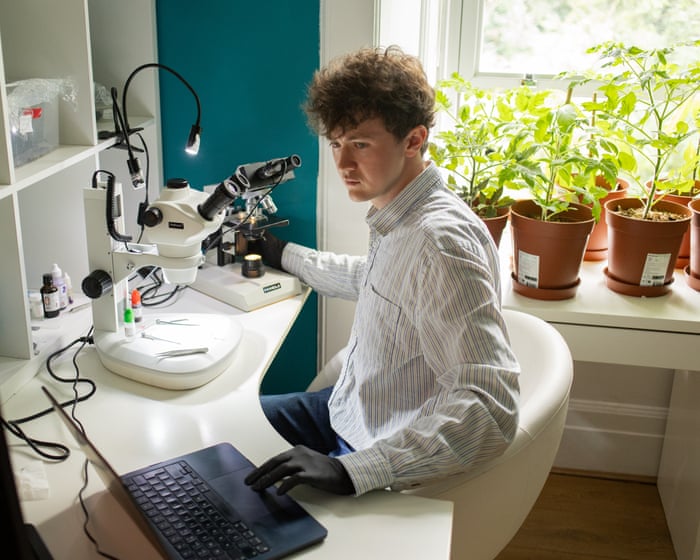
Alfred Drummond-Herdman might be the only person in the UK who gets animal droppings sent to him in the post as a kind gesture. His bedroom in Edinburgh is packed with the stuff: his wardrobe and cupboards have been cleared out to make room for terrariums and plastic boxes filled with bits of cowpats, grouse droppings, and rabbit pellets. “I have a very understanding housemate,” he says.
But what comes out of those containers has turned the 27-year-old trainee lawyer into a social media hit in the natural history world: vivid, twisted shapes of fungi, captured every 30 seconds as they grow and turned into timelapses that millions of people around the globe watch.
Inkcaps, fieldcaps, and ascobolus—which look a bit like barnacles—all sprout from the dung he collects, including two new species he has officially identified, with more on the way. These stunning images offer a rare peek into a world that surrounds us all, but that almost no one ever sees.
Drummond-Herdman is a self-taught amateur taxonomist who got hooked on fungi that grow on dung, called coprophilous fungi, while walking in the Ochil Hills near Stirling during the pandemic.
Cowpats from highland cattle, like those of many other plant-eaters, are home to thousands of fungal spores. These spores race to produce mushrooms from the moment the dung hits the ground.
“One summer in Scotland, I came across cowpats with all sorts of mushrooms growing out of them. It was like a little forest. It was so strange, you couldn’t miss it. I looked them up online to identify them, and that’s really where I fell down the rabbit hole, and I’ve been going deeper ever since,” he says.
According to estimates from Kew, at least 2 million fungi species are still waiting to be discovered worldwide. From his Edinburgh bedroom, Drummond-Herdman is doing his part, teaming up with other enthusiasts and experts on forums to study and identify British species.
He has gained over 60,000 followers on Instagram, and some of his posts rack up millions of views. One of his latest is a video of a slime mould, nicknamed dog’s vomit slime mould, seemingly eating a live ant. Another shows a conecap mushroom growing on deer droppings.
“I’m fascinated by how bizarre it is—the contrast between something like a cowpat, which is the last thing anyone wants to be near, and the incredible beauty and complexity of the fungi. Usually, when you see these in the wild, you only catch a brief moment of their life cycle. The timelapses show the whole story,” he says.
Through a webcam, Drummond-Herdman shows me his microscope setup and the containers placed around his bedroom. He explains that the boxes of dung don’t smell because they come from herbivores and are mostly undigested plant material. He hopes his videos encourage people to value nature conservation in the UK more, especially fungi.
“I’m trying to spread the word about them in the right way. The point isn’t to name some random species that only ten people read about in a journal. I want to show that taxonomy is at the frontline of biodiversity research. Studying habitat loss and native species means nothing without it,” he says.
Frequently Asked Questions
Here is a list of FAQs based on the scenario you provided ranging from basic curiosity to deeper concerns
1 What exactly is the project about
Answer Its a science or art project where a student is documenting the growth of fungus on animal droppings over time using timelapse or regular video
2 Why would anyone film fungus on animal poop
Answer To study decomposition the life cycle of fungi and how nutrients cycle back into the soil Its also visually interesting because some fungi look like tiny alien forests when magnified
3 Is it dangerous to have that in the house
Answer It can be if the droppings are fresh or from unknown animals However if the droppings are dry sealed in a container and the student is only filming through glass the risk is low The spores can still be an issue for people with asthma or allergies
4 What kind of animal droppings work best
Answer Herbivore droppings are best because they contain undigested plant matter that fungi love Carnivore droppings rot and smell terrible so they are rarely used
5 My housemate understands medoes that mean they help with the project
Answer Not necessarily It usually means they dont complain about the weird smell the strange camera setup or the fact that theres a jar of poop in the kitchen corner They get that its for science not weirdness
6 How do you stop the house from smelling like a barn
Answer Use a sealed glass jar or a plastic container with tiny air holes The student should also wear gloves when handling the droppings and keep the setup near a window or in a wellventilated room not in a bedroom
7 How long does it usually take for fungus to grow
Answer Depending on humidity and temperature it can take anywhere from 3 days to 2 weeks The student will need to keep the droppings slightly damp to encourage growth
8 Is this legal or ethical