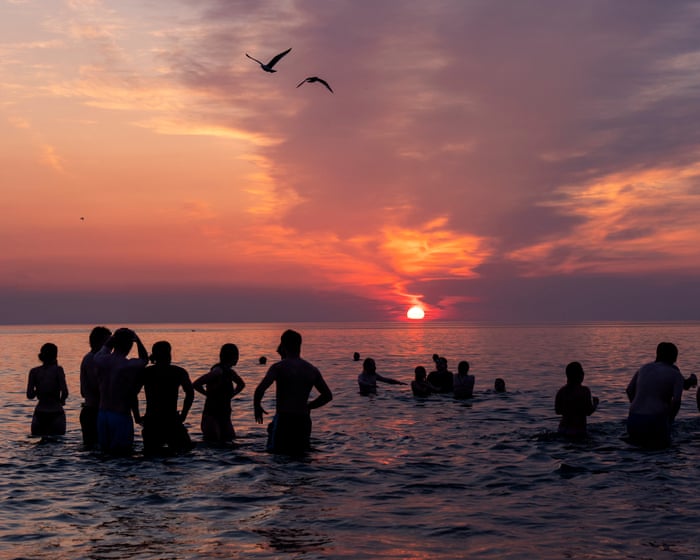
At dawn on Friday, hundreds of students from St Andrews University will brave the cold North Sea for the annual May Dip, a tradition believed to bring good luck in exams. But they won’t be the only ones on the beach. In recent years, this quirky ritual has become a target for agency and freelance photographers looking to make money from images of students in bikinis. Some even camp overnight on the East Sands dunes near the Fife coastal path.
“It ruined my night,” said Anna, one of the students whose photo appeared in a spread published by the Scotsman. “Now when I think about that May Dip, I think about that image, and that’s it.”
Like many of her classmates, Anna didn’t think twice about taking part in the dip at dawn. Hours later, she was in tears after finding a photo of herself in swimwear published online without her permission. “I clicked on it and my heart sank,” she said. “I’m quite insecure about my appearance. I was thinking: how do I get rid of this? How do I make sure no one else sees this?”
She contacted the newspaper right away to ask them to take the image down, but it had already gone to print for the next day’s edition. Anna’s photo appeared alongside dozens of others, mostly of young women, in national newspapers including the Daily Mail, the Scotsman, and the Sun.
Groups of agency and freelance photographers have become known for staking out the event, waiting in the dark with long lenses until sunrise to capture students running into the sea. Although they claim to be documenting the university’s tradition, the images mostly focus on female students.
“It felt like it was just girls in bikinis getting their pictures taken,” Anna said. “It wasn’t a picture of the whole beach – I was in focus, and everyone else wasn’t.”
While the university warns students in advance that they might be photographed, it has no power to stop the press from attending, since the dip takes place on a public beach where photography is unrestricted.
Olivia, another student whose image was published, said she spotted a man with a camera camping on the beach the night before. “He was putting out a one-man tent, hiding in the dunes and camping there from 9pm. It just seems really wrong.” She added: “They know what they’re doing, they know exactly who they’re picking out.”
A spokesperson for the university said: “There are, and always have been, parts of the media that try to sexualise and objectify young women at this event for profit. Every year before the May Dip, the proctor emails students with advice to keep them safe, including a reminder that press photographers often attend and any images taken can spread worldwide.
“We hate this practice, and that’s why we include a specific warning in our communications to students before the Dip. But it’s a symptom of a much bigger societal problem that continues to allow the objectification of women, despite clear evidence of the harm it causes.”
Reader comments under the photos online are often openly objectifying. Olivia said she was disgusted by what she saw under the post she appeared in. One comment on the Daily Mail’s post read: “The 4 in the first picture are fire. Most blokes would pile in.” Another user wrote: “No hippos or tattoos, what a nice change that makes.”
Anna said: “To have comments on your body just feels really repulsive. We’re just girls on the beach in our swimsuits.”
More than 60% of adults in the UK report negative feelings about their body image. For students as young as 18, having photos published online without their consent can be upsetting and harmful to their mental health.
Alex Chun, the president of wellbeing and community at the St Andrews students’ association, said: “I understand the fear of not being able to control your own image.It’s hard to remove something from the internet. You might not even realize your photo is being taken. Seeing it later, especially when it’s been shared by the press, can be really stressful.
Anna said: “It’s a very vulnerable situation to be in. It made me feel uncomfortable. I didn’t even look at it much because I didn’t want to zoom in and overanalyze it.”
The Scotsman, the Sun, and the Daily Mail were contacted for comment.
The names of Anna and Olivia have been changed.
Frequently Asked Questions
Here is a list of FAQs based on the news story about photographers allegedly targeting women at the St Andrews May Dip
BeginnerLevel Questions
1 What is the St Andrews May Dip
Its a traditional event where students and locals run into the freezing North Sea at sunrise on May 1st Its meant to be a fun community celebration to welcome spring
2 What happened that ruined the night for some people
Several women reported that photographers were aggressively taking photos of them in revealing swimwear or while they were changing They felt targeted objectified and that their privacy was violated
3 Were the photos used for anything bad
The main complaint was about the act of taking the photos without asking However there were also concerns that the images could end up online on social media or photography websites without the subjects consent
4 Is it illegal to take photos at a public event like the May Dip
In a public place its generally legal to take photos However the issue here wasnt the legality but the ethics and social norms Taking photos of someone in a vulnerable state without permission is widely considered disrespectful and creepy
5 Did the university or police do anything about it
The University of St Andrews issued a statement reminding photographers to be respectful and ask for consent Student leaders also condemned the behavior Police were present but focused on safety rather than regulating photography
AdvancedLevel Questions
6 How is this different from regular event photography
Regular event photography usually captures the crowd the action or the atmosphere The problem here was targeted photography of specific women often focusing on their bodies and the photographers ignoring requests to stop It felt predatory not documentary
7 What specific common problems did the women report
Photographers positioning themselves near changing areas
Using long telephoto lenses to zoom in on individuals
Following women as they tried to leave the water
Ignoring verbal requests to delete photos or stop taking them
Some photographers were not accredited or part of official media
8 What practical tips can someone take away from this incident