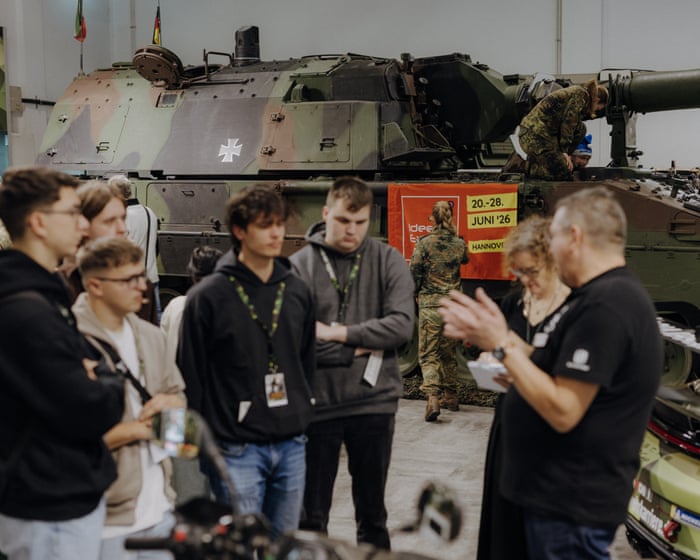
Inside the tight space of a Panzerhaubitze 2000 armored vehicle, 20-year-old Tom listens intently to Achim, a German military officer, who eagerly explains the functions of “the world’s most modern tank” to the students.
“What kind of damage can its ammunition cause?” Tom asks.
Achim responds, “A standard shell has a range of 30 kilometers, and anything within a 100-meter radius of impact would be a direct hit.” The students look at each other in surprise.
They are on a day trip to the Essen Motor Show in western Germany, where the Bundeswehr, or German army, is among the exhibitors. Displaying its offerings—including quad bikes, an armored weapons carrier, VR equipment, and a khaki Porsche sports car—the military hopes to attract a mostly male, all-ages audience to consider a career with them.
The Bundeswehr is undertaking its largest recruitment effort in decades. Experts say the professional military needs to grow by about 80,000 members to 260,000 over the next ten years, with reservists increasing by 140,000 to 200,000 in a similar timeframe.
This extensive public outreach aims to persuade a population, long defined by pacifism due to the scars of the Nazi era, that the military’s primary role is to defend Europe’s largest economy—and that soldiers are not warmongers, but citizens in uniform.
Starting January 1, young men turning 18 must complete a questionnaire assessing their suitability for armed service. In about two years, they will also be required to undergo a mandatory health check, so authorities know who is available if needed for a full-scale war.
To attract more volunteers, the army is raising wages and offering benefits like language courses, subsidized driver’s licenses, free second-class train travel (while in uniform), and opportunities to gain new qualifications.
The motor show is just one of many venues the Bundeswehr is using to recruit. It is setting up career lounges across the country—at sports events, equestrian competitions, supermarket parking lots, and truck stops—while also hosting “discovery days” and women-focused “girls’ days” at barracks and training grounds.
Outside the armored vehicle, Tom, a trainee car mechanic from a vocational school in Aachen, says he needs little convincing about a military career. “I’m finishing my apprenticeship and plan to join the paratroopers to defend my country,” he shares.
Nearby, 21-year-old Luca, an IT specialist from near Koblenz, admires the military’s racing car. He questions why Germany ended conscription in 2011, the year he started school. The official reason was that it was no longer needed after the Cold War, but Luca believes that since Russia’s full-scale invasion of Ukraine in 2022, “it’s very clear how much we need it. Ending it was short-sighted.” Abolishing conscription also dismantled recruitment infrastructure, and rebuilding it has proven costly and slow, everyone agrees.
Luca supports a mandatory year of service for everyone. He says he would be “prepared to defend Germany, but not to go abroad to attack another country.”
Meanwhile, growing numbers of young men are proactively submitting applications to declare themselves conscientious objectors, in case compulsory military service returns.“I wouldn’t go that far myself,” Luca says. “I wouldn’t know how to justify it. But at the same time, I don’t think you can force anyone to serve either.”
Nearby, lift fitters Jennifer and Matthias Schleicher from Erkelenz watch their five-year-old son Erik clamber over a rugged, all-terrain quad bike. “It’s about time our army was strengthened,” Jennifer remarks, partly referring to the billions in military funding unlocked by the previous government—with more to come—after Germany pledged this summer to raise defence spending to 3.5% of GDP by 2029. “For too long we’ve spent too much on other people’s defence while neglecting our own. It’s only right that we adjust that and become ready for war ourselves,” she says.
Like more than 50% of Germans, she and her husband support a conscription model, which 63% of young people oppose. “Views have changed along with the times,” she notes. And if her son Erik were called up to fight? “As a mother, of course it’s difficult, but I can’t shield him if it becomes necessary. The same rules should apply to everyone.”
Specially trained recruiters are on hand to answer questions. Among them is Marco, who oversees the Bundeswehr stand. He says the Essen Motor Show allows the military to reach over 200,000 visitors across ten days. Interest has grown exponentially since they first exhibited here in 2007.
“Back then people would ask, ‘Why are you here?’” he recalls. “Now, with the changed security situation, people are more willing to talk with us and even say, ‘Thank you for your service.’”
Achim, the tank operator, joined in 2006 when he was still well under 18. “I got in with a Muttizettel,” he jokes, using the colloquial term for a mother’s written consent.
Having served in Norway, Lebanon, and France, he says he was never driven by a desire to take part in war, “but to help create such a strong deterrent that no one would even consider attacking us and our democracy in the first place. I firmly believe this has helped keep the peace for over 70 years.”
Frequently Asked Questions
Of course Here is a list of FAQs about Germanys military recruitment in its new era designed to sound like questions from real people
Beginner General Questions
1 What does a new era mean for the German military
It refers to a major shift in policy and mindset following Russias invasion of Ukraine in 2022 Germany is moving from a postCold War army of deterrence to a combatready army of defense that needs to be significantly larger and better equipped
2 Why is the German military suddenly looking for so many new recruits
For decades the Bundeswehr shrank in size after the Cold War The new security threats in Europe have led the government to commit to permanently expanding the military aiming for a strength of 203000 active soldiers by 2031
3 Im not a German citizen Can I join the Bundeswehr
Since mid2024 yeswith conditions The new Opportunity Citizenship Law allows nonEU citizens who have lived legally in Germany for at least 5 years and have a secure residence status to apply Proficiency in German is required
4 Do I have to be super fit and love marching to join
While good basic fitness is required the Bundeswehr has over 1000 different roles They need IT specialists mechanics medics engineers and cyber experts just as much as infantry soldiers Theres a place for many skill sets
5 Is there still mandatory military service
No conscription was suspended in 2011 The Bundeswehr is now a volunteer army However there is ongoing debate about possibly reintroducing a new form of mandatory service for young people which could include civilian options
Advanced Practical Questions
6 What are the main benefits of joining now compared to 10 years ago
The benefits and prospects have improved significantly better starting pay more modern equipment being delivered clearer career advancement paths and a strong sense of purpose given the Bundeswehrs central role in national and European defense
7 Whats the biggest challenge the recruitment drive faces
Its a competitive job market The Bundeswehr is competing with private companies for skilled workers especially in technical fields Changing its image from a bureaucratic institution to a modern tech