It’s quite the scene. Midnight in Tokyo, Usain Bolt is DJing and the launch party for the World Athletics Ultimate Championships is in full swing. Then World Athletics chief executive Jon Ridgeon walks up to me and says, “I read your recent Guardian column, and I thought it was very unfair.”
Imagine Gary Lineker making a two-footed tackle, having never picked up a yellow card in his career. This is the track and field equivalent. Ridgeon, a former world silver medallist in the 110m hurdles, is one of the smartest and most reasonable people in sport. He’s saying, politely, that he’s really rather annoyed.
It’s not that Ridgeon wildly disagrees with my premise that athletics needs to do more to attract Gen Z and stay relevant. But he maintains my column was overly negative, skewed to one side, and didn’t reflect how much World Athletics has transformed the sport.
I enjoy a good debate. So we begin to tease out the arguments and find common ground. At one point, Ridgeon graciously admits that some of his friends agree with me more than him. I respond by saying I should have acknowledged World Athletics’ achievements, including the Athletics Integrity Unit to tackle doping.
But there is still plenty to discuss when Usain pushes the bass to tinnitus-inducing levels and we have to postpone our conversation. Last weekend, though, we finally got the chance to thrash things out. Think of it as Ridgeon v Ingle II: this time we can actually hear each other.
If this were a 1980s tabloid, a photographer might have snapped him planting a boxing glove on my jaw. Instead, after some initial sparring, we get on to why the future is brighter than I suggested a couple of months ago.
First, though, Ridgeon wants to get something off his chest. “In your column you quoted a US-based coach who implied the sport was slightly asleep and in decline. But by any metric – global television audience, media audience, social media audience, income – it is growing.” Warming to his theme, he says, “Our income has grown by 25% in the last three or four years. Global cities ring me up to say they want our world championships. And the biggest sporting event in the world in 2025 was our event in Tokyo. I don’t say this complacently, but it shows growth, right?”
He’s not finished. “And we’re not just sitting passively back going, ‘Gen Z is tough – let’s rely on our middle-aged audience!'” There’s a glint in his eye as he explains that World Athletics had 700 million video views on its social media channels during the world championships in September – double that of Budapest two years ago.
It is impressive. But my central argument is that, while athletics is incredible at the Olympics and world championships, it needs to do more to attract casual fans the rest of the time.
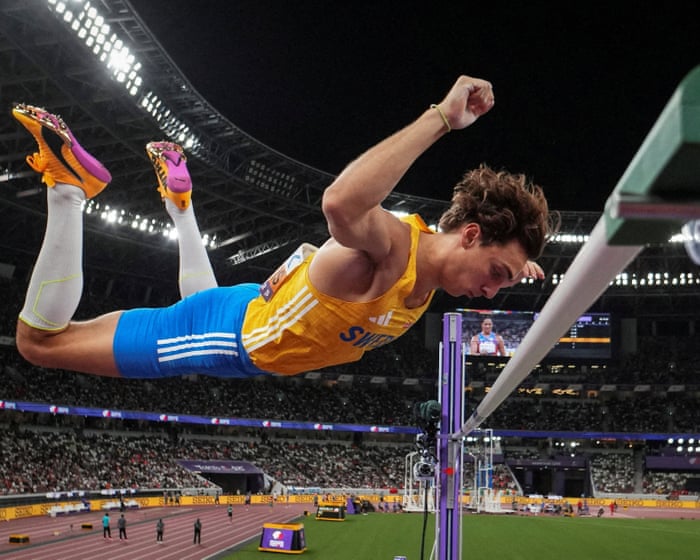
Mondo Duplantis, for instance, can vault over a double-decker bus with nearly 2 metres to spare. Sabastian Sawe, the London Marathon winner, can run 26.2 miles at an average pace of about 4 minutes 40 seconds per mile. Unless you’re up close, it’s impossible to grasp how impressive such feats are.
Ridgeon agrees and promises World Athletics will do more to capture the extraordinary. “Television often sanitizes those incredible superhuman performances, and we need to do more to bring that to life,” he says. “Drone footage, in particular, can unlock new ways of filming things.”
Ridgeon insists, however, that World Athletics’ data and research unit, which examines behavior inside stadiums and when people watch the sport on television, has already led to subtle improvements. They have…They even wired up spectators with sensors to track their emotional responses while watching sports. “Do people get sweaty palms when the 100-meter race starts, or when the shot put begins?” Ridgeon asks. “You can probably guess the answer, but it shows we’re trying all sorts of things. Still, reforming the sport can be challenging. We’re a 150-year-old sport.”
But changes are ongoing. A World Treadmill Championship is coming soon, aimed at making elite competition more appealing to gym-goers. And at next year’s Ultimate Championships, athletes will be allowed to bring their own social media teams to create content for their platforms.
The goal is to let athletes amplify their personalities for a younger audience—and hopefully create the rivalries every sport needs.
Ridgeon also acknowledges that athletes need to realize their competition isn’t just who they line up against on the track. It’s every other sport, TV show, and activity vying for attention. Jake Paul versus Anthony Joshua is nonsense on many levels, but it will sell.
Despite the Grand Slam Track’s rocky first season in the U.S., Ridgeon remains optimistic. He points to Nielsen data suggesting one in seven people globally like athletics, indicating limitless potential. “But one thing we haven’t managed,” he adds, “is to turn the billion people who run for fitness into athletics fans.”
So, could athletics one day make a leap like Formula One? “There are two groups of sports in the world,” he replies. “Football, F1, and other giants that are drawing more and more money and attention. Then there are traditional, often Olympic sports, which are struggling. Athletics is in the middle.”
Ridgeon pauses, then strikes a more hopeful note. “Our foundations are incredible, so we should be able to break into the bottom tier of those giants. We just have to keep up the pressure and energy and stay on that trajectory.” On that, at least, we firmly agree.
Frequently Asked Questions
Of course Here is a list of FAQs based on the article Your column was very unfair my meeting with World Athletics Sean Ingle
General Beginner Questions
1 What is this article about
This article is a firstperson account by sports journalist Sean Ingle about a confrontational meeting he had with the president of World Athletics Sebastian Coe and his team The meeting was called because Coe believed a previous column Ingle wrote was very unfair
2 Who is Sean Ingle
Sean Ingle is the chief sports reporter for The Guardian newspaper He writes investigative pieces and commentary on major issues in sports particularly athletics
3 Who is Sebastian Coe
Sebastian Coe is a former British Olympic champion runner and the current President of World Athletics the global governing body for track and field
4 Why was the meeting called
The meeting was initiated by Sebastian Coe to directly challenge Sean Ingle about a column Ingle had written Coe felt the column was unfairly critical of World Athletics handling of specific issues likely related to doping corruption or athlete welfare
5 What does Your column was very unfair refer to
This is the quote from Sebastian Coe that sparked the meeting He was directly accusing Ingle of publishing a piece that he felt was biased inaccurate or presented World Athletics actions in an unjustly negative light
Advanced Detailed Questions
6 What are the key issues debated in this meeting
While the specific column isnt detailed here typical points of tension include World Athletics effectiveness in combating doping its transparency in governance its handling of prize money and athlete finances and its response to controversies involving member federations
7 What is the dynamic between a journalist and a sports governing body like
This article is a prime example of that oftentense dynamic Governing bodies like World Athletics want to control their narrative and protect their reputation while investigative journalists seek to hold them accountable for their decisions and actions This meeting shows a direct attempt to challenge critical reporting
8 What is the significance of this being a facetoface meeting
Its relatively unusual for the head of a major global sports federation to personally confront a journalist It signifies how seriously Coe took the criticism and his desire to address it directly potentially to apply pressure or clarify his position off the record