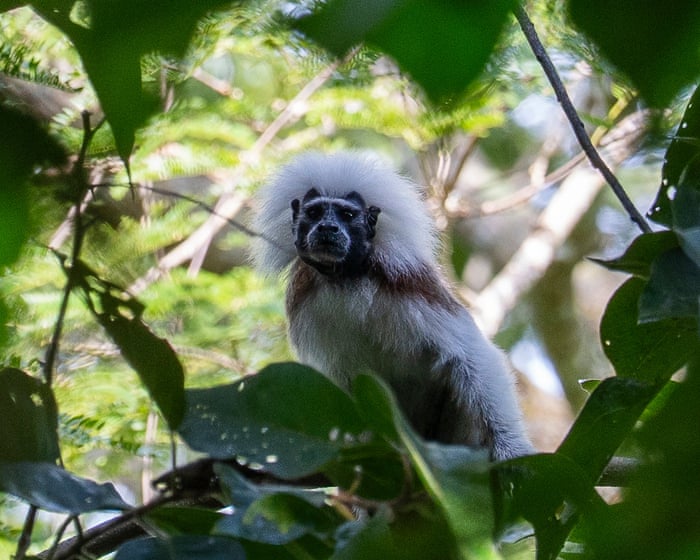
Luis Enrique Centena spent decades silencing the forest. Now, he listens. With a whistle, the former logger points to a flash of white and reddish fur in the canopy. Inquisitive eyes peer back—a cotton-top tamarin, one of the world’s rarest primates.
“I used to cut trees and never paid attention to the titís,” says Centena, using the local name for cotton-tops. “I ignored them. I didn’t know they were in danger of extinction; I only knew I had to feed my family. But now we have become friends.”
Weighing barely a pound, these tiny monkeys are among the most threatened primates in the world, pushed to the brink by medical experiments, rampant deforestation, and the illegal pet trade. Today, they are critically endangered, with fewer than 7,500 left in the wild.
They live only in the tropical dry forests of northern Colombia, an ecosystem reduced to just 8% of its original size, largely due to cattle ranching and logging. Their survival depends on restoring this stripped landscape.
In the hills outside San Juan Nepomuceno, a team of former loggers, farmers, environmentalists, and biologists is working to bring the forest back—and with it, the monkeys known for their punk-like manes.
“Nobody knew anything about the cotton-tops; they weren’t on anyone’s agenda,” says Rosamira Guillen, who leads Fundación Proyecto Tití, a conservation initiative that has spent decades protecting the species and rebuilding its forest home. “But they exist only here and are at great risk—we must protect them.”
Guillen and Centena note that cotton-tops are strikingly human-like. They live in tight family groups, usually of five to seven individuals, communicate with a complex system of calls, and fiercely defend their territory. They also play a vital role in the ecosystem by dispersing seeds, pollinating flowers, and keeping insect populations in check.
“Titís are a lot like us,” says Centena, who is part of the foundation’s forest restoration and research team. “They teach you things. They look after their young. The only thing missing is that they don’t speak Spanish.”
The monkeys’ numbers first plummeted in the 1960s and ’70s, when tens of thousands were exported to the U.S. for medical research. Later, their habitat shrank to just 720,000 hectares due to clearing for cattle ranching and agriculture. The illegal pet trade continues to take a toll, with poachers capturing and selling the tiny monkeys as exotic pets.
Franklin Castro, an environmental guard, has spent the past decade trying to stop titís from being captured for the illicit market. “I started this work 10 years ago,” he says, sharing photos of rescued animals. “More than 200 have passed through my hands. Traffickers pay people to catch them—60,000, 70,000, sometimes 100,000 pesos. We find the titís trembling and dehydrated. It’s a terrible sight.”
Fundación Proyecto Tití began with a handful of biologists and field assistants monitoring the monkeys. After receiving a grant nearly a decade ago, the NGO was able to buy a patch of degraded land to start restoring the remaining fragmented forest.
Marcelo Ortega, who leads the foundation’s tree restoration work, says the first plot of land was barren. “There was nothing left,” he says.
The cotton-tops are starting to come into the newly restored areas.The cotton-top tamarins are starting to come into the new forest to forage. It’s amazing to see.
Today, Fundación Proyecto Tití manages more than 13 plots across nearly 1,000 hectares and works with more than 100 farmers, providing them with plants to restore strips of their land. About 120,000 trees and shrubs have been planted to date, with 60,000 more planned for next year.
The team plans its plot purchases to stitch isolated patches of forest back together, planting dense mixes of native species to form wildlife corridors. “Our goal is to restore what once existed,” says Ortega.
They are already seeing the results. “The cotton-tops are starting to come into the new forest to forage,” says Guillen. “It’s amazing to see.”
They monitor the monkey populations by fitting a small transmitter—a “little backpack”—to the dominant male of each family group. It sends a signal to an antenna carried by field researchers as they follow them through the forest.
Centena is one of them. “I’m not a biologist, I’m not a scholar, but I’ve learned so much,” he says. “I was cutting trees down for 25 years. I’ve been here since 2018, so I have about 10 more years to make up for the mistakes I made.”
The next census is soon to be released, with the team estimating that the cotton-top population has remained stable—or grown—since the last count in 2012-13, when fewer than 7,500 were estimated.
The regrowth is important for other creatures too—rare turtles, black spider monkeys, toucans, and tamanduas all call this land their home, and recently a puma was caught on camera for the first time in years. “When you protect the forest for cotton-tops,” Guillen says, “you protect it for everything else that lives there.”
Frequently Asked Questions
Of course Here is a list of FAQs about saving the tiny punklike monkeys written in a natural conversational tone
About the Monkeys
Who are these punklike monkeys
Theyre most likely tamarins and marmosets tiny primates from Central and South America Many have wild white facial hair that gives them a distinctive punk look
Why are they so small
They are among the smallest primates in the world with some species like the pygmy marmoset being small enough to fit in your hand Their small size helps them move quickly through the dense forest canopy
Where do they live
They live in tropical rainforests primarily in the Amazon Basin but also in coastal forests of Brazil and Colombia Their habitat is very specific and fragmented
The Threat of Extinction
Why are these monkeys going extinct
The main reasons are habitat loss the illegal pet trade and sometimes hunting
How close are they to extinction
It varies by species The Cottontop Tamarin is critically endangered with perhaps only 20006000 left in the wild The Pied Tamarin is also in dire straits competing for space with the city of Manaus Brazil
What does Theyre a lot like us mean
It highlights their complex social behaviors They live in tightknit family groups communicate with sophisticated vocalizations share food and cooperatively raise their youngtraits that feel very familiar and make their plight more relatable
How to Help
Whats being done to save them
Conservation efforts include
Protected Reserves Creating and guarding safe forest areas
Rehabilitation Caring for monkeys rescued from the pet trade and preparing them for wild release
Reforestation Planting forest corridors to connect fragmented habitats
Community Programs Working with local people to develop sustainable livelihoods that dont require destroying forest
Can I have one as a pet