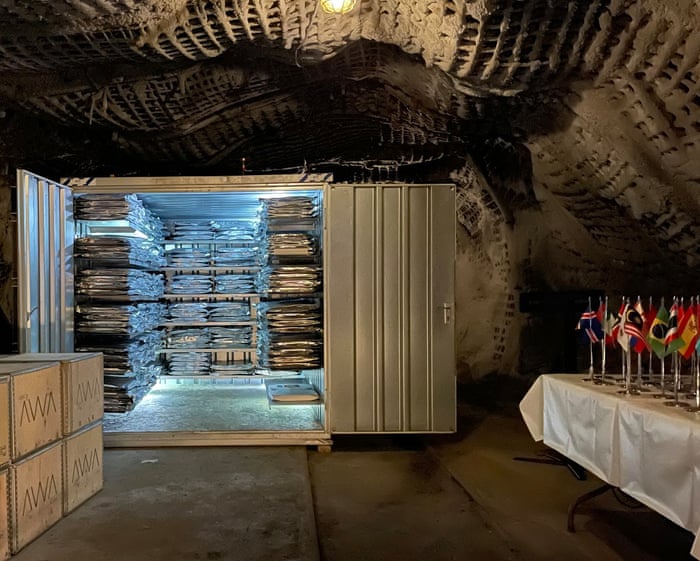
A decommissioned coal mine near the North Pole is the last place you’d expect to find Indigenous stories from rural Nigeria. Yet deep beneath the Arctic permafrost of Svalbard, a storage facility holds a collection of cultural and literary records from the West African country.
The Arctic World Archive (AWA) is a data storage unit where organizations and individuals can deposit records on a specialized digital film called Piql, designed to last up to 2,000 years. On February 27, Nigeria became the first African country to place archives in the facility, located 300 meters inside a mountain. The cold, dark, and dry conditions there are ideal for preservation.
Inspired by the nearby Svalbard Global Seed Vault—which stores over a million seed samples as a safeguard against catastrophe—the AWA was created to preserve the “world’s memory” for future generations. Launched in 2017 by the Norwegian technology company that developed Piql, it now holds a diverse range of historical and creative records from 37 countries. Contributors include the Vatican Library and the European Space Agency, with materials ranging from Chopin’s manuscripts to the work of Belgian photographer Christian Clauwers, who has documented the disappearing Marshall Islands in the Pacific.
The Nigerian records blend social and cultural history with archives from the country’s creative industries. They were gathered from 12 Nigerian organizations, including private art foundations, museums, and libraries.
Historian Nze Ed Emeka Keazor initiated the collection after being appointed chair of Piql’s first Africa office in Lagos in 2022. He began approaching cultural organizations in Nigeria to encourage them to preserve their records. “It took me a year and a half of traveling to Abeokuta in Ogun state to speak to the head of archives at the Olusegun Obasanjo Presidential Library,” says Keazor, who traveled to Svalbard last month with colleague Esona Onuoha to deliver the archives.
Other participating institutions include the Lagos art gallery Bloom Art; the Asaba Monument Trust, which commemorates the 1967 Asaba massacre; the Nsibidi Institute, a social research organization run by Keazor; and the Umuchieze Community Legacy Deposit, a cultural project focused on preserving Indigenous knowledge and history.
“It is important to me that Nigeria is remembered, because my work is about building cultural infrastructure,” says Ugoma Ebilah, founder of Bloom Art. “Nigeria has produced some of the world’s brightest and most creative people. It’s no coincidence that in the same year this archive is deposited, the Grammys finally acknowledged the contributions of Fela Anikulapo Kuti by awarding him a Lifetime Achievement Award.”
In another significant moment for Nigeria’s creative community, British-Nigerian director Akinola Davies Jr. won the Outstanding Debut BAFTA for his film My Father’s Shadow, a coming-of-age story following two brothers and their father during Nigeria’s historic 1993 election. In his acceptance speech, Davies urged everyone to “archive your loved ones. Archive your stories, yesterday, today, and forever.”
In Nigeria, where libraries and museums are often underfunded and rely heavily on paper records, research and historical documents can easily be lost or remain inaccessible. Aware of the fragility of public records, Dr. Chima Korieh, an expert in West African social and economic history at Marquette University in Wisconsin, USA, led a project to help the Umuchieze community preserve its legacy.In Imo State, southeast Nigeria, the Umuchieze community is preserving their stories, accounts of cultural practices and rites of passage, along with records from precolonial Nigeria. Their deposit with the Arctic World Archive (AWA) includes manuscripts on the history of the Umuchieze people and reports detailing the community’s judicial and political systems.
“From 1960 onward, most public records that should be in Nigerian archives are missing,” says Korieh. “Many materials currently in the archives are at risk of being lost due to poor preservation.”
For Korieh, the project goes beyond remote storage. “The whole community is involved, and we plan to open a community center in Umuchieze where the public can access these materials.”
Nigeria’s National Commission for Monuments and Museums and the National Council for Arts and Culture also made deposits, including reports on the country’s creative economy, such as music and film.
“One of Africa’s key challenges has been memory—often overlooked because we haven’t been deliberate about protecting and projecting our narrative,” says Obi Asika, director-general of the National Council for Arts and Culture. “When the opportunity arose to be among the first in Africa to archive here, we were proud to be part of history.”
It’s not just written history at risk. A 2024 Pew Research Center study found that 38% of webpages from 2013 to 2023 no longer exist, meaning vast amounts of information have vanished. AWA originated from a research project seeking secure long-term data storage. “The world is increasingly aware of how fragile data storage is—each migration risks alteration,” says AWA co-founder Katrine Loen.
However, at €9,000 per reel, Piql film is costly for institutions with limited funds. In response, AWA transitioned from a commercial enterprise to a nonprofit in 2025, using funds to subsidize organizations needing financial support. This year, it partnered with UNESCO to archive the Memory of the World Register and records of World Heritage sites, stored as digital 3D scans.
Alongside the archived materials, AWA includes instructions for decoding them. It also plans to provide depositors with tokens to guide future generations to the storage facility.
Svalbard’s unique geology, with rock formations from nearly every geological era, has earned it a reputation for holding the history of the world. “Now,” says Loen, “we are adding humanity’s knowledge.”
For Nigeria, Asika says this marks the start of “a long journey toward narrative restitution, ensuring we are present in all the spaces where we should be.”
Frequently Asked Questions
FAQs Nigerias History in the Svalbard Doomsday Vault
Beginner General Questions
1 What is this worlds memory vault in Svalbard
Its the Arctic World Archive a secure underground digital storage facility located in a decommissioned coal mine on the remote Norwegian archipelago of Svalbard Its designed to preserve the worlds most important digital data for centuries safe from global disasters cyberattacks and technological obsolescence
2 Why is Nigeria storing its history there
Nigeria is depositing key historical documents cultural artifacts and government data to create a permanent unalterable backup This ensures that critical parts of Nigerias national heritage and administrative records survive no matter what happens in the futurebe it conflict natural disasters or data loss at home
3 Isnt that the Doomsday Vault for seeds
Thats a different but nearby facility The Svalbard Global Seed Vault stores physical seeds The Arctic World Archive stores digital data They are separate projects with the same core mission longterm preservation in the Arctics stable cold environment
4 What kind of things is Nigeria preserving
The deposit includes digital copies of Nigerias proclamation of independence the 1999 constitution national symbols landmark literary works key cultural artifacts and important historical footage Its a curated digital time capsule of the nations identity
Benefits Motivation
5 Whats the main benefit of doing this
FutureProofing It guarantees that Nigerias foundational documents and cultural memory exist independently of any political changes technological failures or catastrophic events within the country itself Its an insurance policy for national identity
6 Doesnt Nigeria have its own archives
Yes but local archives face challenges like inadequate funding environmental threats political instability and the risk of physical damage or loss The AWA provides an ultrasecure politically neutral and geographically distant backup
7 How does this help ordinary Nigerians
It protects the collective heritage that belongs to all citizens Future generations researchers and artists will always have access to an authentic preserved record of their history which can support education