Lying in bed recovering from his most recent surgery, Ayman Ali recounts Syria’s revolution through his own scars. His right eye, lost in a 2012 attack on a rebel outpost he was guarding, is covered with yellow medical tape. Leaning against the wall is the cane he needs to walk, after a rocket attack in 2014 left him with a permanent limp.
For 14 years, Ali dreamed of freedom and justice. A year after the fall of Bashar al-Assad, he has his freedom, but not justice. The man he hoped to hold accountable—a distant relative who served in an Assad militia—had already fled the country by the time Ali returned home to Damascus.
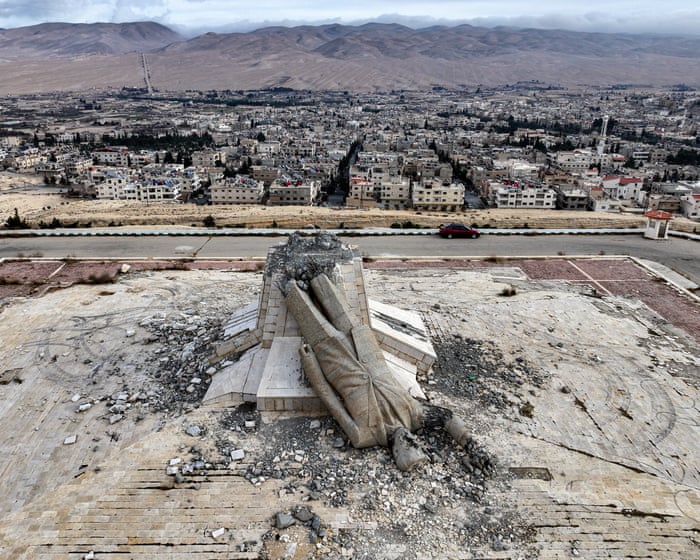
A year ago this Monday, the 53-year rule of the Assad family ended following a stunning 11-day rebel offensive that shocked Syria and the world.
Assad’s overthrow concluded a devastating 14-year civil war that claimed 620,000 lives and dismantled the fearsome security apparatus that had earned Syria the nickname “kingdom of silence.”
Assad and his family were granted asylum in Moscow in December 2024, and recent reports indicate they now live quietly in exile under Russian protection.
Syrians from across the country gathered to celebrate the regime’s end, waving the revolutionary three-starred flag and chanting for freedom. In a speech at Damascus’s Umayyad Mosque, Ahmad al-Sharaa, who would become the country’s new president, promised to rebuild a “strong and just Syria” for all its people and to reconstruct the devastated nation.
On Monday, tens of thousands of Syrians filled the capital’s squares to mark the anniversary. Yet behind the celebrations linger painful questions about the country’s future.
“We know who committed massacres against us—they’re still living among us. But to file a complaint you need evidence, and who has that?” says Ali, who works in digital media.
A lack of evidence did not protect Riham Hamouyeh. In late October last year, attackers climbed the garden wall of her home in Homs, central Syria, and threw a grenade inside, killing her in front of her two young children. The 32-year-old Alawite schoolteacher had faced repeated harassment since her husband, a former mechanic in Assad’s army, was arrested two months earlier.
“None of us are okay; we’re all exhausted. My wife has broken down—she won’t even open the door anymore,” said Hamouyeh’s father-in-law, Mohammed Issa Hameidoosh, 63, as he swept broken glass from her home. Sections of the floor were still missing where the grenade had exploded.
Hamouyeh’s death was part of a series of targeted killings of former regime officers and members of the Alawite sect, to which Assad belonged. These attacks happen almost daily in the multi-sectarian city of Homs, despite a general amnesty issued by the new authorities for former regime members not directly accused of bloodshed.
The Karm al-Zaytun neighborhood in Homs, central Syria, was the site of several massacres during the civil war. Most of its original residents were displaced by the fighting and returned to find their homes in ruins.
A year after Assad’s fall, Syria’s new leaders have successfully reintegrated the country into the global community, exceeding even the most optimistic expectations.
But inside Syria, tensions remain.Simmering tensions continue as a slow-moving transitional justice process fails to meet victims’ needs, allowing old grievances to resurface in new cycles of violence. This threatens fragile efforts to rebuild the state.
Syria’s new president, Ahmed al-Sharaa, has stunned many with a deft diplomatic charm offensive, especially given his background as a former jihadi leader. He has forged a relationship with Donald Trump, eased US sanctions on Syria, and become a regular presence at international conferences.
Scenes of Sharaa meeting Trump and Syria’s return to the global stage have filled many Syrians with pride. “Even if I don’t like him, it feels good to see Syria in the White House,” said one Alawite activist, watching footage of Trump spraying Sharaa with perfume in the Oval Office last November.
For the global community, a pro-Western strongman in Damascus is a welcome change. After 14 years of a civil war that flooded the Middle East and Europe with drugs, created the world’s largest displacement crisis since WWII, and allowed Islamic State to establish a caliphate, the world has been eager to unite behind Syria’s new president.
Sharaa gained power partly by capitalizing on a weakened Iranian axis after Israel’s assault on Hezbollah in Lebanon prevented Tehran from saving its ally, Assad. He has since managed to keep Iranian elements from re-establishing themselves in Syria, much to the delight of Western capitals.
But at home, stalled transitional justice is fueling renewed violence and deepening the country’s divisions.
Four days of massacres in March, perpetrated by government forces and other armed factions against mostly Alawite civilians on Syria’s coast, along with continued killings, have left the religious minority feeling besieged.
Another massacre in July, in which members of government security forces and tribal elements killed Druze civilians in the southern province of Sweida, further put the country’s religious and ethnic minorities on edge.
Since the massacres, Sweida has been virtually sealed off from the rest of the country. Its people have hardened their positions against Damascus and rallied around the hardline Druze leader Hikmat al-Hijri, who demands autonomy.
One 33-year-old Druze resident of Sweida, Bahaa, was initially suspicious but open to the new leadership. Since the July massacres, however, the former government employee now carries a gun and refuses to leave the province.
The Syrian government has launched a council for civil peace and a body to oversee transitional justice. Their tasks are momentous: untangling ownership of appropriated property, establishing justice for crimes committed during the civil war, and maintaining social cohesion.
In mid-November, Syrian authorities held a public trial of Assad loyalists and members of the new security forces accused of violence during the March coastal massacres. Hooded and shackled defendants were presented before cameras as justice officials boasted of the first trial of security officials in modern Syria’s history.
“The court is sovereign and independent,” said presiding judge Zakaria Baccour, though the decision was postponed for a second session in December.
Authorities have also carried out small, local initiatives aimed at giving victims a measure of peace of mind.Hassan al-Abdallah, 56, lives in the Karm al-Zaytun neighborhood of Homs. He described how 14 of his neighbors were killed by Assad loyalists in 2012. Now, he and his family gather for warmth around a fire in the ruins of that same neighborhood, which was stripped bare by pro-Assad militias during the civil war.
In July, security forces arrested one of the men responsible for the massacre, Hassan Dawa, and brought him back to the scene. They made him re-enact the killings and confess his motives in front of Abdallah and other witnesses. “We wanted to kill him, but security wouldn’t let us. After that, I felt much better, some relief,” Abdallah said.
He sat with 11 extended family members around a barrel fire, all crammed into a single room as they work to repair their homes. The entire neighborhood was leveled by Assad militias, who scavenged buildings for copper, pipes, and masonry to sell as scrap. “The shabiha who did this were from that neighborhood over there,” Abdallah said, pointing to an intact housing block about 100 meters away. “The shabiha are still there, but there are good people living there too.”
Activists argue that the government lacks a clear national strategy for transitional justice. The bodies tasked with pursuing accountability remain underfunded. They warn that if progress continues at this slow pace, the brief opportunity to achieve justice will be lost.
“After all these months, the state is growing stronger, external relations are improving, and things are calming down,” said Alaa Ibrahim, a civilian activist in Homs who focuses on social cohesion. “But we’re now a year into liberation. If assassinations keep happening every day, where does that leave us?”
For many Syrians, the issue of justice is now tied to a broader debate about the future shape of the Syrian state after Assad. A new social contract is being written, and the actions of Syria’s new authorities are starting to define the values that will govern the relationship between the people and a state that has ruled through fear for half a century.
There is no doubt that Syrians are experiencing a newfound freedom unimaginable a year ago. “A year ago, people wouldn’t dare complain about the price of a kilo of onions. Now they’re calling for ministers to resign,” quipped Ayman Ali.
However, civil society activists note that there is little talk of democracy in the new Syria—a key demand of revolutionaries over the past 14 years. Syria’s new constitution grants extensive powers to the presidency, and a recent parliamentary “election” was held without a popular vote. Instead, committees appointed candidates for two-thirds of the legislature, while the president appointed the remaining third.
Activists also point to the new political affairs bureau, an opaque institution that has taken over former Ba’ath party buildings across the country and appears to function as a new political security apparatus. One lawyer who runs social cohesion workshops said officials sit in on meetings and demand approval of their curriculum before granting permits for organizations to operate.
Radwan Ziadeh, a Syrian writer close to the president, remarked, “There are some institutions which give you an indication…”They are attempting to establish a more authoritarian system. “Political parties are not allowed to operate. No one can organize any political gathering without permission from the bureau of political affairs.”
In Damascus, Ali rests in his recovery bed, reflecting on the new Syria he fought to create. He says the country’s stability a year after the end of a 14-year civil war feels like “a miracle,” even though he has not achieved the justice he once envisioned.
Yet the shadow of Assad’s crimes still hangs heavily over Ali and Syria, as the temptation of revenge endangers the nation’s unexpectedly hopeful future. “If everyone took justice into their own hands, the country would collapse,” he said, his remaining eye gazing steadily ahead. “We’ve spent 14 years exhausted and displaced. We either throw that away, or we build a state.”
Frequently Asked Questions
Of course Here is a list of FAQs about the situation in Syria a year after the hypothetical fall of President Bashar alAssad framed in a natural conversational tone
BeginnerLevel Questions
1 What does a fractured Syria actually mean
It means that after the central government collapsed no single group has full control Instead the country is split among different factionslike former rebels local militias extremist groups ethnic enclaves and regional powers backing different sidesall fighting for power and territory
2 Why is there still so much violence if the main leader is gone
Removing a dictator doesnt automatically create peace The power vacuum often leads to even more chaos as former allies turn on each other old grievances surface and many groups see an opportunity to seize control leading to continued fighting
3 Who is trying to run the country now
There likely isnt one clear government Instead you might have a weak internationally recognized transitional council in one city while local warlords civilian councils or extremist groups administer their own areas making national coordination nearly impossible
4 Whats a cycle of violence in this context
Its a pattern where one act of violence provokes revenge which leads to counterrevenge and so on For example a militia from one community attacks another that community retaliates and the conflict escalates endlessly making peace deals very difficult
5 Are people better off now than under Assad
Its a tragic mixed bag Some areas may have more personal freedoms but overall most people face extreme hardship crippling economic collapse destroyed infrastructure lawlessness and persistent fear of different armed groups which for many feels even less secure
Advanced Practical Questions
6 What are the biggest obstacles to rebuilding a unified state
The main obstacles are a Security Disarming hundreds of militias b Justice How to deal with crimes committed by all sides without triggering more revenge c Governance Agreeing on a new political system that includes all ethnic and religious groups d Foreign Interference Regional powers supporting their own proxies
7 How do you even start to rebuild an economy thats been destroyed
It starts with the most basics securing major roads and trade