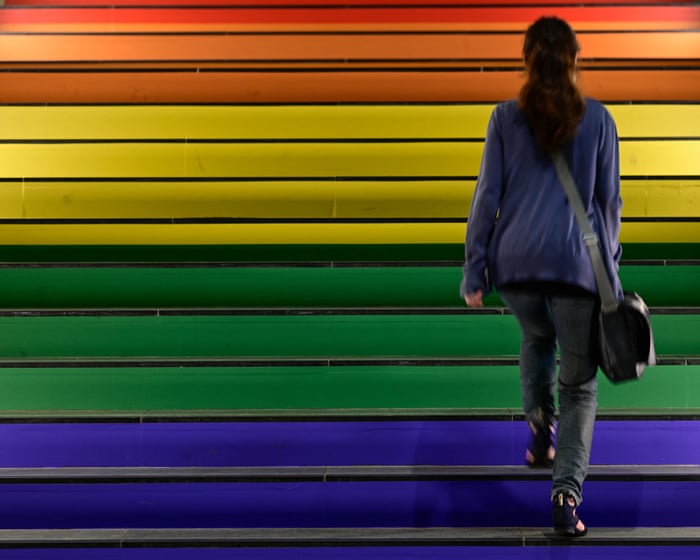
The UK’s largest companies are significantly reducing their public backing for Pride events, according to a Guardian analysis, raising concerns that “clear signals” of support are needed amid increasing global hostility toward LGBTQ+ people.
An examination of social media posts from the country’s biggest firms shows mentions of Pride have fallen by 92% since 2023, following a similar pattern among major American companies.
This trend follows US President Donald Trump’s 2025 executive orders that dismantled federal diversity, equity, and inclusion (DEI) programs, leading many companies in the US and UK to rename, reduce, or even eliminate their equality policies.
The Guardian reviewed the primary public social media accounts of the 10 largest UK-listed or headquartered companies and the 10 largest US companies by market value. The UK group included Arm Holdings, AstraZeneca, GSK, British American Tobacco, HSBC, Linde, Rolls-Royce, Shell, and Unilever.
In 2023, these UK companies made 52 posts on Facebook, Instagram, and X containing the word or hashtag “Pride,” related to events, months, or employee networks. By 2024, that number dropped 48% to 27 posts. In 2025, it fell sharply to just four posts—an 85% annual decline and 92% lower than the 2023 total.
HSBC was the British company most likely to post about Pride during this period, though its posts still decreased by 94%. AstraZeneca, Shell, and Unilever were the least likely to post about Pride from 2023 to 2025. HSBC stated that a social media count does not fully represent its inclusive approach.
A similar decline was seen among the top 10 US companies, including Alphabet, Amazon, Apple, Berkshire Hathaway, Broadcom, Eli Lilly, Meta, Microsoft, Nvidia, and Tesla. Their “Pride” posts fell from 39 in 2023 to 21 in 2024, and then to 18 in 2025—a 54% drop. Apple was the only US company to increase its posts, rising 22% between 2023 and 2025. Berkshire Hathaway, Broadcom, and Tesla were the least likely to post about Pride.
Simon Blake, CEO of the LGBTQ+ rights charity Stonewall, emphasized that in a world where LGBTQ+ people often feel less safe, companies benefit from sending “clear signals” of support. He noted that daily actions are a better measure of a company’s commitment to inclusion than social media activity. While he advocates for consistent efforts year-round, he also believes visible symbols like flags are important for signaling that LGBTQ+ people are welcome and valued.
Blake expressed optimism about corporate commitment to inclusion, citing ongoing Pride sponsorships and revitalized employee networks. He regularly sees senior leaders reaffirming their support for LGBTQ+ inclusion at work. However, he acknowledged the current political climate is more hostile, which affects people’s sense of safety.Is there a global rollback of LGBT rights happening in many places? Yes. Is the UK immune to it? Absolutely not.
Posts about Pride from the UK’s 10 largest companies fell by 92% between 2023 and 2025.
Paul Sesay, founder of the Inclusive Top 50 UK Employers, the National Diversity Awards, and the Elevate 1000 initiative, which connects young people from lower socioeconomic backgrounds with employers, said his research shows that cuts to diversity budgets disproportionately affect corporate LGBTQ+ networks. His data indicates these networks have historically been the most numerous and best-funded.
“We hold roundtables and speak to our members regularly, and some DEI budgets have been significantly reduced in recent months,” he said. “However, many people in companies tell me they feel DEI needed a reset to some degree—to simplify it and return to basics. The sense is it became too politicized, rather than focusing on its core purpose: equality for everyone within an organisation.”
Bruce Daisley, a podcaster and workplace culture expert who formerly served as vice-president of Twitter EMEA and YouTube UK, said: “Some organisations have maintained their initiatives, but they’re trying to carry them out in a lower-key way. All of this is happening in a context where Trump has created fear around companies endorsing these issues.
“For the groups meant to benefit from these efforts, it highlights the old saying—‘a principle is only a principle if it costs you money.’ Many people within the LGBTQ+ community, such as the trans community, are finding it a difficult time.”
Daisley added that the visibility of “toxic replies” and “extreme rightwing” views on X, formerly Twitter, since Elon Musk acquired the platform could also be discouraging companies from speaking out on social media.
The Guardian contacted all companies mentioned in the analysis for comment. Arm Holdings stated that “inclusion has always been at the heart of our culture and values” and that its social media presence reflects a “broad set of conversations.” Rio Tinto said diversity is “very important” to its business and that it supports staff participating in Pride events in Brisbane, Perth, Montreal, and London.
A GSK spokesperson said: “We are committed to building an inclusive culture that values different perspectives and experiences. This includes our continuing support for Pride in the UK and in many countries where we operate through social media, partnership initiatives, and at Pride events.”
An HSBC UK spokesperson said: “We are committed to inclusion for all our colleagues and customers and celebrate and support the LGBTQ+ community in many ways, including through an active Pride network, ambassador and mentoring programmes, and as a signatory of the Conduct for Business.”
Frequently Asked Questions
Frequently Asked Questions Companies Scaling Back Public Pride Support
Beginner Definition Questions
1 What does it mean when a company scales back support for Pride
It means a company is reducing its visible public participationlike pulling out of Pride parades removing themed merchandise or reducing social media campaignswhile often stating its internal policies of inclusion remain unchanged
2 Why is this happening now
Many companies are facing increased public pressure and polarized political debates around LGBTQ issues Some are trying to avoid backlash from conservative groups or customers while others are reevaluating their approach to corporate activism
3 Isnt this just rainbowwashing
Rainbowwashing is when a company uses Pride symbols for marketing without meaningful action Scaling back can be seen as the oppositewithdrawing the marketingbut critics argue it reveals the initial support was superficial if it disappears under pressure
Reasons Motivations
4 What are the main reasons companies are pulling back
The primary reasons are 1 Fear of boycotts or backlash from conservative consumers 2 A desire to avoid culture war controversies 3 Internal debates about the effectiveness of symbolic gestures and 4 In some regions new laws that make public support riskier
5 Are companies changing their internal LGBTQ policies too
Not necessarily Most companies publicly state that their internal Diversity Equity and Inclusion policies employee resource groups and benefits for LGBTQ staff remain intact The scaling back is often a change in external marketing not internal policy
6 Is this a coordinated effort
No its not a formal coordination However companies often watch each others responses to social pressure When a few major brands change tactics others may follow believing it reflects a broader shift in public sentiment or reduced risk
Impacts Consequences
7 How does this affect LGBTQ employees
It can significantly impact morale and feelings of safety Employees may feel their employer is abandoning them or valuing profit over their wellbeing especially if the company previously used their identities for marketing
8 Whats the business impact for these companies
Its a doubleedged sword They might avoid backlash from one group but face criticism boycotts or loss of trust from LGBTQ