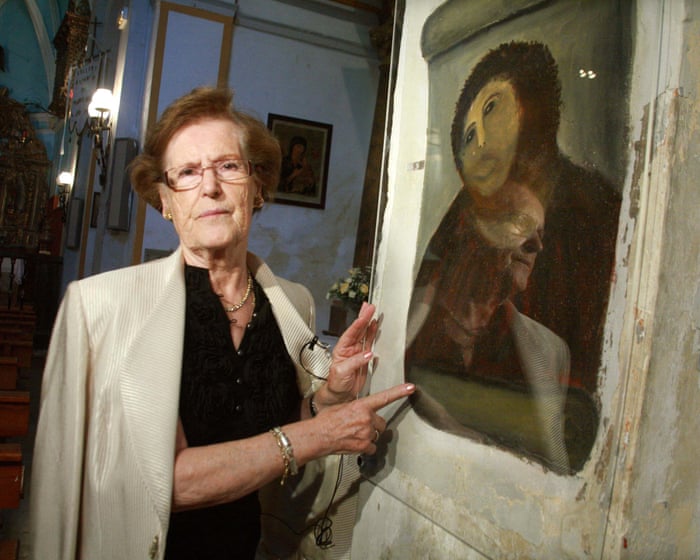
Few people achieve fame as late in life, or as harshly, as Cecilia Giménez did in the summer of 2012. The Spanish amateur artist was 81 when her attempt to restore a modest fresco of the scourged Christ brought her a level of renown that nearly crushed her.
Overnight, Giménez—who died Monday at 94—was torn from her quiet life in the northeastern town of Borja and recast as the well-meaning, accidental creator of what the English-speaking world came to call Monkey Christ. In Spain, the meme was dubbed Ecce Mono (Behold the Monkey), a play on the painting’s Latin title Ecce Homo (Behold the Man).
For weeks, months, and even years, side-by-side images of Elías García Martínez’s original and Giménez’s unfinished restoration spread worldwide, becoming a symbol of botched efforts and disastrous results.
But there was more to that summer’s events at Borja’s Santuario de Misericordia than early reports—including my own—let on. Giménez, who had been married in the church, had cared for the fresco for two decades, trying to shield it from time and water damage. She was only halfway through the restoration and had left for a two-week holiday when news of Monkey Christ began to circulate.
“Reporters told the world the story of the old woman who couldn’t paint and had ruined a painting,” Giménez told the Guardian in 2015. “That’s not true. It’s true I haven’t done many portraits. But if it hadn’t been for me, the painting would probably have disappeared long ago.”
By then, however, the damage was done. Stressed and ashamed, she lost considerable weight, worrying over the consequences of her good intentions and the ridicule they brought upon her hometown.
Yet, little by little, a small miracle unfolded. The people of Borja rallied around Giménez, gathering outside her home to applaud her, and the town became an unlikely tourist hotspot. Today, the Santuario de Misericordia houses a bustling museum celebrating the church’s fame and a shop stocked with every imaginable piece of Monkey Christ merchandise. From wine bottles and teddy bears to T-shirts, mugs, and mousepads, Giménez’s oddly gentle restoration gazes down at visitors from shelf after shelf.
The hundreds of thousands of pilgrims who have visited Borja in recent years have brought the town fame—and a significant amount of money. That revenue not only pays the salaries of the sanctuary-museum’s two caretakers but also covers care home fees for local residents who otherwise couldn’t afford to live there. Among those residents were Giménez herself and her surviving son, who has cerebral palsy. Then, in 2023, a warmhearted comic opera titled Behold the Man opened in Las Vegas, honoring Giménez and her extraordinary impact on Borja.
When I met Giménez in Borja in the winter of 2018, her memory was starting to fade, so her niece, Marisa Ibáñez, joined the interview. By then, Giménez—clutching a large handbag filled with press clippings—had made peace with what happened and told me she would do it all again.
“It was done with good intentions, and despite what happened, it’s been good for Borja,” she said. “People from all over the world visit the sanctuary now. That’s the best medicine. I used to cry a lot over all this, but I don’t cry anymore because I can see how much I’m loved.”
When I think of Giménez, who was laid to rest on Tuesday afternoon, I’m reminded of “The Saint,” a short story by Gabriel García Márquez. It tells of a man who spends years in…In Rome, a father hopes to convince the Vatican that his daughter’s miraculously weightless and perfectly preserved body proves she should be made a saint. Yet by the story’s end, we understand it is the father himself—through his years of patient devotion to her cause—who is the true saint.
The same is true of the elderly, devout woman from Borja. We were all too busy laughing at the meme to realize that the botched restoration was never the real story—the restorer was.
Through her many years of quiet devotion and the dignity with which she endured hardship, Cecilia Giménez shone as a rare example of grace and humility in an increasingly dark and cruel world. That—not the “Monkey Christ”—was her life’s work and her legacy.
In her final years, Giménez’s dementia proved unexpectedly merciful, erasing the bitter memories of her humiliation and leaving only positive ones. As her friend Ibáñez told me, she had “turned it into a beautiful story.”
Recent headlines have called her “the woman who immortalised the Ecce Homo” and “the woman who turned Borja’s Ecce Homo into a global attraction.” But as her niece remarked when we spoke a few years ago, Cecilia Giménez can be summed up in one word: “good.” She added, “You can look up lots of adjectives to describe her, but I think the one that fits her best is ‘good.’ It’s a word we use so lightly that we often forget what it truly means.”
Sam Jones is the Guardian’s Madrid correspondent.
Frequently Asked Questions
FAQs Cecilia Giménez The Monkey Christ Restoration
The Basics
Q What is the Monkey Christ painting
A Its a popular name for a 1930s fresco of Jesus titled Ecce Homo in a church in Borja Spain It became globally famous after a wellintentioned but amateur restoration dramatically altered its appearance in 2012
Q Who is Cecilia Giménez
A She is the elderly Spanish parishioner who attempted to restore the deteriorating fresco Despite the initial backlash she is a devout woman who acted out of a desire to preserve a painting she loved
Q Why is it called Monkey Christ or Potato Jesus
A The botched restoration made Jesuss face look misshapen with fuzzy simianlike features and a crude lumpy texture leading to these unflattering but viral nicknames
The Restoration Aftermath
Q Why did she restore it without permission
A Cecilia then in her 80s saw the fresco flaking due to moisture damage With a history of touching up church art and believing she had implied consent she took it upon herself to save it
Q What was the immediate reaction
A Initially there was shock outrage and mockery from art experts and the public It was seen as a tragic case of art destruction and became a global internet meme
Q How did it turn from a disaster into a positive story
A The viral fame drew tens of thousands of tourists to the small town of Borja The surge in tourism generated significant revenue which was used for local charities and the church Public sentiment shifted towards sympathy for Cecilia
Q Did Cecilia Giménez face legal issues
A Initially there was talk of a lawsuit but an agreement was reached Cecilia waived any financial rights to the image and the foundation managing the church retained ownership The focus moved to managing the unexpected tourism
The Deeper Story
Q What is the true wonder or silver lining in this story
A The true wonder is how a humble act though flawed led to unexpected global attention that benefited an entire community It also highlights Cecilias resilience and grace in facing worldwide ridicule