Cyprus says it will bring “a new approach to the table” when it assumes the EU presidency on Thursday, with defence, migration, and Ukraine remaining top priorities amid heightened geopolitical uncertainty.
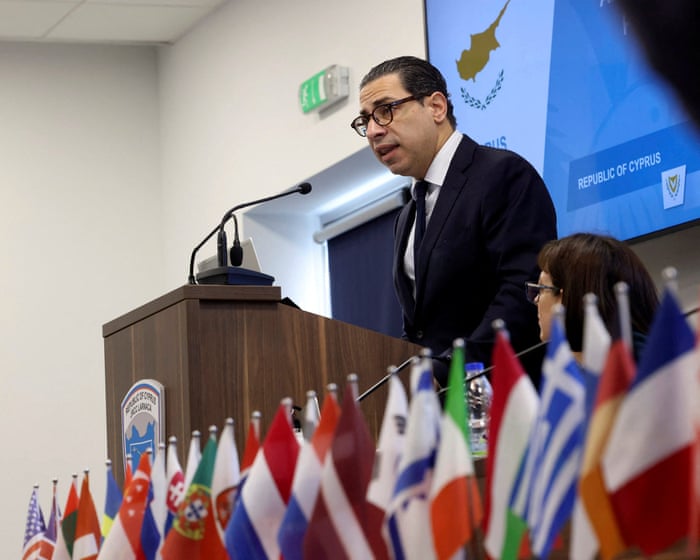
As one of the bloc’s smaller members, Cyprus will approach its six-month term leading the EU with discipline and dedication, but also “a different mindset,” said Cypriot Foreign Minister Constantinos Kombos.
“We believe that small states have a lot to offer in these kinds of situations,” Kombos told the Guardian, with the EU flag prominently displayed in his office. “It’s a very different mindset that one can bring to the table, a different approach. As a small state, we are dedicated. We don’t see [the presidency] as something we have to do; we want to do it in the best possible way.”
With the conflict in Ukraine entering its fourth year, Kombos said the EU’s focus would remain on the war-torn country and Russia’s aggression. He noted that Cypriots, more than 50 years after the Turkish invasion—which was launched in response to a coup aimed at union with Greece—understand all too well the realities of military conflict and occupation.
Even though Cyprus once had close ties with fellow Orthodox state Russia, and has seen wealthy Russians, including oligarchs allied with Vladimir Putin, seek refuge on its shores, Kombos said Cyprus is particularly sensitive to the plight of Ukrainians.
“The agenda is rightly about Ukraine, and it will remain so,” said Kombos, who was an academic before his appointment. “But we want to bring into the mix issues relating to the wider Middle East region because we see Cyprus as being part of that region as well.”
Cyprus has spent over two years preparing for a role it last held in 2012. EU diplomats describe its proposed agenda as highly ambitious. Buildings and roads in Nicosia, the divided capital, have been refreshed, and “Cyprus EU presidency” banners welcome visitors at the island’s international airport.
However, the island’s ongoing division between the internationally recognized Greek Cypriot south and the breakaway Turkish Cypriot north has raised concerns. Officials have openly worried that long-standing tensions with Turkey could hinder military cooperation with Ankara at a time when Brussels sees closer alignment as key to stability.
Nicosia, like Athens, has blocked Turkey’s participation in the EU-funded defence procurement programme, Safe. Cypriot President Nikos Christodoulides has ruled out any change, citing the presence of Turkish troops in the north as an occupation of EU territory.
The quest to reunify the country adds further complexity. Long considered a graveyard for peace mediators, Cyprus is the West’s longest-running diplomatic dispute.
In his interview, Kombos insisted that Nicosia would not “get in the way” of the bloc’s relations with Ankara. “The president has said very publicly that he would like to see President Recep Tayyip Erdoğan attend the informal council meeting in April,” he said. “We are not going to use the presidency to raise national issues.”
In its stewardship role, the country of 1.2 million people will oversee the EU’s legislative agenda and diplomatic negotiations. Christodoulides has pledged to prioritize security and defence readiness to strengthen the union’s strategic autonomy.
The Cyprus presidency’s motto is “an autonomous union, open to the world”—a reflection, officials say, of the country’s commitment to policies that enhance the bloc’s independence and global engagement. In that spirit, Kombos added, emphasis will be placed on unlocking the potential of regions that often go unnoticed, with decisive action to address the EU’s outreach.
“Normally this part of the world is associated with crHe noted that the EU and its member states often become actively engaged in managing crises, citing examples like Syria, Gaza, Lebanon, and the Red Sea. “But this is also a region of opportunities,” he added.
With the Trump administration’s tariffs disrupting global trade, Cypriot officials believe there has never been a better time for the EU to explore alternative markets.
Kombos pledged that, with the bloc’s competitiveness also a key priority, Cyprus would leverage its EU presidency to advance a free trade agreement between India and the EU.
“We want to open up the EU toward the Middle East and toward India,” said Kombos. “The EU is a success precisely because it has managed to navigate through all the various crises it has faced. Despite all the despair and complaints about how it functions, and despite its shortcomings, it continues to surprise us by always moving forward and evolving.”
Frequently Asked Questions
Of course Here is a list of FAQs about Cyprus taking over the rotating presidency of the European Union designed to be clear and conversational
Beginner General Questions
1 What does the rotating presidency of the EU actually mean
It means a member state takes a turn leading the Council of the European Union for six months They chair meetings set agendas and broker compromises between EU countries to help pass legislation Its like being the meeting facilitator for the club
2 When is Cypruss presidency and how often does this happen
Cyprus holds the presidency from July 1 to December 31 2024 The presidency rotates among the 27 EU member states every six months in a preestablished order
3 What does Cyprus mean by a fresh approach
Cyprus is emphasizing that as a smaller geographically peripheral EU member it will focus on bridging divides and giving a stronger voice to the perspectives of smaller states and the EUs southern and eastern regions
4 Does this mean Cyprus is in charge of the whole EU now
No not at all The presidency manages the work of the Council of the EU It does not control the European Commission or the European Parliament Think of it as an administrative and diplomatic leadership role not supreme power
5 What are the main priorities for Cypruss presidency
Their key priorities are expected to focus on
Migration Asylum Finalizing the new EU Pact on Migration and Asylum
Strategic Autonomy Strengthening the EUs selfreliance in energy defense and critical raw materials
Enlargement Managing the accession processes for candidate countries like Ukraine and Moldova
The Cyprus Problem Keeping the reunification talks on the EU agenda
Advanced Detailed Questions
6 How can a fresh approach make a difference in practice
Cyprus can use its position to shape discussions by
Prioritizing topics often overlooked by larger states
Creating new informal formats for dialogue
Leveraging its unique experience with division and migration to build pragmatic compromises
7 What are the biggest challenges Cyprus will face during its presidency