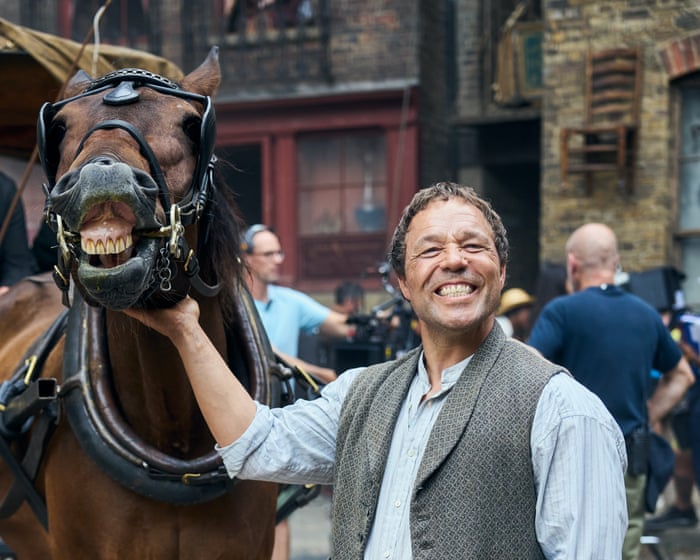
Stephen Graham had an outstanding 2025. Not only did he play Bruce Springsteen’s father in the biopic Deliver Me from Nowhere, but he also co-created and starred in Netflix’s mega-hit Adolescence—the groundbreaking drama that ignited global conversations about online misogyny, incel culture, and the “manosphere.”
His friend and frequent collaborator Steven Knight watched with admiration from afar as the powerful four-part series became must-see television. “My God, it was a cultural phenomenon,” he says, puffing out his cheeks with pride. “Adolescence got people talking who don’t usually talk, about things they don’t usually discuss. Is there any greater achievement than having a direct, immediate, and positive impact worldwide on human relationships? It’s like putting something on screen that acts as medicine. It’s actually good for you.”
“Making an impact like that was beyond our wildest hopes,” says Graham. “Having a guy come up to me in Tesco and say, ‘I just want to thank you. I had a really good chat with my son the other night after we watched your program.’ No disrespect, but you can keep your awards and all that shiny stuff. That’s the real accolade.”
He has already won an Emmy for Adolescence and was recently nominated for a Golden Globe, but Graham remains healthily skeptical about awards recognition. “What we do isn’t football,” he says. “It’s not a competitive sport. There aren’t winners and losers. It’s subjective. I might think something’s a load of rubbish and it ends up winning five Baftas. That’s actually happened quite a few times. I might get myself into trouble here, but take Cillian Murphy—wonderful actor. He’s never won a Bafta for playing Tommy Shelby in Peaky Blinders! One of the finest performances I’ve ever seen. What’s that about? Shows like Adolescence, which leave a mark on the collective consciousness, come out of nowhere. The fact that we even got it made is a win in itself.”
I’m sitting down with Stephen and Steven to discuss the explosive return of their period boxing thriller A Thousand Blows. The first season was a smash hit for Disney+ last year. Now comes the sequel, which weaves together the illegal bare-knuckle boxing scene with the story of the Forty Elephants, an all-female crime syndicate known for pickpocketing and confidence tricks.
One year after the events of the first season, Jamaican boxer Hezekiah Moscow (Malachi Kirby) is a shadow of his former self. His fierce rival, Henry “Sugar” Goodson (Graham), is in even worse shape—estranged from his family and drinking himself to death. As the series begins, he’s unkempt, with straggly hair and a bushy beard, falling face down in puddles. He even has a severe case of trench foot.
“I know, it’s gross,” says Graham. “Those manky feet are a metaphor for the path Sugar has walked in the time we’ve been away. He’s at his lowest point ever. Now he has to rebuild his sense of self.” As we know from his masterful performance in Shane Meadows’s The Virtues, Graham—a teetotaler himself—is remarkably good at playing drunk. “I was the kind of kid who sat in working men’s clubs, getting cans of Coke and bags of crisps bought for me. I saw a lot of great drunks! I tap into that.”
Graham transformed his physique for the first series. With fewer fights this time, has his training slacked off? “No, I’ve still got it going on,” he says, pulling up his T-shirt to flex impressive biceps. “Look at these! This season, the fight Sugar is having is mainly with himself. But I’m still working out. I’m filming something at the moment where I play a prisoner…””So, I’ve adjusted the routine,” he says, rubbing his shaven head. “It’s more of a prison workout with a low-carb diet.”
The first season ended with Sugar brutally beating his younger brother, Edward “Treacle” Goodson (played by James Nelson-Joyce). “These two had a hellish upbringing,” explains Graham. “Everything Sugar did was for his brother. Now he’s betrayed that, so he’s questioning his very identity.” This is one advantage of building the story on real historical figures, says Knight: “The truth gives our scripts weight. Records show Sugar did severely beat his brother in a fight. With that one fact, you have a whole world to imagine before and after.”
Nelson-Joyce has come a long way since he approached Graham in a Nando’s restaurant ten years ago and was taken under his idol’s wing. “He really has,” says Graham. “After I gave him my details, Hannah [Walters, his wife, co-star, and co-producer] looked at me and said, ‘I think he could play your brother one day.’ And here we are. I’m incredibly proud of James’s career. He deserves every bit of his success.”
The gritty series returns with a vengeance for its second season. This time, the bone-crunching violence extends beyond the boxing ring and into the streets of London’s East End. “There are a lot more explosions, which always makes for exciting days on set,” Graham says with a grin. “All these experts come in and say, ‘Right, let’s blow something up over here.’ They do it, and then they always say, ‘We need bigger bangs and bigger flames. Let’s turn up the gas!’ It’s huge fun, and when you see it on screen, you just go, ‘Wow.'”
“Action scenes are great as long as nothing hits you,” Knight notes. “Because it does happen. Scripting a fight can feel silly: ‘He swings, he ducks, he swings again.’ But I genuinely believe our show has the most authentic boxing sequences I’ve ever seen. The punches feel real.” He adds, “Without naming names, we’ve all seen how easy it is to do them badly.”
Just as the criminal underworld of Wapping is lacking a leader, Mary Carr (Erin Doherty), the self-styled queen of the Forty Elephants gang, returns to reform her crew and reclaim her crown. As always, the shrewd and charismatic Mary has a plan—this time, riskier than ever. “Erin is unbelievable,” says Knight. “You can’t imagine anyone else playing Mary Carr. She just becomes her. I’m sure it isn’t effortless, but Erin makes it look that way.”
“The only word for Erin is mesmerizing,” Graham adds. “I could watch her read the phone book. Mary looks after Sugar while he’s recovering. We shot a whole day of her helping me through detox, and there were scenes as an actor I’ll never forget. At one point, we sat on the floor of a bedroom above a pub and she just held me. It was a very vulnerable moment, but the crew was so respectful, allowing us to stay in it. It was special. Something I’ll cherish deeply.”
The Forty Elephants reflect the changing world of the late Victorian era. “It’s the truth—real social history, not just textbook stuff. They ran their own organization and were incredibly successful. Newspapers at the time were outraged, saying, ‘How shocking that ladies are doing this,’ but nobody on the streets was surprised. Most working-class families are run by the mother. The only place equality wasn’t acknowledged was in the political system. In their own way, the Forty Elephants are…”Like the suffragettes, looking around and saying: ‘Wait a minute, this is ridiculous.’
‘The only word I can use for Erin is mesmeric’ … Erin Doherty as Mary in A Thousand Blows, season two.
The two Steves are regular partners in crime, having worked together on Peaky Blinders, Taboo, and A Christmas Carol. What do they admire about each other’s work? Graham goes first: “Growing up, I loved writers who told working-class stories, like Alan Bleasdale, Jimmy McGovern, and Willy Russell. They’re one of the reasons I’m an actor today. Steve has that quality, too. You can imagine him writing Educating Rita. He creates these magical worlds with humour, heart, and human struggle. To be part of his thought process when he writes is an honour. It’s the food that gives me life.”
“The motivation for me is that he’s just so good,” says Knight. “If it’s possible to get Stephen into something, then I will, because I know he’s going to be fantastic.”
Next up for the pair is the long-awaited Peaky Blinders film, The Immortal Man, which dons its razor-sharp cap and swaggers onto screens in March. “I’m not allowed to talk about it, but it’s fucking brilliant,” Knight says proudly. “I’m so excited that it’s coming soon.” Graham reprises his role from the TV series as Liverpool dockyard union leader Hayden Stagg. “It was a total riot to make,” he says. “I don’t normally get to do the kind of things I do in this film, so I had a lot of fun.” What kind of things? “I can’t say, can I? You won’t catch me out!”
Knight is now writing the screenplay for the next James Bond film. “I can’t say anything about that either. Apart from it’s a dream come true.” If he’s in the market for a Scouse 007, he doesn’t need to look far. “I’d rather be a villain,” says Graham. “It’d be more fun.” Knight nods: “Every great actor that I’ve spoken to has said that. They’d all rather be the villain.”
He’s also been working on the third series of the BBC wartime romp SAS: Rogue Heroes. The drama has led to petitions in parliament to award maverick hero Blair “Paddy” Mayne (played by Jack O’Connell) a posthumous medal. “I’m 110% in support of the campaign to give Paddy the recognition he deserves,” says Knight. “His incredible courage, mental strength, and battlefield intelligence helped turn a crucial chapter of the war in favour of Britain. There’s no logical reason not to acknowledge this.”
Knight’s approach to period drama views society from the bottom up, not the top down. “Why wouldn’t you do it that way?” he says. “The best stories are in those places. In any taxi or Uber, the driver’s story will almost certainly be more interesting than the passenger’s. The themes of A Thousand Blows—poverty, migration, prejudice, family, ambition, the fight for survival—are just as relevant today. There’s loads more stories I’d like to tell. I want to do something about Shakespeare.”
Knock out … Stephen Graham in A Thousand Blows, season one.
The pair are both frighteningly prolific. Are they the busiest men in showbiz? “Quite possibly!” laughs Graham. “It’s taken me 30 years to become an overnight success, but that’s sweet. I adore what I do. I’m a grown-up Mr. Benn, and I love it.”
“Me too,” says Knight. “I’d sit down and write stuff even if nobody wanted me to. It doesn’t feel like an effort; it’s just about putting it into words fast enough.” Knight didn’t write Peaky Blinders until his 50s. Does he wish he’d become a dramatist earlier? “I do, actually. It all goes back to class. It takes 20 years to recover from a working-class upbIt took me that long to believe I was as good as other people, if not better.” This resonates with Graham: “It took me ages to shake off that imposter syndrome. It’s only faded completely in the past five years.”
If their hectic schedules allow, will A Thousand Blows return for a third season? “Fingers crossed,” says Graham. “Steve has ideas for it that are next level! If the stars align, there could be something big on the way. That’s all I’ll say.” Knight is keeping quiet. “I refer you to the answer previously given by my honorable friend,” he smiles.
I leave the two Steves lamenting the fortunes of their respective football teams, Liverpool and Birmingham City. “We’re the only team in Europe who failed to score a goal during the reign of a pope,” says Knight. “That’s our proud boast.” Graham is delighted by this: “That’s an amazing stat! You’ve got to work that into a script sometime.” You wouldn’t put it past him.
A Thousand Blows is on Disney+ starting Friday, January 9.
Frequently Asked Questions
Of course Here is a list of FAQs about Stephen Grahams interview on his boxing drama alcohol and awards written in a natural conversational tone
About the Show Comeback
Q What is this hardhitting boxing drama Stephen Graham is talking about
A Its the TV series Boiling Point which started as a film It follows the intense pressure inside a highend restaurant kitchen with Graham playing the head chef The series is described as a boxing drama for its relentless inyourface tension and emotional punches
Q Is Boiling Point actually about boxing
A No not literally It uses boxing as a metaphor The kitchen environment is portrayed like a fightfastpaced brutal and demanding where characters are constantly under pressure and taking emotional hits
Q Why is the show making a comeback
A The original film was critically acclaimed The TV series continues the story diving deeper into the characters lives and the aftermath of the films events generating a new wave of attention and praise
About Stephen Grahams Comments on Alcohol
Q What did Stephen Graham mean by Ive known some truly legendary drinkers
A He was reflecting on his upbringing and career acknowledging the pervasive drinking culture hes witnessed particularly in the workingclass communities he often portrays and in the acting industry itself Hes speaking from observation not necessarily personal endorsement
Q Is Stephen Graham criticizing drinking culture
A His tone is more observational and reflective than purely critical Hes highlighting its reality and impact likely drawing on his experiences to inform his authentic performances of complex often struggling characters
Q Has he played roles related to alcoholism
A Yes many A prime example is Al Capone in the film Capone where he portrayed the gangsters later years suffering from syphilisinduced dementia and alcoholism Hes known for tackling gritty raw roles
About Awards Recognition
Q Has Stephen Graham won any major awards for Boiling Point