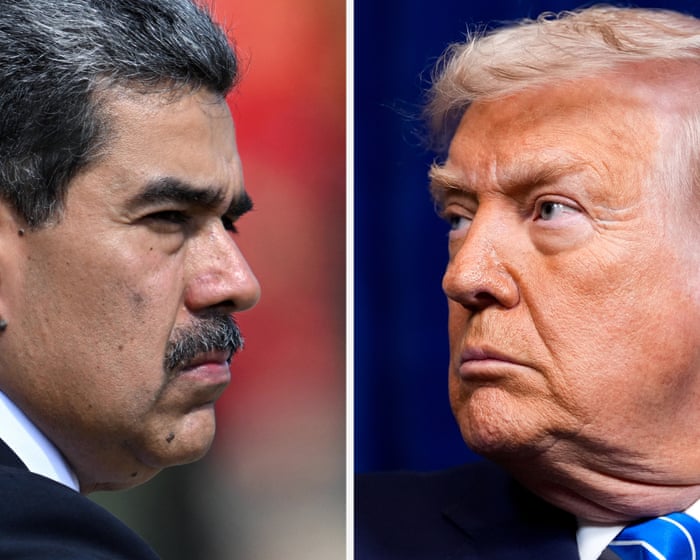
The United States conducted airstrikes across Venezuela overnight on Friday, with explosions shaking the capital, Caracas, before dawn. Shortly after, Donald Trump announced that U.S. forces had captured Venezuelan President Nicolás Maduro and his wife, Cilia Flores, and flown them out of the country.
U.S. Attorney General Pam Bondi stated they would face trial in New York on charges related to narco-terrorism. A new indictment was issued on Saturday.
Trump later posted a picture on his Truth Social platform with the caption, “Nicolas Maduro on board the USS Iwo Jima.” Late Saturday, the White House shared a video on social media appearing to show Maduro handcuffed and escorted by agents at the U.S. Drug Enforcement Administration offices.
The attack and unprecedented capture of a sitting president follow months of intense U.S. pressure against Venezuela. Since September, the U.S. Navy has assembled a large fleet off the Venezuelan coast, conducted airstrikes against alleged drug trafficking boats in the Caribbean and Pacific, and seized Venezuelan oil tankers. At least 110 people have been killed in these strikes, which human rights groups say could amount to war crimes.
This was the largest and most direct U.S. military action in Latin America since the 1989 invasion of Panama. The swift operation shocked the international community, with both U.S. allies and adversaries surprised by the brazen interference in a foreign country.
At a Mar-a-Lago news conference, Trump said the U.S. would “run the country” until a leadership transition could occur and that U.S. oil companies would enter Venezuela. He boasted that “no nation in the world could achieve what America achieved.”
The future of Venezuela’s ruling regime remains uncertain. Despite Trump’s claims that the U.S. will decide the country’s fate, the Venezuelan military appears to remain in control of the nation and its assets.
On Saturday, Venezuela’s Supreme Court ordered Vice President Delcy Rodríguez to assume the role of acting president during Maduro’s “temporary absence.” Trump later remarked that Rodríguez had offered her support to Washington, adding, “She really doesn’t have a choice.”
Rodríguez comes from a strong leftist background as the daughter of a Marxist guerrilla known for kidnapping a U.S. businessman, but she is also a French-educated technocrat who has built ties with Venezuela’s economic elites, foreign investors, and diplomats.
Trump seemed to dismiss Venezuela’s democratic opposition, stating that Nobel Peace Prize winner María Corina Machado lacked the necessary respect and support to lead.
How did we get here?
Since Trump began his second term, he has focused intensely on Maduro, pursuing a maximum pressure campaign against the Venezuelan regime. He accused Maduro of destabilizing activities in the Americas, including drug trafficking and illegal immigration to the U.S. In July, the U.S. announced a $50 million bounty on Maduro, accusing him of being one of the world’s largest narco-traffickers.
The Trump administration designated Venezuelan gangs like Tren de Aragua as terrorist organizations and began airstrikes against alleged drug traffickers in the Caribbean Sea. Soon after, the U.S. started seizing Venezuelan tankers and building up its military presence in the waters surrounding the South American country.
Trump has openly considered regime change in Venezuela. In late November, he gave Maduro an ultimatum to relinquish power, offering him safe passage out of the country. Maduro refused the offer.In Venezuela, the leader told supporters he rejected what he called “a slave’s peace” and accused the United States of seeking control over his country’s oil reserves.
As the Trump administration increased pressure, the government in Caracas often appeared confused. The Venezuelan leader repeatedly stated that Venezuela did not want war with the U.S., even dancing in front of students to lyrics that said “no war, yes peace,” while mimicking a double-fist pumping move associated with Trump.
Trump was reportedly not amused, and this dancing is said to have played a role in the decision to remove him from power. Just two days before his capture, the leader said in a televised interview that he would welcome U.S. investment in Venezuela’s oil sector.
A recently unsealed U.S. Justice Department indictment accuses him of leading a “corrupt, illegitimate government” supported by a large-scale drug trafficking operation that sent thousands of tons of cocaine into the United States.
Why are the U.S. and Venezuela in conflict?
Relations between the U.S. and Venezuela have been tense since Hugo Chávez became president in 1999. A self-declared socialist and anti-imperialist, Chávez angered the U.S. by opposing its invasions of Afghanistan and Iraq and by forming alliances with countries like Cuba and Iran. Relations worsened further after Chávez accused the U.S. of supporting a failed coup attempt in 2002.
To many in the U.S., particularly among more hawkish Republicans, the socialist ideology of Venezuela’s government made it a natural adversary, alongside its ally Cuba.
As Chávez consolidated power, punished political opponents, and took over much of the country’s private sector, the U.S. condemned Venezuela for its poor human rights record. Despite occasional minor improvements over the years, the relationship has continued to decline, especially after the current leader took power in 2013.
Under the Trump administration, the U.S. declared his government illegitimate and recognized Juan Guaidó, the head of parliament, as Venezuela’s president in 2019.
In July 2024, the leader appeared to suffer a major defeat in the presidential election, amid widespread frustration with his increasingly authoritarian rule and Venezuela’s economic crisis. The Biden administration recognized the opposition candidate, Edmundo González, as the winner. Detailed voting data released by the opposition and verified by independent experts indicated González won, but the leader held onto power after launching a severe crackdown.
In early December, the Trump administration issued what it called the “Trump corollary,” stating that the Western Hemisphere must be controlled by the U.S. politically, economically, commercially, and militarily. As part of this new doctrine, the U.S. military could be used to secure access to energy and mineral resources in the region.
During a press conference hours after the leader’s capture, Trump referenced the 19th-century Monroe Doctrine, historically used to assert U.S. military power in Latin America. Calling it the “Don-Roe doctrine,” he said, “American dominance in the Western Hemisphere will never be questioned again.”
Who is this leader and why was he captured?
He has been the president of Venezuela since 2013. A former bus driver, he rose to prominence under Chávez, serving as his foreign minister before becoming president after Chávez’s death.
His rule is widely considered dictatorial, with the UN estimating in 2019 that over 20,000 Venezuelans were killed in extrajudicial executions.Key institutions like the judiciary have been weakened under Maduro, and the rule of law has declined. In recent months, Trump has repeatedly called for Maduro’s removal, accusing him of sending drugs and criminals into the U.S.—a claim experts say lacks evidence. He also alleged that Maduro was stealing U.S. oil.
Despite months of escalating rhetoric, Saturday’s capture of the sitting president came without warning, and Venezuelan authorities appeared caught off guard by the brazen operation. Citing a senior Venezuelan official, The New York Times reported that at least 40 people, including civilians and soldiers, were killed in Saturday’s attack.
What happens next remains uncertain. Venezuela’s defense minister has vowed to fight on, urging citizens to unite against the foreign “invasion” and calling resistance to the U.S. a “fight for freedom.” Although Maduro has been captured, Venezuela’s institutions and military seem intact. It is unclear whether Saturday’s attack marks the start of a wider conflict or is a one-off operation, as Trump stated the U.S. retains the right to conduct further military actions in the country.
What is clear is that the U.S. is determined to play a major role in Venezuela, whether through military force or other means. Trump said on Saturday that the U.S. would decide what comes next for Venezuela, stating, “We can’t take a chance in letting somebody else run and just take over what he left, or left off.”
It was unclear exactly what Trump meant by saying the U.S. would run Venezuela, as there were no signs of a U.S. takeover of the capital, and Venezuelan soldiers remained at their posts across the country. Trump did not rule out deploying U.S. troops but said Venezuelan officials were agreeable to his demands—a sharp contrast to the defiant statements from officials in the hours after Maduro’s capture.
The U.S. has previously conducted war games simulating a scenario where Venezuela’s leadership was “decapitated.” The simulations predicted prolonged chaos, with refugees fleeing Venezuela and rival groups fighting for control. “You’d have prolonged chaos … with no clear way out,” said Douglas Farah, a Latin America expert who helped run the war games.
Colombia has mobilized its armed forces and expressed concern about a potential influx of refugees.
Frequently Asked Questions
Of course Here is a list of FAQs about the US and Venezuela designed to clarify the common misinformation about the capture of Venezuelas president
BeginnerLevel Questions
Q1 Is it true that the United States captured or arrested Venezuelas president Nicolás Maduro
A No this is false The United States has not captured arrested or detained President Nicolás Maduro He remains in Venezuela and in control of the government
Q2 Where did this rumor come from
A It likely stems from confusion over the US governments official position The US has issued indictments and offered a large reward for information leading to Maduros arrest on narcoterrorism charges but no physical capture has occurred
Q3 So who does the United States recognize as the leader of Venezuela
A Since January 2019 the US government no longer recognizes Nicolás Maduro as the legitimate president It recognizes opposition figure Juan Guaidó as the legitimate Interim President of Venezuela
Q4 What does Interim President mean in this case
A It means the US views Guaidó as the temporary constitutional leader because they believe Maduros 2018 reelection was fraudulent However Guaidó does not control the government military or territory within Venezuela
Q5 Why is there a political crisis in Venezuela
A The crisis involves a deep dispute over democracy and legitimacy One side controls the state institutions while the other side argues that control was obtained through undemocratic means leading to a humanitarian and economic collapse
Advanced Detailed Questions
Q6 What are the specific US actions against the Maduro government
A The US has employed several measures
Sanctions Extensive economic sanctions on Venezuelas oil sector and government officials
Legal Actions Criminal indictments against Maduro and other officials for drug trafficking and corruption
Diplomatic Recognition Withdrawing recognition of Maduros government and recognizing Guaidós interim government