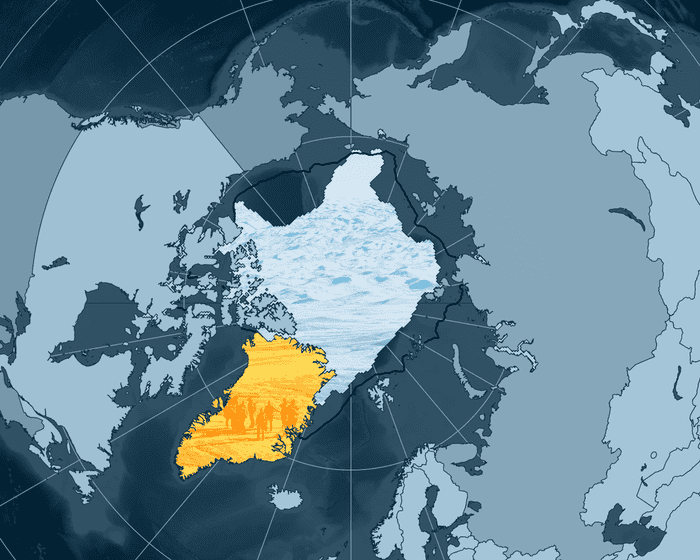
Located between the US and Russia, Greenland has emerged as a critical frontline as the Arctic opens up due to global warming. Its significance was highlighted when Donald Trump openly considered the US acquiring the island from its NATO ally Denmark, whether through purchase or force.
The climate crisis is shrinking Greenland’s ice sheet and Arctic sea ice, opening new shipping routes and revealing valuable resources. Trump’s threats, once dismissed as bluster, are now seen as an early sign of how melting ice is turning Greenland into a geopolitical hotspot. The maps below illustrate this shift.
Sea Ice Is Melting
The average Arctic sea ice extent over the past five years was 4.6 million square kilometers—roughly the size of the European Union. This represents a 27% decrease compared to the 1981–2010 average of 6.4 million square kilometers, according to the National Snow and Ice Data Center. The lost ice area is about the size of Libya.
As Arctic ice shrinks, the summer ice cap no longer reaches the Russian and Canadian coasts. With no land beneath the North Pole, previously inaccessible seas are now exposed.
Arctic Shipping Routes Are Becoming More Viable
New shipping routes are opening as polar seas remain navigable for longer periods. Routes once limited to icebreakers are becoming commercial corridors.
The most developed is the Northern Sea Route, which follows Russia’s Arctic coast from Europe to Asia and is central to Moscow’s ambitions. Farther west, the Northwest Passage cuts through Canada’s Arctic archipelago, while a central Arctic route across the North Pole is also being planned for the long term.
These changes are redrawing the global trade map, offering alternatives to the Suez Canal and cutting the journey from Western Europe to East Asia by nearly half. In 2025, the container ship Istanbul Bridge became the first liner to travel from China to Europe via the Northern Sea Route, also known as the “Polar Silk Road” shortcut. The voyage from Ningbo, China, to Felixstowe, UK, took about 20 days.
Data from the Marine Exchange of Alaska shows that transits through the Bering Strait, which separates Russia and the US, reached 665 in 2024—a 175% increase from 242 in 2010.
However, these routes are not without risks, which affect their commercial viability. Serafima Andreeva, a researcher at Norway’s Fridtjof Nansen Institute, notes that Moscow aims for year-round use of the Northeast Passage and is investing heavily in nuclear icebreakers. But ships still get stuck in the ice, even in summer.
Rising Tensions Around the Arctic
Several Arctic nations—Canada, Denmark, Norway, Russia, and the US—have territorial claims in the region. The UN’s Commission on the Limits of the Continental Shelf provides recommendations on these claims.
The US already maintains a military presence in the Arctic, including at the remote Pituffik base in northwest Greenland, which supports missile warning, missile defense, and space operations for the US and NATO. Russia has opened several military bases over the past decade, restoring old Soviet infrastructure and airfields. In 2018, China declared itself a “near-Arctic state” to expand its influence in the region.
Andreeva observes, “There has been an increased military interest in the Arctic over the past decade.”Over the past 10 to 15 years, the landscape has shifted significantly, especially since Russia’s invasion of Ukraine in 2022. Finland and Sweden joining NATO has reshaped the security picture, drawing more attention to the Nordic region as a whole. This has reinforced Russia’s determination to maintain control over strategic areas like the Kola Peninsula and the Barents Sea.
Even with its focus on Ukraine, Russia has kept up its presence in the Arctic. NATO countries have been strengthening their naval forces in the region and announcing plans to build more icebreakers. Since NATO’s Nordic expansion, Denmark’s air force has become more closely integrated with those of Finland, Norway, and Sweden. In 2024, China also sent three icebreaking ships to the Arctic.
Greenland is gaining importance in the global competition for critical minerals. It holds the world’s eighth-largest reserves of rare earth elements, estimated at 1.5 million tonnes. Two of the biggest known deposits are located at Kvanefjeld and Tanbreez, and foreign interest is rising. For example, China’s Shenghe Resources owns a 12.5% stake in the Kvanefjeld project.
So far, no rare earth mining has taken place in Greenland due to the challenging environment. Only about 20% of the island is ice-free, and much of it remains hard to access for most of the year. However, as global warming makes shipping routes more viable, retreating ice is also beginning to expose new mineral resources.
Frequently Asked Questions
Of course Here is a list of FAQs about Greenland focusing on its strategic importance resources and geopolitical context
BeginnerLevel Questions
1 Why is Greenland suddenly in the news so much
Greenland is gaining attention due to climate change which is melting its ice sheet This is opening up new shipping routes and revealing valuable minerals making the island strategically important for global powers
2 What are the emerging shipping lanes near Greenland
As Arctic sea ice melts new sea routes are becoming navigable for longer periods The most significant is the Northwest Passage and transArctic routes that pass near Greenland potentially cutting shipping times between Asia Europe and North America
3 What kind of mineral resources does Greenland have
Greenlands bedrock now more accessible is believed to hold vast deposits of rare earth elements iron ore gold rubies zinc and potentially oil and gas
4 Why would the US and Russia care about Greenland
Its about Arctic dominance Control or influence over Greenland means influence over new shipping lanes resource extraction and military positioning The US has a major air base there and Russia is modernizing its Arctic military assets putting them in closer proximity
5 Who owns Greenland
Greenland is an autonomous territory within the Kingdom of Denmark It manages most of its own affairs but Denmark handles its defense and foreign policy This is a key point in the geopolitical tensions
Advanced Strategic Questions
6 Whats the big deal about rare earth elements in Greenland
Rare earth elements are crucial for manufacturing smartphones wind turbines electric vehicles and military hardware Currently China dominates the global supply Greenlands deposits could provide an alternative nonChinese source for the West which is a major strategic goal
7 Is the Northwest Passage really a shortcut
Yes but with major caveats A voyage from East Asia to Europe