A solitary figure stands on the shore of Thailand’s Tang Khen Bay. The tide is slowly rising over the sandy beach, but the man doesn’t seem to notice. His eyes are not on the sea, but on the small screen in his hands.
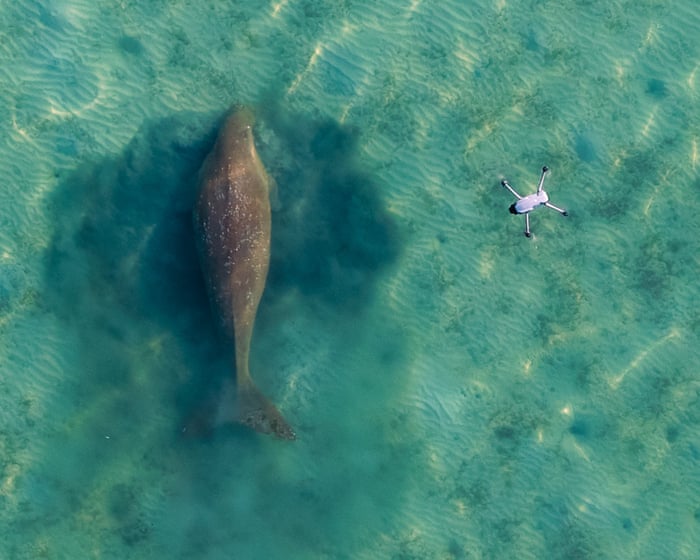
About 600 meters offshore, past the shadowy fringe of coral reef, his drone hovers over the murky water, focused on a swirling grey shape: Miracle, the local dugong, is back.
Theerasak Saksritawee, known as Pop, has been visiting Tang Khen Bay nearly every day for the past 15 months to monitor the dugongs, including Miracle, that have come to live in this part of the Andaman Sea.
After dropping his daughter off at school, Pop, 42, makes the short drive from his home in Phuket city to a roti bread shack on the bay’s shore. Sometimes he travels farther—to the beaches of Koh Phra Thong or down to Trang province.
There, he watches the bay for up to eight hours, guiding his drone over the water in search of dugongs.
“I see Miracle almost every day, although there have been times when I didn’t spot him for as long as a month,” says Pop, a hobbyist photographer who began filming the dugongs after seeing them on social media.
“I feel a deep connection to these incredible creatures,” he says. “Dugongs are a vital part of my home.”
At one point, there were as many as 13 dugongs living in Tang Khen Bay, nibbling the stubbly seagrass that grows along the ocean floor.
But today, Miracle is the only one left. Pop says the aggressive dugong chased the others away, nipping at their paddle-shaped flippers to keep the precious seagrass to himself.
It is not known where the others have gone. The only companion Miracle seemed to tolerate—a small female dugong named Jingjok—died last year.
“I felt disappointed and heartbroken because she was one of my favorite dugongs,” Pop recalls. “The lady who makes the roti here cried.”
Across the shallow coastal and island waters of the Indo-Pacific Ocean, dugongs—medium-sized marine mammals similar to their sea cow relatives, manatees—are in trouble.
An August 2025 assessment found that the dugong, already considered vulnerable to extinction, is also critically endangered in many parts of the world. They are threatened by habitat loss, climate breakdown, noise, boat strikes, and water and plastic pollution. The latter gained significant media attention in 2019 after a beloved baby dugong named Marium was found dead in Thailand with plastic in her stomach.
The dugongs living along Thailand’s Andaman Coast are now thought to be critical to the survival of the species. The region is one of only six locations in the world, outside Australia, with a population of more than 100 dugongs. In 2022, at least 273 dugongs lived in Thai waters, according to government estimates.
But a couple of years ago, dead or emaciated dugongs began washing up in large numbers along Thailand’s shores. From 2019 to 2022, an average of 20 dugong strandings a year were reported along the Andaman Coast. Then, from 2023 to 2024, that number more than doubled, to 42 a year. Jingjok’s death became just another statistic.
“We have probably easily lost half the population,” says Petch Manopawitr, an ecologist and adviser on dugongs to Thailand’s marine and coastal resources department.At the Phuket Marine Biological Center, a major cause of dugong deaths is starvation. In the image below right, Pop collects a sample of contaminated seawater at Tang Khen Bay, which was found to contain diesel spilled from a local boat. On the left, the tail fluke of a dead dugong is being measured.
Much of the devastation has occurred in nearby Trang province, southeast of Phuket. Once a stronghold for dugongs due to its abundant seagrass meadows, locals now report that the animals are no longer seen in Trang. Many have instead migrated about 60 miles (100 kilometers) to the waters off Phuket, a global tourism hotspot with expansive resorts that attract millions of visitors each year. Scientists say this poses additional challenges, as the area is not accustomed to dugong presence, and boat traffic needs to be carefully managed to protect them.
In January 2025, an international team of 13 scientists assembled for a fact-finding mission along the Andaman Coast to determine what was killing Thailand’s dugongs. Helene Marsh, a global dugong authority and emeritus professor at Australia’s James Cook University, spent five days traveling along the coast. She inspected seagrass meadows and interviewed government scientists, conservation organizations, and local residents about what they were witnessing.
Marsh and her colleagues concluded that the dugongs were responding to a massive seagrass die-off. “Dugongs are seagrass specialists,” she says. “An adult animal eats maybe 40 to 60 kilograms a day.” The team found the most serious seagrass losses in coastal waters near Trang, while seagrass in Krabi, Phuket, and Phang Nga provinces remained in decent shape. As a result, Trang’s seagrass dieback led to more dead dugongs washing ashore, starving animals becoming stranded, fewer calves being born, and animals migrating in search of greener pastures.
However, the cause of the seagrass die-off remains unclear. The mission’s report concluded that the root causes are unknown but suggested it may be due to a combination of factors: reduced light reaching seagrass because of silt in the water, increased pollution and dissolved nutrients, the effects of dredging, warmer seas, and shifting tidal cycles that leave seagrass more exposed to the sun.
“The Thai situation is quite puzzling because it doesn’t seem to have been linked to an extreme weather event, and it could be a chronic condition,” says Marsh. “Everywhere we went, local people would tell us about a different cause. But it was clear that whatever was happening had moved along the coast.”
Some experts suggest that higher water temperatures from human-caused climate change may be pushing an already stressed ecosystem to a breaking point. “If you have a good, intact, and healthy ecosystem, it can probably cope with such extreme conditions,” says Manopawitr. “But if the system is already a little sick, this kind of thing can easily push it over the edge.”
At Tang Khen Bay, Pop looks across the water at a new hotel under construction. Heavy rains in recent weeks have triggered deadly floods in southern Thailand. “The rain washes down materials from the construction site,” he notes.
In the images: Top, scientists from Kyoto University prepare to acoustically monitor dugongs to test if underwater sounds can prevent boat strikes; above right, government marine biologists test seawater contaminated with diesel; left, fisheries biologist Attawut Kantavong checks climate-resilient seagrass in a lab in Sri Racha. Another image shows Theerasak Saksritawee attaching a 360-degree fisheye lens camera to a drone to monitor dugongs in the bay.”The wastewater and sediment flowing into the bay deprive seagrass of essential nutrients, while algae blooms spread over the seagrass and block out sunlight,” he explains. Pop recalls that during one heavy rain period, Miracle left the bay for a week.
Manee Sanae, who operates a roti stall, says she used to see many dugongs surfacing for air near the buoys. “There was also much more seagrass before, even near the boats parked in front of my shop. But not anymore.”
While the government has made some efforts to plant new seagrass and provide extra food for hungry dugongs, Manopawitr notes that such measures cannot reach the scale needed to sustain dugongs in the long term. “This critical ecosystem is much more fragile than we previously believed,” he says. “We never imagined we would lose such a vast area of seagrass—Thailand’s last stronghold—in such a short time.”
Looking ahead, he advocates for locally managed marine areas and adaptive measures in protected zones to help create an ocean corridor as dugongs migrate in search of food. One hopeful sign, he adds, is that the dugongs that moved to Krabi have started to give birth.
Meanwhile, locals like Pop and Sanae do what they can to help the species, with an online group now dedicated to protecting the bay’s dugongs. If Sanae sees fishing boats entering Tang Khen when Miracle is present, she immediately alerts the group chat so they can help keep the fishermen away.
She adds that visitors to her stall don’t know much about dugongs. “But sometimes I tell them about Miracle.”
Frequently Asked Questions
Of course Here is a list of FAQs about the disappearance of dugongs from Thailands coasts designed to be clear direct and cover a range of understanding
Beginner General Questions
1 What exactly is a dugong
A dugong is a large gentle marine mammal often called a sea cow Its related to the manatee and is the only strictly marine herbivorous mammal meaning it only eats seagrass
2 Why are dugongs important to Thailands coasts
They are a key indicator of a healthy coastal ecosystem Their presence means the seagrass beds are thriving which provides food and nursery grounds for many fish species supports local fisheries and helps stabilize the seafloor
3 Have dugongs really disappeared from Thailand
They are critically endangered and functionally extinct in many areas where they were once common While a small population remains primarily in Trang and Krabi provinces their numbers have plummeted dramatically
4 Whats the main reason they are disappearing
The single biggest threat is the loss and degradation of their seagrass meadow habitats This is caused by coastal development pollution destructive fishing practices and boat strikes
Intermediate CauseFocused Questions
5 How does pollution affect dugongs
Chemical runoff from agriculture and plastics can poison seagrass or block sunlight it needs to grow More directly dugongs often mistake plastic bags for jellyfish or seagrass which can block their intestines and cause a slow painful death
6 What role do fishing nets play
Dugongs need to surface to breathe every few minutes When they get accidentally caught in fishing nets they drown Gill nets and abandoned ghost nets are particularly deadly
7 Ive heard about orphaned baby dugongs in the news Why does that happen
Dugong calves stay with their mothers for up to two years If a mother is killed by a boat strike or in a net the calf is left orphaned Their survival without maternal care is extremely low highlighting the loss of breeding adults
8 Is climate change a factor
Yes Rising sea temperatures can damage seagrass More severe storms and changes in water quality also degrade their habitat making it harder for the remaining populations to recover