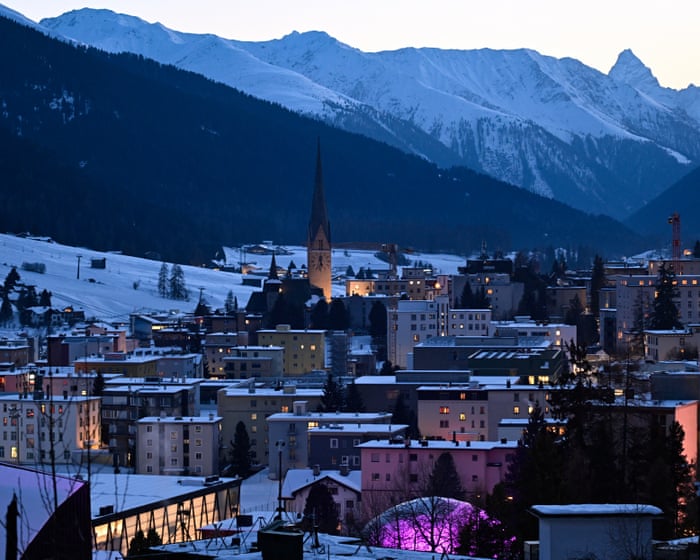
Hundreds of global CEOs, financial leaders, and more than 60 heads of state are gathering in Davos, Switzerland, for the World Economic Forum—the annual meeting of the world’s wealthy and powerful.
This year’s forum takes place as Donald Trump is not only deploying aggressive tactics in American cities like Minneapolis, but also systematically dismantling the international order that has prevailed since World War II. He is undermining NATO, withdrawing from international agreements such as the UN climate treaty, violating the UN charter by invading Venezuela and seizing Nicolás Maduro, overturning long-standing trade rules, and even demanding that the U.S. annex Greenland.
He has also threatened to raise tariffs on fellow NATO members—Denmark, Norway, Sweden, France, Germany, the UK, the Netherlands, and Finland—after they expressed solidarity with Denmark over its refusal to cede Greenland.
In a text message to Norway’s prime minister over the weekend, Trump suggested one reason for pursuing Greenland was his resentment over not receiving the Nobel Peace Prize. “Considering your Country decided not to give me the Nobel Peace Prize for having stopped 8 Wars PLUS, I no longer feel an obligation to think purely of Peace,” he wrote, adding that he could now focus on what he believes is best for the United States.
I hope the leaders assembled in Davos will speak out against Trump’s authoritarian disregard for international law and institutions designed to maintain peace. A collective rejection from them could empower other CEOs and world leaders to voice their opposition as well—potentially creating a tipping point.
But will they? Trump is actively trying to prevent it.
For instance, on Saturday he threatened to sue JPMorgan Chase, the largest U.S. bank, led by CEO Jamie Dimon—one of the most prominent executives attending Davos. Trump claimed the bank “incorrectly and inappropriately DEBANKED” him after the January 6th protest, which he falsely called “correct” and based on a “RIGGED” election.
This is nonsense. There is no evidence JPMorgan Chase “debanked” Trump—nor that the 2020 election was rigged. And if Trump truly believed the bank acted improperly, why wait five years to sue?
In reality, the lawsuit threat likely has little to do with banking. It appears Trump is reacting to Dimon’s recent public criticism of his criminal investigation into Federal Reserve Chair Jerome Powell. Trump may be worried about what Dimon might say at Davos.
Dimon’s remarks were measured: “Anything that chips away at [the Fed’s independence] is not a good idea… It’ll increase inflation expectations and probably increase rates over time.” Yet even this mild critique seems to have angered Trump.
By saying he will sue “over the next two weeks” rather than immediately, Trump seems to be maximizing pressure on Dimon ahead of his high-profile speaking role at Davos. If Dimon uses that platform to condemn Trump’s attacks on the global economy and democracy, he could encourage other CEOs and world leaders to do the same. But if Trump can silence Dimon, others are unlikely to speak up.
Thus, Trump’s legal threat is less about winning a case and more about intimidating Dimon and others into compliance.
The question now is whether Dimon has the integrity to risk the bank’s profits—and his own substantial compensation—by speaking the truth: that Trump must be opposed by anyone with power and principle.
We will soon find out.I’m not counting on it. Time and again, Dimon has proven more loyal to JPMorgan Chase than to the United States. His mild criticism of Trump for undermining the Federal Reserve’s independence may simply reflect concern for his bank’s profits.
But who knows? Dimon will retire soon. This is his chance to be on the right side of history.
To intimidate the gathered CEOs and world leaders, Trump is going to Davos himself, bringing the largest U.S. delegation ever—including five cabinet secretaries and other senior officials.
With the U.S. president openly willing to raise tariffs or punish countries that oppose him, will any prime minister or head of state at Davos dare to challenge him?
Maybe, but only meekly and indirectly. Who wants to poke the bear?
Still, Dimon and others at Davos must speak out against what is happening. If ever there was a moment for global leadership, it is now.
Davos claims its purpose is to provide world leadership—though its attendees haven’t exactly stood out in the past for their commitment to democracy, social justice, or international law. Some are directly benefiting from Trump’s tax cuts and deregulation. Many hold their positions precisely because they avoid rocking the boat or making waves.
Yet if there was ever a time for them to speak up, it is now. This is their opportunity—and their duty. The world needs to hear leaders clearly and firmly denounce the chaos Trump is creating.
Robert Reich, a former U.S. Secretary of Labor, is Professor of Public Policy Emeritus at the University of California, Berkeley. He is a Guardian US columnist, and his newsletter is at robertreich.substack.com. His new book, Coming Up Short: A Memoir of My America, is out now.
Frequently Asked Questions
Of course Here is a list of FAQs about the topic World leaders in Davos must confront Trump This is their opportunity
BeginnerLevel Questions
1 What is Davos
Davos refers to the annual meeting of the World Economic Forum held in Davos Switzerland Its a major gathering where global leaders CEOs and experts discuss economic and political issues
2 Who is this about
This is about world leaders attending the Davos forum and former US President Donald Trump who is running for president again The idea is that they have a chance to directly address his policies and statements
3 Why do leaders at Davos need to confront Trump
Because Trumps potential return to power could significantly change international policies on trade climate defense alliances and support for Ukraine Leaders at Davos who generally favor global cooperation see this as a key moment to challenge his views and understand his plans
4 What does this is their opportunity mean
Davos provides a unique highprofile stage Its a chance for leaders to publicly debate Trumps America First agenda ask him tough questions and try to influence global opinion and perhaps his policies before a possible second term
Advanced Strategic Questions
5 What specific issues would they likely confront him on
Ukraine Aid Commitment to continued military and financial support
NATO Concerns over his past comments suggesting the US might not defend allies
Climate Change The future of international agreements like the Paris Accord
Global Trade Tariffs and the risk of new trade wars
China His strategy for dealing with Chinas global influence
6 Is confrontation the best strategy or would diplomacy be more effective
This is a major debate Some argue direct confrontation forces clarity and shows resolve to voters back home Others believe a more diplomatic private approach might be more productive for building working relationships and finding compromises avoiding public spats that could harden positions
7 What are the risks for world leaders in doing this
Publicly confronting a figure like Trump could backfire It might energize his domestic support be framed as global elites ganging up on America and make him less cooperative if he wins