Greenland’s futsal players line up, then turn left to face their flag on the far wall. No one looks away as their national anthem echoes through the hall. The red-and-white banner, with its contrasting semicircles, hangs proudly among those of this week’s opponents: Scotland on the right, Morocco on the left, and further along, even the flags of UEFA and FIFA.
The moment always feels special. Their longtime coach, Rene Olsen, has been picturing it for days. His team knows these rare occasions must be seized. “It gives me goosebumps,” says star player Patrick Frederiksen later. “That’s when you realize it’s time.”
It’s Thursday morning, and Greenland is about to face Romania, ranked 36th in the world. Just hours earlier, Donald Trump appeared to step back from his threat to annex Greenland after a week of escalating rhetoric. The backdrop of intense uncertainty for its 57,000 residents isn’t lost on anyone here.
That Greenland is in this stunning, quiet corner of Croatia speaks volumes. Despite persistent efforts, they haven’t been admitted to any football or futsal governing body. They can’t play official matches or qualify for major tournaments. But Futsal Week, a private eight-team competition sanctioned by UEFA and FIFA, offers a priceless chance to prove themselves against elite teams. In football, they’re limited to matches against other non-sovereign regions.
Originally scheduled for autumn, Futsal Week’s postponement to late January now feels grimly timely. “It’s hard to call it land, it’s a big piece of ice,” Trump said of Greenland at Davos. There are few international stages where Greenland can visually counter that demeaning myth. Olsen and his squad aim for recognition and self-assertion, but no one is here to make loud political statements. Their stories are powerfully human.
“Every time we travel, it brings positive attention to Greenland,” says Frederiksen, who also captains the 11-a-side team. “We earn more respect with each game, and people remember us. It gives us energy and strength to keep going. It confirms we’re doing something great.”
Frederiksen, a skilled and imposing 31-year-old, works full-time at an orphanage in Nuuk, Greenland’s capital. Like many teammates who work with youth, his care in interactions is evident. Twenty-two-year-old Rass Ikila Abelsen, who once idolized Frederiksen, is training to be a teacher and will finish his course in two years.
“The young players I work with look up to me,” he says. “We always talk about football and futsal, and they ask how they can join the national team.”
Ikila Abelsen, like his teammates, has become a role model, living a childhood dream from Tasiilaq, a town of 1,800 on Greenland’s east coast. Reaching Nuuk requires a helicopter ride followed by a plane trip. In winter, he and friends would build goalposts from snow and play outside in temperatures as low as -20°C (-4°F). Sometimes he misses those days, when unreliable internet made outdoor activity more appealing than phones or gaming.
Many of the 17 traveling players share similar stories. Their number 10, Aiko Nie…Lsen recently published a book about his rural upbringing. But the trip to Croatia has brought more ordinary challenges. Their luggage didn’t make it onto the third and final flight from Zagreb to Pula. It finally arrived on Wednesday evening, so that day’s training had to be done in whatever clothes they had on hand. No one is too bothered. “We are spontaneous, flexible people, and we bring that into the game,” Frederiksen says. “We have to be, because in Greenland, the weather is in charge.”
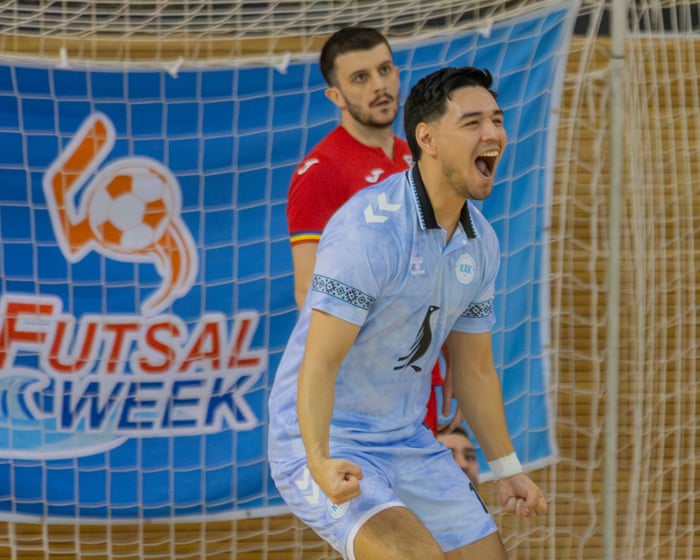
Greenland’s Patrick Frederiksen, in light blue, goes on the attack against Romania. “We show our emotions,” he says. “We let it all out.”
The match against Romania is seen as a chance to make a statement. Greenland lost their previous meeting in 2023, but keeping up with opponents who include several professionals would further cement their place on the scene. Maybe other countries, reluctant to travel to Nuuk, will at least recognize that they would be evenly matched with a team excluded from the official rankings. Futsal Week offers more than just tough competition: the Greenland Football Association’s general secretary, Aqissiaq Ludvigsen, is in town, and the networking opportunities are everywhere. Scotland’s presence sparks interest: perhaps Greenland could co-host a tournament with some of the home nations.
After the anthem, Greenland charge into Romania. Is there pent-up aggression, frustration, or whatever you might call it, being released after the stress of recent weeks? That can only be guessed. Besides, there’s been a long buildup—their last international game was at a tournament in Brazil, a notable breakthrough ten months ago. This return to competition has been a long time coming.
“We are fighters, it’s in our DNA,” Frederiksen says. “We yell, we show our emotions, we don’t hide them. If we’re disappointed, sad, happy, we show our energy. We let it all out every time—you can see it and feel it.”
Whatever is driving Greenland, it puts them 3-1 up by halftime. Players like the lanky Angutivik Gundel-Collin, who recently came close to joining an Italian club, look skillful, bold, and determined. The keeper, Aqqalooraq Ejvind Lund, is inspired, and Romania are visibly shaken. “I hadn’t dreamed of a first half like we produced,” Olsen says. “I thought, ‘Okay, they’re finally performing at the level we know they can.’” The bench erupts with each goal.
They savor a stunning fourth goal, flicked in after the best move of the game, and Greenland seem headed for one of the best results in their history. Anyone tuning into a stream from Zurich or Nyon would be impressed. But they collapse in the later stages, with Romania’s 8-4 win owing much to futsal’s harsh penalty rules.
“Something happened that was hard to explain,” Olsen says. The emotions afterward are raw. Greenland were brilliant for two-thirds of the match, and there is devastation that they couldn’t finish it.
Greenland spent years trying to join UEFA but, as an autonomous territory of Denmark, found the path blocked when European football’s governing body stopped accepting non-independent regions in 2013. Last year, they were optimistic about being admitted by CONCACAF, the confederation for North and Central America and the Caribbean, only to be shocked when their application was unanimously rejected in June. It came after Trump had publicly expressed his fixation with Greenland and felt like a gut punch.
“We thought that maybe it was time, maybe the dream was finally coming true,” Frederiksen says. “So it was really disappointing, but it just turned on a feeling inside us that we want to give even more when we travel. We were never going to start pointing fingers. We just said, ‘We need to work harder and come up with better plans, developing football and futsal in Greenland.’”Greenland is determined to reach the point where the football world must accept them. Efforts to achieve this recognition continue within the sport’s governing bodies. In the meantime, every victory helps their cause.
The soft-spoken coach, Rene Olsen, has led the futsal team for over ten years while also running a graphic design company in Nuuk. He gives his players freedom to shape their own path. Ahead of their match against Malta—a playoff between quarterfinal losers on Friday—the squad prepares by dividing into three groups.
These groups, or “chains,” are loosely based on the players’ regions: north, south, or Nuuk. Each focuses on implementing a specific part of Olsen’s game plan. “We want to nurture this group mentality,” Olsen explains. “We try to educate them, and then they can decide the best course of action.”
Their decisions pay off. Within thirty seconds of kickoff against Malta, they score twice through Nielsen, who had just flown in on Thursday afternoon after a holiday in Thailand. Nielsen is considered one of the best players in Greenland’s 11-a-side league, and he shakes off any jet lag to score four times in a 6–2 victory. The mood after the win is jubilant. “This is what we work for,” Olsen says with a smile. On Sunday, they will face Switzerland for fifth place.
The very dreams that some have threatened to take away remain alive. “My biggest wish is to play a home game in Nuuk against another country, in front of our own fans, with all of Greenland behind us,” says Ikila Abelsen.
For Frederiksen, the potential of weeks like this is boundless. “Whenever we get the chance to play, it’s all or nothing,” he says. “It means so much to us to change how people see us.”
Frequently Asked Questions
Of course Here is a list of FAQs about the topic We are fighters its in our DNA Greenland takes pride in its rare pursuit of futsal glory
Beginner General Questions
Q What is this article about
A Its about Greenlands national futsal team and their unique determined journey to compete internationally despite huge logistical and geographical challenges
Q What is futsal
A Futsal is a fastpaced indoor version of soccer played with five players per side and a smaller heavier ball that encourages skill and quick passing
Q Why is Greenlands pursuit rare
A Greenland is not a member of FIFA so they cant play in World Cup qualifiers They have to find special tournaments and often travel immense distances at great cost just to get games
Q What does its in our DNA mean in this context
A Its a metaphor It means the players and people of Greenland see resilience toughness and a fighting spirit as a fundamental part of their national identity honed by their environment and history
Q Has Greenlands futsal team had any success
A Yes They have competed in the UEFA Futsal Euro preliminary rounds and other tournaments often performing respectably against established European nations and winning games which is a massive achievement given their circumstances
Advanced Detailed Questions
Q What are the biggest practical challenges the team faces
A The main challenges are travel funding and a very small player pool to select from in a population of around 56000
Q If theyre not in FIFA how do they get to play in UEFA tournaments
A Greenland is an autonomous territory of the Kingdom of Denmark While not a FIFA member it is affiliated with the Danish Football Association which allows them to apply for special admission to compete in UEFAs Futsal Euro qualifiers
Q Whats the significance of them playing futsal instead of outdoor soccer
A Greenlands climate makes playing outdoor soccer on grass impossible for most of the year Futsal played indoors is a natural