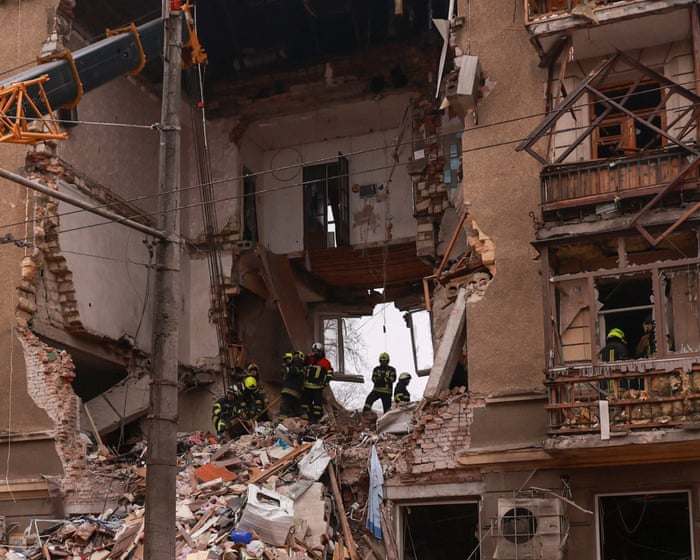
Outside the Kadorr apartment complex in Odesa, a Black Sea city in Ukraine, residents and rescue workers gather in the freezing cold about 500 meters from the shore. On the 25th floor, above an office, a section of the wall has been blown out by a Russian drone. Down below, rubble and glass have been hastily piled up as owners inspect cars crushed by falling debris.
Anastasia, 35, who lives in a nearby building, was forced to flee to Odesa from Donetsk after the Russian invasion and occupation in the east. Now she is grappling with the reality of the recent attack. “I was asleep. At first, I thought it was a dream when the building shook. I didn’t hear the explosion, but I heard another Russian Shahed drone that was incredibly loud. It had been relatively quiet since I arrived here, but lately it’s started to feel more dangerous. I haven’t decided whether to move yet, but right now I’m scared.”
She is not alone. Russian strikes on Odesa have intensified dramatically in recent months, as tensions in the Black Sea region have reignited after a period of stalemate.
Ukrainian attacks late last year on oil tankers in Russia’s shadow fleet, along with strikes on the Russian naval base at Novorossiysk, coincided with renewed Russian focus on Odesa. Vladimir Putin has long claimed Ukraine’s main port as Russian territory, and in December he threatened to cut the city off from the sea.
Capturing Odesa, or even imposing a naval blockade, remains well beyond Moscow’s capabilities. Ukrainian naval missile batteries destroyed Russian warships, most notably the Moskva, early in the war. Instead, Russia has relentlessly bombarded the city with missiles and drones.
The largest recent strike occurred on December 13, when 160 drones and missiles targeted energy infrastructure, leaving much of the city without water or electricity for days. This marked the start of a period of near-daily attacks.
In his Odesa office, Dmytro Pletenchuk, spokesperson for Ukraine’s navy, pulls out a calendar for January. “Shahed. Shahed. Shahed… There have been only two days this month without an attack,” he says. It is January 19, and there have been 16 days of rockets and missiles in total.
“The Russians are attacking our energy infrastructure day and night because they think the cold will force us to surrender,” he explains. “Right now, the situation in the Black Sea is like a chessboard—no one can make a move. We’ve pushed Russian warships back to Novorossiysk, but Russian aviation still controls the air over large parts of the Black Sea. So now it’s a gray zone, 25,000 square kilometers of sea turned into a gray zone.”
This has led to a long-range war, fought just as violently, as Ukraine targets crucial Russian oil shipments, and Moscow aims to disrupt Kyiv’s key economic lifeline: the export of agricultural products by sea. “The escalation began in the autumn when Russia increased its shelling of Ukrainian ports,” Pletenchuk said.
Alongside these efforts—as in other parts of Ukraine—Moscow has targeted civilian energy infrastructure, which Ukrainian officials say is intended to “disconnect” the country from the power grid.
According to Oleh Kiper, the governor of the Odesa region, the Black Sea is both an asset for the country’s defense and a complicating factor. “On the one hand, it is nature’s…””The sea acts as a barrier protecting us,” he said. However, unlike cities farther inland, such as the capital, which are surrounded by layered air defenses, the sea makes it harder to build similarly deep defenses for Odesa. This leaves the city vulnerable to long-range drone and missile strikes launched from Russian-occupied Crimea.
“The worst attack was on December 13,” said Kiper. “After that massive strike, at least 60% of the Odesa region was without electricity, water, or heat. It depends on the wider situation in the country, but some houses and districts now go without power for up to 10 hours a day.”
Lt. Col. Denys Nosicov, who heads territorial defense groups in the south, is among those responsible for protecting Odesa.
“In the last couple of months, the enemy has used combined attacks with rockets and Shahed drones,” he explained. “The goal is to put psychological pressure on the people of Odesa region. They want to damage our morale. We face Shahed attacks every day, alongside Russian psychological operations on social media.”
The importance of Odesa and the Black Sea to Moscow’s ambitions was highlighted last year in a statement by Ukraine’s chief of staff, Oleksandr Syrski.
“The Russian aggressor sought to end the war against Ukraine by devastating us and imposing its terms from a position of strength,” he said. “They tried to seize the remaining territories of Donetsk, Luhansk, and Zaporizhzhia regions, as well as the right bank of Kherson, and aimed to reach Odesa to completely cut off our access to the sea.”
This was echoed in early January by President Volodymyr Zelenskyy.
“They definitely want to cut off Odesa and other cities in terms of infrastructure,” he stated. “They are striking and killing both people and the economy by reducing our export capabilities through the maritime corridor.”
With 90% of Ukraine’s agricultural exports shipped by sea through Odesa’s ports, shipping routes have become a war zone. “The Black Sea, which feeds us and is an integral part of our economy, is also our weak spot,” Ukrainian military analyst Oleksandr Kovalenko told the Wall Street Journal in a recent interview.
All of this, says Nosicov, requires Ukraine to treat every aspect of the Russian threat—on land, sea, and air—with equal seriousness.
“Even now we are preparing Odesa for a circular defense with anti-tank traps, kill zones, and mines,” he said. “We will always take this Russian threat seriously, even though I believe that if Putin ordered the capture of Odesa, it would result in Russia’s biggest defeat in this region.”
While Russia currently seems capable only of long-range strikes, it is civilians who bear the brunt of these attacks.
At the Lyceum for Construction and Architecture, a trade school in central Odesa, director Igor Chernenko is overseeing cleanup and repairs after the institution was hit by three Shahed drones in January.
With no heating, the smell of smoke lingers in Chernenko’s office, where he wears a winter coat and hat in a building that once hosted over 320 students and 72 staff members.
“The strike happened on January 13 around 2:40 a.m. A night guard in the basement called to say everything was shaking. When I arrived at 4 a.m., the building was still on fire.
“I can’t understand why the Russians would target this place. My only th…”They don’t want us to train the workers who will rebuild Ukraine.”
He guides the reporter to a snow-covered second-floor roof, where two drones had struck, shattering the windows of an office building a block away and spraying shrapnel across a neighboring tower.
“One of our most precious losses was our archive, which we’ve maintained since 1945. Honestly, the situation is only deteriorating. Before, we faced attacks about once a week, but now it’s every night.
“This is what they’re doing. It’s because Odesa is a seaside jewel. The Russians still believe it belongs to them. And the person leading Russia thinks like a terrorist.”
Frequently Asked Questions
Of course Here is a list of FAQs about the recent escalation of attacks on Odesa and the shift in the war to the Black Sea designed to sound like questions from a concerned public
BeginnerLevel Questions
1 Why is Odesa being attacked so much right now
Russia has shifted its focus back to the Black Sea region They are targeting Odesas port infrastructure to disrupt Ukraines ability to export grain and other goods which is crucial for Ukraines economy and global food supplies
2 What is the war shifting back to the Black Sea
Earlier in the war the fighting was concentrated on land in eastern and southern Ukraine Now Russia is using missiles drones and naval forces to attack key cities and ports along Ukraines Black Sea coast like Odesa making the sea a major battleground again
3 How is this affecting the people living in Odesa
Residents are facing daily air raid alarms frequent power outages damage to homes and historic buildings and a constant threat to their safety The attacks on the port also threaten jobs and the citys economic lifeline
4 What is the grain deal I keep hearing about
This was a UN and Turkeybrokered agreement that allowed Ukraine to safely export millions of tons of grain from Black Sea ports despite the war Russia pulled out of the deal in July 2023 and the attacks on Odesa are a direct effort to enforce that blockade
5 Is Odesa in danger of being captured by Russia
While the constant attacks are devastating most analysts believe a fullscale amphibious assault to capture the city would be extremely difficult for Russia The current goal appears to be to cripple the citys function as a port and terrorize its population not an immediate ground invasion
Advanced Strategic Questions
6 Whats Russias strategic goal with these attacks
Russia aims to achieve several goals 1 Strangle Ukraines economy by destroying its export capabilities 2 Gain leverage in any future negotiations by controlling Black Sea trade 3 Force Ukraine to divert air defenses and resources away from the front lines to protect the coast
7 How is Ukraine fighting back in the Black Sea without a strong navy
Ukraine has been remarkably effective using asymmetric tactics This includes deploying naval drones uncre