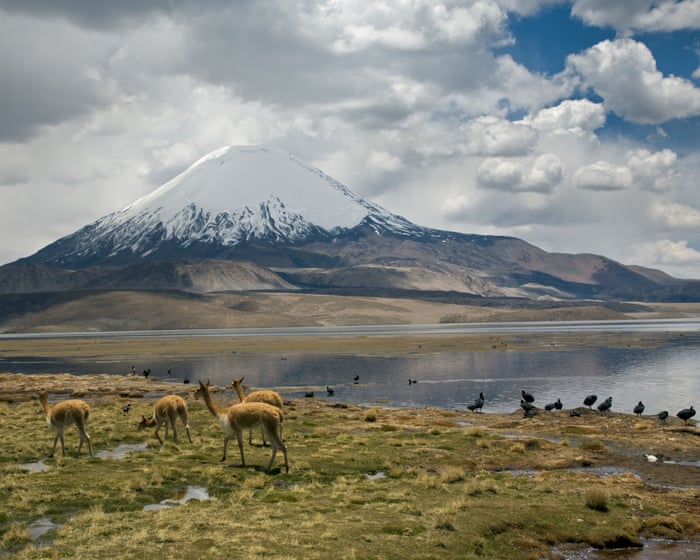
In Chile’s northernmost region, Arica y Parinacota, 62-year-old Andrea Chellew depends on tourists for her cafe business. Visitors typically travel from the coastal city of Arica to the unique biosphere of the Andean highlands, which soar above 5,000 meters and are home to nature reserves and wetlands.
Chellew lives at 3,000 meters above sea level along Highway 11, a trade route connecting Bolivia and Chile. Yet her cafe sits empty as tourist numbers decline, with increased reports of mining activity near protected areas like Lauca National Park.
As a regional councillor, Chellew explains, “The highlands sustain life. All that water flows down from the mountains to the valleys—Azapa and Lluta—and to the coast, where Arica is located. So we have a very serious problem.”
She adds, “The mining business in Chile benefits very few people. The rest are left in absolute misery.”
Far-right president José Antonio Kast recently won Chile’s election, campaigning on greater security and a “pro-business” platform under the slogan “fewer permits, more investment.” This was a direct criticism of what he sees as “excessive bureaucracy” in environmental permitting, which he believes hinders economic growth.
In Arica y Parinacota, Kast won by a wide margin, securing over 62% of the vote. As he assumed the presidency on March 11, many environmental activists grew concerned about what his term could mean for conservation, Indigenous rights, and water access.
Chellew notes, “The entire north of Chile is contaminated with polymetals,” referring to toxic pollution from heavy metals like arsenic, lead, cadmium, and copper left by mining.
“Kast is more like Trump,” she says. “We are worried. People here voted for the far right—it’s absurd.”
Marcela Gómez Mamani, a representative of the Indigenous Umirpa community and a member of the regional council, shares these concerns about the new government’s environmental impact. “The greatest concern is water,” she says.
In the southern part of the region, over 4,000 meters above sea level, the Indigenous Aymara community in the Vitor-Codpa basin has long been worried about mining operations.
Chilean company Andex Minerals has been exploring for copper and other resources around the small town of Camarones, leading locals to fear mining may soon begin.
“The company is operating right where the water sources are,” says Gómez Mamani. “They drill one or two kilometers deep, even if their project documents say 200 or 800 meters.”
She warns, “We will not have water—not for agriculture, not for livestock, not for tourism, not for any economic activity we currently depend on.”
Andex Minerals was contacted for comment.
Surrounded by three mountains known as the Mallku, rainwater flows and collects on the western slopes, used by communities along the basin. The area is designated an Alto Andino Indigenous Development Area (ADI), intended to support sustainable development and cultural preservation for Indigenous communities in these high-altitude ecosystems.
Yet Gómez Mamani says little is being respected. “They blocked ancestral ceremonial sites…””They blocked our ceremonial paths by placing rocks across them. We filed complaints, and nothing happened,” she says. “The government talks about our rich culture, but when it comes to water and land rights, that recognition vanishes. That’s where Indigenous peoples are labeled as obstacles to ‘development’.”
An abandoned sulphur mine near Chile’s border with Peru highlights the region’s long history of resource extraction. Mining accounts for over half of Chile’s exports.
The link between mining companies, the health of local communities, and access to clean water ties the profits from extractive industries to environmental damage. Mining is a cornerstone of Chile’s economy, contributing about 20% of state revenue in 2021. All mining occurs in the country’s northern regions, which have drawn significant foreign investment for decades.
Fernando Cabrales Gómez, an economist and associate professor at the University of Tarapacá, states: “Mining makes up more than half of Chile’s exports and is the only industrial sector with productivity matching that of a developed country.”
In the past, large-scale dumping of toxic materials by foreign companies in Arica y Parinacota has led to severe health issues, including arsenic and heavy metal poisoning. This is seen as a consequence of prioritizing foreign investment over public health.
“It has been a long and painful struggle,” says Luz Ramírez, president of the Mamitas del Plomo (“Mothers of Lead”) Foundation, which she helped establish after discovering high arsenic levels in her children’s blood.
She is among more than 700 Chileans who sought compensation in 2013 after allegedly suffering health problems from living near waste left by a Swedish mining company in the 1980s.
“We need a government committed to environmental protection,” says Ramírez. “We are deeply contaminated, and 50 years later, the damage remains unresolved.”
Last month, an accident involving a cargo truck traveling between the Bolivian and Chilean borders spilled over 20,000 liters of soybean oil into Lake Chungará in Lauca National Park, as the main road runs along the lake’s shore. This was the sixth such accident this year and sparked protests in Arica, demanding stronger government action to protect the environment.
Nationally, the two-year deadline set by the previous leftist government under Gabriel Boric to establish the newly created Biodiversity and Protected Areas Service (SBAP) passed without the legislation being enacted. This means it could be discarded by the new government, potentially blocking environmental protection efforts.
Now, conservation organizations are on high alert, striving to preserve existing environmental safeguards. Lorena Arce, coordinator of the biodiversity and development alternatives program at Chile’s Citizen Observatory, noted that political activism “will be focused more on defense than on promotion.”
The Atacama Desert is one of the driest places on Earth, making water an intensely political issue. Sources range from tributaries of the Lluta and San José Rivers, which irrigate the important agricultural valleys of Azapa and Lluta, to groundwater and high-altitude wetlands known locally as bofedales and vegales.
The Azapa Valley, one of the region’s main agricultural centers and known as “Chile’s refrigerator,” produces tomatoes, olives, and other vegetables year-round. Yet the Azapa aquifer is facing shortages.
San Miguel de Azapa, an agricultural oasis in the Atacama Desert known for…Known as ‘Chile’s refrigerator’ for the year-round produce from its greenhouses, the region faces challenges worsened by climate change. A government report projects that highland temperatures could rise by 2-6°C (3.6-10.8°F) by 2080, with precipitation declining by up to 30%, threatening major water sources.
Chile’s water system is one of the world’s most privatized, rooted in a code established in 1981 under the Pinochet dictatorship. This law granted permanent, tradable water rights to private entities, leading mining companies to acquire large shares and creating tensions with Indigenous communities who depend on the same water for farming, livestock, and wetlands.
Gloria Lillo Ortega of the National Irrigation Commission notes, “The main problem in the north is less about infrastructure and more about governance: the rules, the legal framework, the water code, land-use planning, and long-term strategy.” She adds, “The Boric administration has prioritized small-scale agriculture and Indigenous communities, but a future administration could shift focus toward large-scale users.”
A 2022 reform limited water rights to 30 years instead of granting them indefinitely, prioritizing human consumption and environmental protection. However, critics say it fails to adequately address historical inequalities in water access.
In Putre, Sebastián Vidal Díaz of the Aka Pacha Foundation expresses concern about the new Kast administration. “We fear this focus on production could bring extreme changes to the north, a region with relatively few mining projects,” he says. “Kast simply wants more foreign investment.”
Frequently Asked Questions
Of course Here is a list of FAQs about the topic Kast is similar to Trump Chiles environmentalists gear up to fight for the nations future framed in a natural conversational tone
Understanding the Headline Key Figures
1 Who is José Antonio Kast and why is he being compared to Trump
José Antonio Kast is a conservative Chilean politician who founded the Republican Party Hes compared to Donald Trump due to his populist rightwing style strong stance on immigration and lawandorder skepticism of climate change policies and use of polarizing rhetoric
2 What does the headline mean by Chiles environmentalists gear up to fight
It means that environmental activists and organizations in Chile are mobilizingorganizing protests lobbying and raising public awarenessbecause they view Kasts political rise and policies as a major threat to the countrys environmental protections and climate goals
3 Is Kast actually like Trump or is it just a media comparison
While there are clear similarities in political style and some policy areas its an analogy Their contexts are different Chile has a unique history a powerful environmental movement and is a major copper producer facing specific climate challenges
Policy Environmental Stakes
4 What are Kasts main views on the environment and climate change
Kast has expressed skepticism about the urgency of humancaused climate change prioritizes economic development over strict environmental regulation and has criticized Chiles ambitious climate goals as economically damaging
5 What specific environmental policies in Chile are at risk
Policies at risk include Chiles goal of being carbon neutral by 2050 protections for glaciers and biodiversity regulations on mining and industrial pollution and the implementation of its Framework Law on Climate Change
6 Why is Chiles environment so important globally
Chile contains unique ecosystems like Patagonia the Atacama Desert and vast glaciers Its also the worlds largest copper producer and has enormous potential for solar and wind power making its climate policy influential
7 What are the benefits supporters see in Kasts approach
Supporters argue his focus on economic growth deregulation and support for key industries like mining will create jobs reduce energy costs and assert national sovereignty over natural