A new analysis reveals that the U.S.-Israel conflict with Iran is devastating for the climate, depleting the global carbon budget faster than 84 countries combined.
In the first 14 days alone, the war—marked by airstrikes, drones, and missiles that have killed thousands, destroyed infrastructure, and turned parts of the Middle East into an environmental sacrifice zone—produced an estimated 5 million tonnes of greenhouse gas emissions.
The study, shared exclusively with the Guardian, adds to growing reports of catastrophic environmental damage from attacks on fossil fuel infrastructure, military bases, civilian areas, and ships.
“Every missile strike is another downpayment on a hotter, more unstable planet, and none of it makes anyone safer,” said Patrick Bigger, research director at the Climate and Community Institute and a co-author of the analysis. “Every refinery fire and tanker strike is a reminder that fossil-fueled geopolitics is incompatible with a livable planet. This war shows, yet again, that the fastest way to supercharge the climate crisis is to let fossil fuel interests dictate foreign policy.”
The U.S. and Israel claim to have bombed thousands of targets inside Iran, with Israel also striking hundreds in Lebanon. Reports from both countries show widespread infrastructure damage.
Destroyed buildings account for the largest share of emissions. Based on Iranian Red Crescent reports that around 20,000 civilian buildings have been damaged, the analysis estimates emissions from this sector at 2.4 million tonnes of CO₂ equivalent.
Fuel use is the second-largest contributor. U.S. heavy bombers flying from as far as western England to raid Iran, along with support vessels and vehicles, consumed an estimated 150–270 million liters of fuel in the first two weeks, producing 529,000 tonnes of CO₂ equivalent.
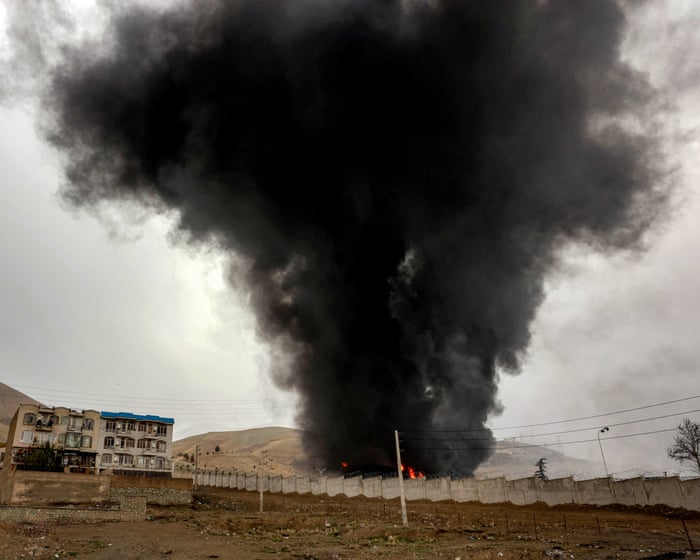
One of the war’s most shocking images was the dark clouds and black rain over Tehran after Israel bombed four major fuel storage depots, setting millions of liters of fuel ablaze. Similar strikes—including Iranian retaliatory attacks on Gulf neighbors—are estimated to have burned 2.5–5.9 million barrels of oil, emitting about 1.88 million tonnes of CO₂ equivalent.
In the first 14 days, the U.S. lost four aircraft, while Iran lost 28 aircraft, 21 naval vessels, and roughly 300 missile launchers. The embodied carbon from this destroyed military hardware is estimated at 172,000 tonnes of CO₂ equivalent.
Extensive use of bombs, missiles, and drones also contributed. With the U.S. and Israel reportedly striking over 6,000 targets inside Iran, and Iran firing back about 1,000 missiles and 2,000 drones—plus an estimated 1,900 interceptors used in defense—munitions accounted for roughly 55,000 tonnes of CO₂ equivalent.
In total, the conflict’s first two weeks produced 5,055,016 tonnes of CO₂ equivalent. Scaled to a year, that equals about 131,430,416 tonnes—comparable to the annual emissions of a medium-sized, fossil fuel-intensive economy like Kuwait, or the combined emissions of the 84 lowest-emitting countries.
Fred Otu-Larbi, the study’s lead author from the University of Energy and Natural Resources in Ghana, said: “We expect emissions to increase rapidly as the conflict proceeds, mainly due to the alarming rate at which oil facilities are being targeted.” He added, “We all need to live with the climate aftermath. Just what are the costs? No one really knows, which is why studies like this are so vital. Burning up the annual emissions of Iceland in two weeks is something we really cannot afford.”
As of June last year, climate scientists estimated that humans could emit only about 130 billion tonnes more CO₂ equivalent to have a reasonable chance of limiting global warming to 1.5°C above pre-industrial levels.We have a 50% chance of preventing the climate from warming beyond 1.5°C. At the current rate of 40 billion tonnes of CO2 equivalent per year, that carbon budget will be used up by 2028.
Bigger noted that the disruption to fossil fuel supplies caused by the war would likely result in increased drilling. “Historically, every energy crisis driven by the U.S. has led to a surge in new drilling, new LNG terminals, and new fossil fuel infrastructure. This war risks locking in another generation of dependence on carbon.
This is not a war for security. It’s a war over the political economy of fossil fuels—and the people paying the price are Iranian civilians and working-class communities worldwide.”
Frequently Asked Questions
Of course Here is a list of FAQs about the environmental damage from the USIsraelIran conflict framed in a natural tone with clear direct answers
BeginnerLevel Questions
1 What does environmental damage from a conflict actually mean
It refers to the harm caused to air water soil and ecosystems This includes pollution from explosions and fires toxic spills from damaged industrial sites destruction of wildlife habitats and longterm contamination that makes areas unsafe
2 Isnt the human cost the most important thing Why focus on the environment
The human cost is absolutely paramount However environmental damage is a critical part of that cost It leads to longterm health problems destroys livelihoods and can make entire regions uninhabitable creating more refugees and suffering for decades after the fighting stops
3 What are the main sources of this environmental damage
Explosions Fires Releasing toxic smoke heavy metals and particulate matter into the air
Targeted Infrastructure Strikes on oil refineries chemical plants or warehouses can cause massive toxic spills and air pollution
Military Activity Fuel spills munitions debris and the destruction of landscapes by vehicles and fortifications
Waste Rubble Massive amounts of hazardous debris that contaminate soil and water
4 Can you give a real example from this conflict
Yes Strikes on oil storage facilities whether in Iran or near conflict zones create huge toxic black plumes that spread carcinogens over large areas polluting the air and settling into soil and water supplies This directly impacts civilian health and agriculture
Intermediate Advanced Questions
5 How does this conflict specifically affect climate change
Largescale fires from bombings release significant amounts of black carbon a powerful shortlived climate pollutant that accelerates ice melt when it settles on glaciers Furthermore the massive carbon footprint of manufacturing and deploying military equipment along with rebuilding destroyed cities adds substantial greenhouse gas emissions
6 What is toxic legacy and how does it relate to this situation
A toxic legacy is the longterm contamination that persists after war Unexploded ordnance heavy metals and chemical residues seep into groundwater