One thing unites the British more than anything else. It’s right there in plain sight, but rarely talked about. We might try to hide it, or not even admit it to ourselves, but underneath it all—in the nicest possible way—we’re all a bit odd. Not in a sinister way, just eccentric, quirky, unpredictable, and wonderfully unique. As a nation, we have a creative spark and a knack for clever, inventive ideas. In innovation, we’ve led the tech world with some of our bold and crazy inventions. Even our landscapes are wonderfully strange, with some of Europe’s oldest, most mysterious, and diverse geological oddities, plus plenty of legends. I spent years exploring Britain’s enchanting weirdness, discovering follies, quirky public art, odd buildings, mysterious ruins, and eerie landscapes for my Weird Guide, which features about 300 of these curiosities. Here are some of my favorites.
The Yoxman, Suffolk
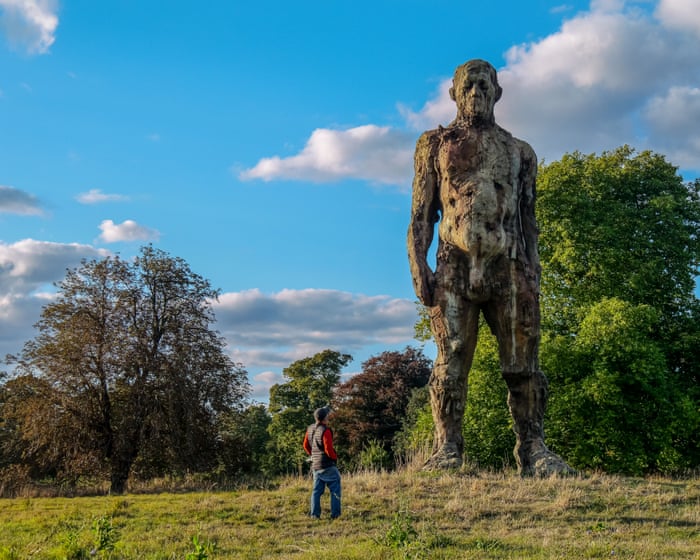
In a field near the A12 in Yoxford, Suffolk, stands the Yoxman—a massive artwork. At 8 meters (26 feet) tall and made of bronze, it took creator Laurence Edwards and his team four years to build. The figure is a personal tribute to Suffolk, with the artist describing it as a visitor from the past, both from the land and of the land. Finished in 2021, the result is stunning—a full-grown adult barely reaches the top of its shin, as the Yoxman towers over even some nearby trees. From Yoxford village, take the path opposite the shop and follow it through the hall grounds to the statue.
Little Italy, Gwynedd
The late Mark Bourne, a chicken farmer, was obsessed with Italy. He visited as often as he could, filling notebooks with sketches of buildings and architecture. When he returned to his remote cottage on the Corris hillside in Gwynedd, Wales, he and his wife aimed to recreate what he’d seen in their garden. Both worked on the creation, named Little Italy, well into their 80s, building models of everything from the Leaning Tower of Pisa to Florence’s Duomo. Although Bourne’s old garden is strictly off-limits to passersby, the surrounding wall is fairly low, and the buildings are big enough to see from the path. From the Corris Institute, turn left up the hill along the lane, then follow a footpath on the right after the youth hostel for about 100 meters.
Mannakin, Lincolnshire
Mannakin Hall near Grantham feels like an eerie plastic graveyard. Tucked down a narrow Lincolnshire lane, it was started by Roz Edwards in 2008 when she realized most mannequins are thrown away after no more than five years of use. She began collecting those headed for landfill. Once repaired or cleaned, they’re rented out, and at any given time, there are about 15,000 mannequins on site. Most are unclothed, but some are dressed in Halloween costumes or strange outfits. As a working business, Mannakin Hall isn’t open for walk-ins, but you can prebook a group visit, attend one of the regular open days, or even stay overnight in your camper van!
White Scar, Yorkshire Dales
On the west side of Ingleborough summit in North Yorkshire, just south of the ancient Roman road, lies one of the country’s most remarkable limestone pavement areas, known as White Scar. This extraordinary landscape formed during and after the last ice age, as massive glaciers scraped away the surface. Thousands of years of weathering broke down the soft alkaline stone, revealing intricate miniature canyons, or grykes. These deep fissures have become like terrariums, providing a home for rare plants that usually thrive in dark woodlands.
Library, Isle of Arran
The Library was built using…Trees knocked down in a storm. Photo: Arran Brough / Wild Things Publishing
The Woodland Library near Levencorroch on the Isle of Arran, Scotland, is a one-of-a-kind tourist spot. It’s a cabin that feels like a giant 3D guestbook inside. Built by the woodland’s owner, Albert Holmes, using trees felled in a storm, the cabin is covered with drawings, poems, messages, words of wisdom, and notes from people all over the world. These papers range from playful to profound and are now about 25 layers deep, filling every possible space, even the ceiling. Stepping inside feels like entering a scene from a Michel Gondry film or a strange nest left by a literary forest creature. Grab a map at the Eas Mor Ecology cafe, east of Levencorroch, and follow a steep gravel path to the waterfall, then on to the library. It’s a 25-minute walk.
Sultan the Pit Pony, Mid-Glamorgan
View image in fullscreen
This earth sculpture was built in the late 1990s. Photo: Tom Goudsmit / Wild Things Publishing
Measuring nearly 200 metres from his nose to the tip of his tail, Sultan the Pit Pony sits on the site of the old Penallta colliery, north of Caerphilly. Mike Petts used 60,000 tons of coal shale rock to create the sculpture in the late 1990s, honouring the thousands of ponies that worked in British mines during the Industrial Revolution. It’s close to Parc Penallta Ponds, which offer wonderful wildlife and walking trails.
Painshill Follies, Surrey
View image in fullscreen
The grotto dates back to the 18th century. Photo: T P Holland / Wild Things Publishing
Inspired by the culture, paintings, and architecture he saw on his grand tour of Europe, aristocrat Charles Hamilton began transforming his country estate—Painshill in Cobham, Surrey—into something between a work of art and a garden in 1738. Alongside a temple, gothic tower, and lake, he created one of the most spectacular follies in the country. He hired grotto builder Joseph Lane to construct a semi-natural cave with sparkling stalactites made from minerals like feldspar and quartz. The park fell into ruin in the 1940s, but the local council took it over in the late 1970s. While much has been restored, work continues. The crystal grotto was finished in 2013, with builders doing their best to make it look like the original, using paintings of the grotto as a guide.
Rock-cut tombs, Lancashire
View image in fullscreen
The tombs are just outside an eighth-century chapel. Photo: Stephen Gidzey / Wild Things Publishing
Local legend says that after being shipwrecked, Saint Patrick washed ashore and built a chapel at Heysham, Lancashire, sometime in the fifth century. Since Saint Patrick is also said to have been shipwrecked on Ynys Môn (Anglesey), this story might be a bit doubtful! Still, in the eighth century, a chapel was built in his honour. The remains of this chapel still stand, along with eight rock-cut tombs—one group of six and another of two.
Blackchurch Rock, Devon
View image in fullscreen
The rocks are a walk away from Clovelly village. Photo: Mark Wordy / Wild Things Publishing
Around 320 million years ago, the great continent of Gondwana collided with Laurasia (which included present-day Europe, Russia, North America, and parts of Asia). The impact was so powerful that it pushed up the rocks of Blackchurch Rock near Clovelly, Devon, into their current shape (we know the date thanks to fossils found in the stone, including Goniatites). Over time, tidal seas further shaped Blackchurch, carving out the large arch. It’s a 30-minute walk northwest along the coast path from Clovelly village.
The Tilted Globe, Highlands
View image in fullscreen
The sculpture at Knockan Crag is made from local Moine schists, a type of metamorphic rock. Photo: Media World Images / Alamy
Joe Smith, creator of The Tilted Globe at Knockan Crag in Assynt, north of Ullapool, first learned dry stone walling in 1961 at the young age of 11. By the time he was 19, dry-stone walling had become his way of making a living.Over time, he stopped seeing walls as just practical structures and began to notice how stacking stones could be beautiful, appreciating their potential as art. He has worked with Andy Goldsworthy on several projects around the world, including Slate, Hole, Wall at the Royal Botanic Gardens in Edinburgh. The Tilted Globe is an independent piece made from local moine schist at Knockan Crag. This area is geologically significant because ancient rock has been pushed about 43 miles (70 km) west by tectonic activity, so it now sits above younger rock layers. It’s a short walk on marked trails from the hexagonal visitor centre, which has a turf roof.
This is an edited extract from Weird Guide by Dave Hamilton, published by Wild Things Publishing (£18.99). To support the Guardian, order your copy from guardianbookshop.com. Delivery charges may apply. Follow @davewildish. This article was amended on 21 May 2026 to remove an incorrect reference to Sultan the Pit Pony being the largest earth sculpture in the UK.
Frequently Asked Questions
Here is a list of FAQs about wonderfully strange places in Britain written in a natural tone with clear concise answers
BeginnerLevel Questions
1 What exactly makes a place wonderfully strange
Its a place that feels unusual quirky or unexpected This could be because of its bizarre history odd architecture weird natural features or an eerie atmosphere that makes you stop and say Wow thats different
2 Are these places hard to get to or can anyone visit them
Most are open to the public and easy to reach by car though a few might require a short walk Some are free while others charge a small entry fee Its always a good idea to check opening times online before you go
3 Do I need to book a tour or can I just show up
For most outdoor spots you can just show up But for indoor or guided attractions you absolutely need to book a ticket in advance especially on weekends
4 Are these places safe for children
Generally yes Many are great for family adventures However some have steep cliffs uneven paths or dark tunnels so keep a close eye on young children and wear sturdy shoes
Advanced Practical Questions
5 Whats the weirdest example on the list
Its a tie between The Shell Grotto in Margate and The Forbidden Corner in Yorkshire
6 Can I take good photos at these places or are they too darkcrowded
You can get amazing photos Most outdoor sites are dreamy for landscape shots For indoor spots you might need a camera that handles low light Try to go early in the morning or on a weekday to avoid crowds
7 Whats the best time of year to visit strange outdoor places like the Fairy Pools or Durdle Door
Late spring or early autumn is perfect