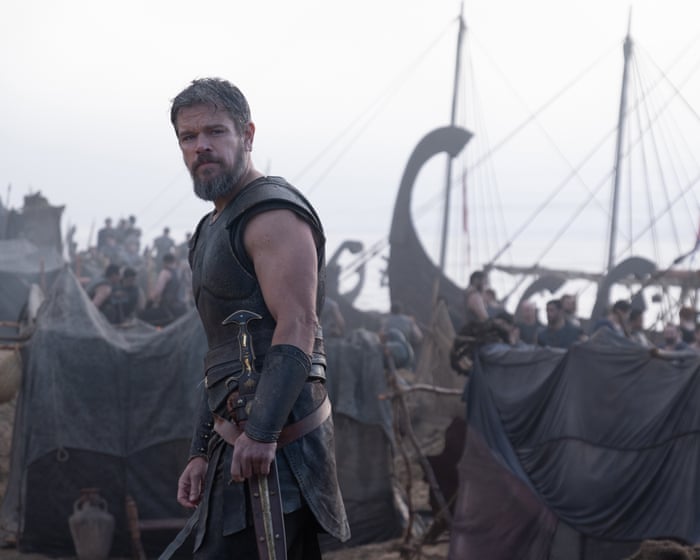
There are the American accents, the shiny bodysuits, and the muddy, war-tone look of Dunkirk. And then there’s Lupita Nyong’o as Helen of Troy—a casting choice that recently drew racist backlash from the usual online complainers, including Elon Musk, who said it wasn’t authentic. Authenticity does matter. He’s just focused on the wrong thing entirely. For many Greeks, what really stands out about the first look at Christopher Nolan’s adaptation of Homer’s Odyssey is the absence of Billy Zane.
Zane, like other beloved Greek diaspora stars in Hollywood, has been popping up on “Alternative Odyssey” lists across Greek social media, and sparking debates over dinner tables from Patras to Palmers Green. (Theo James, Jennifer Aniston, Hank Azaria, and Dave Bautista are also in the running.) Greek and Greek Cypriot media outlets are writing open letters. It’s a sign of feeling left out by Hollywood once again—with no explanation—from our own foundational myths and epics. The cast list doesn’t include a single name ending in –opoulos, –edes, or –iannou. Not one Greek.
This isn’t new. From Jason and the Argonauts (1963) to Troy (2004), Hollywood has been mining Greek stories for generations without much concern for Greek representation—unless it fits a stereotype.
As a film critic, I’ve cringed through my share of loud, plate-smashing, hapless “Zorbas” characters in Mamma Mia! (2008) and Shirley Valentine (1989). Meanwhile, in sword-and-sandal epics, Hollywood often seems unable to connect modern Greeks with legendary figures like Achilles and Odysseus, or historical ones like Alexander and Leonidas. Somehow, today’s Greeks and our ancient past are always kept separate. So, are we unworthy of our own myths?
“It’s true that the world’s image of Greeks is more Zorba than Achilles,” says Thodoris Koutsogiannopoulos, Greece’s leading film critic. “I find it disheartening—and a lazy cliché—that the majority sticks with that instead of more thoughtful versions of what Greekness really is. It would be nice to see a Greek or two among the star cast, but it would be a surprise if it happened.”
Many of us—myself included—assumed Nolan’s epic might break the pattern, and finally give at least one actual Greek actor a role beyond comic relief. After all, Homer’s story has no shortage of characters.
But when you look past the superstars—from Matt Damon (who just posed like a Greek god on a column for GQ’s latest shoot) as the clever Ithacan, to Zendaya, Tom Holland, Charlize Theron, and Jon Bernthal, plus supporting actors Himesh Patel, Will Yun Lee, and Travis Scott—it’s clear that Nolan chose his cast to be “representative of the world,” as Nyong’o put it.
That’s a noble goal. But for us Greeks, it makes our absence even more glaring—especially in the year’s biggest blockbuster. If your film aims to represent the world, wouldn’t it be obvious to save a seat at that big, wonderfully multicultural table for the people most authentically connected to the source material?
The irony is that those shouting loudest about “authentic” casting didn’t even notice there isn’t a single Greek in the film. Not that it matters to people like Musk and their questionable motives—but he couldn’t have been more wrong.
For Greeks, this omission carries another meaning: that ancient Hellenic stories are seen as part of a shared Western heritage—world literature—while Greeks themselves are somehow beside the point. At worst, it suggests that modern Greeks (especially after decades of economic crisis) are no longer seen as worthy keepers of these stories—a sentiment not unlike the logic used against returning the Parthenon marbles.This film also comes at a different time compared to earlier sword-and-sandal movies, like 2004’s Troy. Hollywood is now more careful about respecting cultural stories, and Greeks have noticed. “That’s all we’re talking about,” a friend in Athens who works in film told me. “In Hollywood, Greek stories seem to be the only ones left out of the conversations about representation that now apply to other cultural traditions.” None of us expect to land leading roles. But Greece’s film industry is quietly thriving – with directors like Yorgos Lanthimos and Athina Tsangari, and actors like Angeliki Papoulia gaining recognition. As for the Greek diaspora, Theo James’s performance in The White Lotus shows he’d make a charismatic Antinous. If Nolan had wanted, the talent was there; it’s unlikely any actor today would turn down that opportunity.
Of course, plenty of non-Greeks will ask: what’s the big deal? The Odyssey is fiction, after all. But it’s hard to overstate how deeply these stories resonate in our culture today. Growing up in a Greek household in London, legends are told in such a way that I honestly believed there really was a great Trojan war and maybe some trick involving a giant wooden horse. My mother places clay pots with the names of ancient heroes under Orthodox icons, I have cousins named Achilleos, two aunties named Athena, and a friend from Crete called Odysseas. In Greek schools, young children learn to recite Homer’s poems in Ancient Greek, and phrases from them are used in everyday conversation.
Stories like The Odyssey, while being cornerstones of world literature, have a deep, personal meaning in the Greek subconscious and in our sense of identity – as a people, not just a nation. I imagine it would be the same for Indian Hindus with their Mahabharata or the Polynesian folklore that inspired Disney’s Moana. That said, I’m sure Greek audiences can’t wait to see Nolan’s film – strange internet slang and inaccurate armor designs aside – because beyond all the Christopher Nolan hype, we love seeing our heritage portrayed on screen.
Yet as Hollywood puts more emphasis on representation, being left out feels even more painful. The debate in Greece over The Odyssey‘s casting reminds me of the poem’s central theme: nostos – homecoming, after years of trials and obstacles. We Greeks are simply asking not to be written out of the journey.
Frequently Asked Questions
Here is a list of FAQs based on the question What the hell Why does Christopher Nolans new Greek epic have no Greeks in it at all
Beginner General Questions
Q Wait is this true Is Christopher Nolan really making a Greek epic with no Greek actors
A Yes the casting for his upcoming adaptation of The Odyssey has been announced and the main roles are played by actors like Matt Damon Tom Holland and Anne Hathawaynone of whom are Greek
Q So what is the movie about if its a Greek epic
A Its an adaptation of Homers The Odyssey which follows the Greek hero Odysseus trying to get home after the Trojan War So the story is definitively Greek
Q Is this a common problem in Hollywood
A Yes its a very common criticism called whitewashing or cultural erasure Hollywood often casts bigname nonGreek stars in roles that should represent a specific culture
Q Why does it bother people so much
A Because it feels disrespectful to the culture that created the story It also takes away opportunities for Greek actors and reinforces the idea that only big AmericanBritish stars can sell a movie
Advanced Deeper Questions
Q Is there any historical or artistic reason Nolan might have done this
A Nolan has a history of casting highprofile actors he has worked with before He likely prioritizes bankable stars and actors he trusts over cultural authenticity He may also believe the story is a universal myth that transcends nationality
Q Didnt the ancient Greeks look different from modern Greeks Is that an excuse
A Not really Ancient Greeks were Mediterranean people with olive skin dark hair and varied features Modern Greeks are their direct descendants Casting fairskinned Northern Europeans doesnt reflect the ancient population any better
Q What are the specific benefits of casting Greek actors in a Greek epic
A It provides authenticity supports local film industries gives a platform to underrepresented talent and shows respect for the cultural heritage It also makes the world feel more believable